
What installation options are available for mezzanine floor loading gates, and how do they impact overall safety and efficiency?
Installation options for mezzanine floor loading gates include front-mounted, recessed and self-closing designs, selected according to the platform layout, load-handling process and available space. Correct positioning, secure fixing and suitable guarding maintain fall protection while allowing efficient pallet transfer; an unsuitable installation can obstruct movement, create unsafe access points or reduce loading productivity.
Installation options for mezzanine floor loading gates generally include front-mounted gates, recessed or set-back gates, and bespoke gates integrated with the platform structure. The correct choice depends on the floor layout, pallet transfer method, available operating space, guarding arrangement and the loads imposed on the structure. When properly specified and installed, a loading gate maintains fall protection at the platform edge without unnecessarily slowing the movement of goods.
Front-mounted loading gates are installed at the platform edge and are often suitable where space behind the opening is limited. They provide a direct transfer point for pallets and can work well with counterbalance, forklift or other suitable handling equipment. A two-part arrangement is commonly used: one section closes the loading edge while the other creates the transfer opening. This allows the operator to position a load at the edge without leaving an unprotected opening.
The main safety advantage of a front-mounted design is that the gate can remain closed towards the exposed edge while loading activity is arranged from the protected side. However, the gate must not be positioned where its movement obstructs walkways, emergency routes or the operating area. The installer should also check that the gate cannot be opened towards a person standing in an unsafe position and that the closed sections provide continuous protection at the edge.
Recessed or set-back loading gates are installed behind the platform edge, usually within a short guarded approach or dedicated loading bay. This arrangement creates additional separation between the pallet transfer point and the open edge. It can reduce the likelihood of a person stepping directly into the loading zone and may provide more room for a load to be aligned before it reaches the transfer position.
A recessed installation can improve safety where there is sufficient platform depth, but it requires careful planning. The recess must not create a trapping point, restrict visibility or reduce the turning space needed by handling equipment. It may also require additional guarding, altered floor decking or a stronger supporting frame. If the available space is too tight, the apparent safety benefit can be lost through awkward manoeuvring and increased contact with the gate or surrounding structure.
Side-mounted and bespoke installations may be appropriate where the platform arrangement, building columns or internal traffic routes prevent a standard front installation. A gate can sometimes be positioned at the end of a platform, beside a supporting column or within a purpose-designed transfer bay. These solutions are developed around the actual structure rather than forcing a standard unit into an unsuitable location.
Bespoke work is particularly important where an existing platform is being altered. The fixings must connect to suitable structural members, and the supporting steelwork, decking and edge protection must be checked for the loads created during operation. A gate should not be attached only to lightweight decking, non-structural cladding or a handrail that was not designed to support it. Where the installation changes the platform or its load paths, the design should be reviewed by a suitably competent structural professional.
The opening and closing method also affects performance. Common arrangements include manually operated gates, self-closing gates, counterbalanced gates and designs with interlocked or mechanically controlled movement. A self-closing or counterbalanced arrangement can reduce the risk of the gate being left open after a transfer. It must, however, close reliably under normal conditions and should not require excessive force that encourages operators to bypass it.
Sliding gates can be useful where a swinging gate would obstruct a walkway or handling route. Swinging gates may be suitable where there is adequate clearance and the direction of opening is controlled. In either case, the movement should be assessed for collision, trapping and unauthorised access risks. The gate should remain stable throughout its travel, stop in the intended positions and not create a gap through which a person or load could pass unintentionally.
Installation should be planned around the loading process. Before work begins, the installer should confirm:
- the type, dimensions and weight of loads being transferred;
- the handling equipment used at both floor levels;
- the approach direction and space required for positioning;
- the location of walkways, stairs, access points and emergency routes;
- the height and arrangement of existing edge protection;
- the supporting structure, fixing points and condition of the platform; and
- how the gate will be operated, inspected and kept closed when not in use.
The installation should be supported by a suitable risk assessment and method statement. It should also reflect the manufacturer’s instructions, the platform designer’s requirements and the relevant duties under UK workplace health and safety legislation. The finished arrangement needs to provide a suitable barrier against falls, prevent loads from being placed beyond the safe transfer position and avoid reliance on operator judgement where a physical safeguard can provide better protection.
Installation quality has a direct effect on safety. Incorrectly aligned hinges, inadequate fixings, unsupported posts or excessive movement can prevent a gate from closing fully and may place stress on the surrounding structure. The completed installation should therefore be checked for secure fixings, correct clearances, smooth operation, reliable closing and compatibility with the existing guarding. Any damage to the platform, gate or protective finish should be addressed before the gate is put into service.
The choice also affects efficiency. A gate that matches the transfer method reduces unnecessary repositioning, waiting and manual handling. A front-mounted design may offer the shortest transfer route, while a recessed design may improve separation but require additional manoeuvring space. A self-closing or counterbalanced gate can reduce delays associated with manual resetting, provided it does not interfere with the movement of loads. The most efficient option is not necessarily the one with the fewest components; it is the one that allows a predictable transfer process without compromising protection.
Operators should receive instruction on the gate’s normal use, prohibited practices and response to defects. They should never climb through, stand on, tie back or bypass the gate, and the transfer area should not be used for general storage. Routine inspections should look for loose fixings, distortion, corrosion, damaged hinges, worn counterbalance components, obstructed movement and failure to self-close or latch. Any defect that could affect fall protection or load transfer should be reported and dealt with promptly.
In practice, the safest installation is the one designed around the structure and the real working method, rather than selected solely on price or appearance. A competent site assessment can establish whether a front-mounted, recessed, side-mounted or bespoke arrangement gives the required protection and usable capacity. It also helps ensure that the finished loading gate improves the flow of materials while maintaining a properly guarded mezzanine floor.
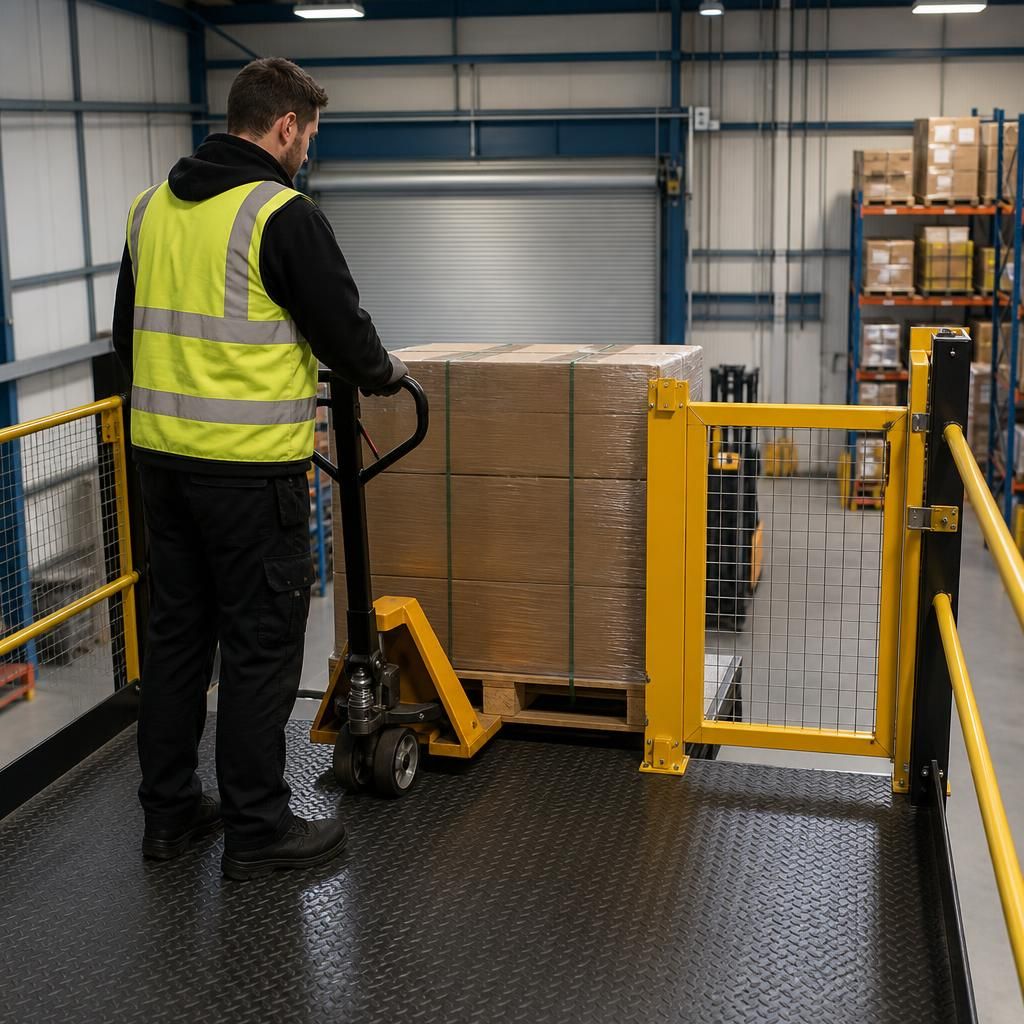
Mezzanine floor loading gate installation should be matched to the platform layout, transfer equipment and available operating space. A front-mounted gate can provide a direct transfer point where space behind the opening is limited, while a recessed or set-back gate can create greater separation from the exposed edge where the platform has sufficient depth.
The installation must leave enough room for loads and equipment to manoeuvre without obstructing walkways or emergency routes. Fixings should connect to suitable structural members, not lightweight decking or unsuitable guarding. The completed gate should close reliably, maintain continuous edge protection and avoid trapping, collision or unintended access points. Selecting the position and operating method around the actual workflow helps maintain fall protection without creating unnecessary delays during loading.
Discuss Your Mezzanine Floor Loading Gate Installation Options
Discuss your mezzanine floor loading gate installation options with our experienced team to confirm the safest and most efficient arrangement for your platform, handling equipment and workflow. We can assess the site requirements and advise on suitable positioning, operation and structural fixings.