
What are the maintenance requirements for mezzanine floor loading gates to ensure long-term reliability and safety?
Mezzanine floor loading gates require routine visual checks, planned inspections by a competent person, and prompt attention to worn hinges, latches, guarding, fixings, counterbalance components and protective finishes. Keep moving parts maintained as specified by the manufacturer, record all inspections and repairs, and remove the gate from service if any defect could affect safe operation.
Long-term reliability and safety depend on a planned maintenance programme for the loading gate, supported by routine operator checks, competent inspections and prompt defect repairs. Maintenance should cover the gate structure, guarding, hinges, latches, counterbalance or assisted-opening mechanism, fixings, protective finishes and any interlocking or warning features. The manufacturer’s instructions, the original design specification and the site risk assessment should determine the inspection and servicing arrangements.
Routine operator checks
Before use, the operator should confirm that the gate is secure, operates smoothly and closes fully in each intended position. Checks should include:
- Visible damage, distortion, cracking or corrosion affecting the frame, mesh, rails or protective barriers.
- Loose, missing or damaged bolts, welds, brackets, hinges and other fixings.
- Correct operation of latches, catches, handles and any release mechanism.
- Unusual resistance, noise, vibration or movement while opening or closing.
- Damage to counterbalance arms, springs, gas struts, chains, cables, rollers or other moving components, where fitted.
- Clear and legible safety signs, operating instructions and load information.
- Adequate clearance around the gate, with no stored materials obstructing its movement or creating a fall hazard.
These checks should be recorded where required by the site’s safety arrangements. A gate should not be used if a defect could prevent it closing securely, allow a person or load to pass through an unprotected edge, or cause uncontrolled movement.
Planned inspections and servicing
A competent person should inspect the loading gate at intervals based on its design, frequency of use, working environment, previous defects and the consequences of failure. Inspections should be more frequent where the gate is exposed to impact, heavy use, dust, moisture, corrosive substances or temperature changes.
The inspection should assess the complete assembly rather than focusing only on the visible opening mechanism. This includes the gate panels, posts, edge protection, support steelwork, anchorage points and surrounding floor area. The inspector should also check whether the gate remains aligned with the supporting structure and whether any movement has developed at the connections.
Where the gate includes counterbalanced or assisted-lifting equipment, its condition and safe operation should be assessed in accordance with the manufacturer’s instructions and applicable UK workplace equipment requirements. If the equipment falls within a category requiring a thorough examination, that examination must be arranged by a suitably competent person at the appropriate interval and after relevant events such as significant alteration, damage or failure.
Moving parts and counterbalance components
Hinges, pivots, rollers and other moving parts should be cleaned and lubricated only in accordance with the manufacturer’s guidance. Incorrect lubricant, excessive application or contamination can attract debris and interfere with the mechanism. Components that are worn, bent, cracked or showing signs of fatigue should be replaced rather than adjusted to compensate for the defect.
Counterbalance systems require particular care. Springs, gas struts, chains, cables and weights can store energy and should not be dismantled, modified or tensioned by untrained personnel. If the gate drops, rises unexpectedly, feels significantly heavier or lighter than normal, or fails to remain in its intended position, it should be isolated and examined by a competent maintainer.
Structure, guarding and fixings
Protective barriers and gate sections should remain securely fixed, with no gaps or damage that could increase the risk of a person falling from the elevated platform. Check for impact damage from vehicles, pallets or handling equipment, particularly around posts, corners and the lower sections of the assembly.
Bolted connections should be checked for looseness and deterioration. Tightening should follow the specified procedure and torque where one is provided; indiscriminate tightening can damage components or alter the intended alignment. Welds, brackets and supporting steelwork should be examined for cracking, deformation or corrosion. Any alteration, strengthening or replacement with a different component should be reviewed to confirm that the gate continues to perform as designed.
Corrosion and protective finishes
Scratches, damaged paint and exposed steel should be cleaned and repaired using a suitable system. Corrosion should not simply be painted over, particularly where it affects a hinge, fixing, support or load-bearing component. Areas that collect water, dust or process residue should be kept clean and inspected regularly.
Cleaning methods should not damage coatings, labels, bearings or electrical components. Where the working environment contains chemicals, salt, moisture or abrasive dust, the maintenance plan should specify suitable materials and additional protective measures.
Repairs and taking the gate out of service
Minor adjustments should be carried out only where permitted by the manufacturer’s instructions. Repairs involving the structure, counterbalance system, guarding or anchorage should be completed by a suitably competent person. Temporary restraints, improvised parts and unapproved modifications should not be used as permanent solutions.
If a serious defect is found, the gate should be clearly identified as unsafe, prevented from use and reported to the responsible person. The surrounding work area may also need to be controlled if the defect creates an unprotected edge or another fall risk. Following repair, the gate should be function-tested and, where appropriate, re-inspected before it is returned to service.
Records and review
Keep an inspection and maintenance record that identifies the gate, inspection date, findings, defects, corrective action, parts replaced and the name of the person completing the work. Records should be available to the person responsible for workplace safety and retained in line with the site’s documented procedures.
Review the maintenance frequency after any incident, impact, change of use, alteration, recurring defect or change in the surrounding operation. A loading gate that is used more heavily than originally intended may need a revised inspection regime or a design review. Routine maintenance does not replace a formal risk assessment, and it should never be used to justify continued operation where the gate no longer meets its design or safety requirements.
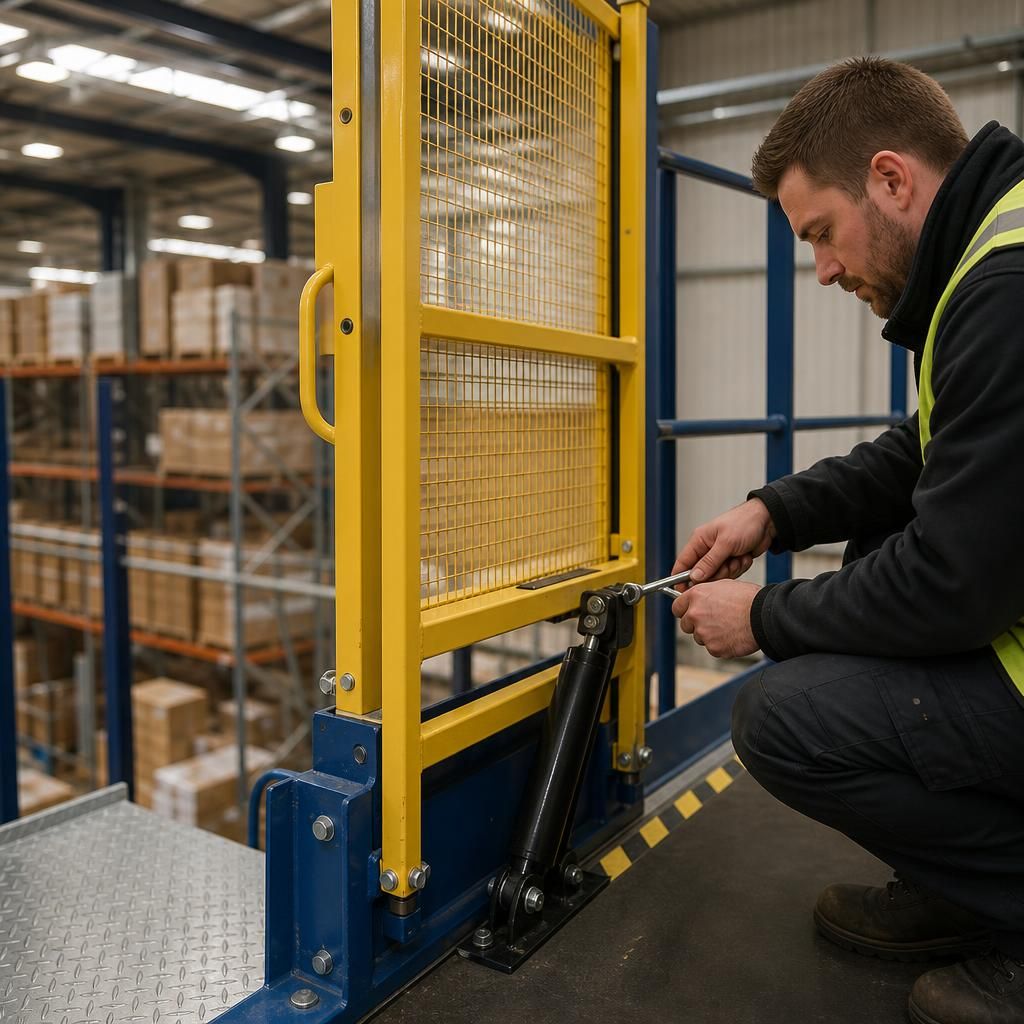
Regular maintenance of the loading gate’s hinges, latches and counterbalance components is essential for controlled movement and safe operation. These parts should be checked for wear, damage, corrosion, unusual noise and changes in operating effort, with servicing carried out in line with the manufacturer’s instructions.
Springs, gas struts, chains, cables and other tensioned components can store energy and should only be adjusted or replaced by a competent person. If the gate drops, rises unexpectedly, fails to close securely or feels substantially heavier than usual, take it out of service until it has been examined, repaired and function-tested.
Arrange a Professional Mezzanine Loading Gate Inspection
Arrange a professional mezzanine loading gate inspection with Able Racking to identify defects, confirm safe operation and support ongoing compliance. Contact our experienced team to plan an inspection suited to your site and usage.