
What are the benefits of choosing different types of mezzanine loading gates?
Different types of mezzanine loading gates provide tailored protection for people, goods and openings at raised working levels. Choosing the appropriate design can improve load handling, maintain safe access control and support efficient warehouse operations while meeting site-specific requirements.
Choosing the right type of mezzanine loading gate can improve edge protection, control the movement of goods and make loading activities more efficient. The main benefits depend on the gate’s operating method, the available space, the equipment used to move loads and the level of protection required when the loading position is open.
Different designs are suited to different working arrangements. A gate should not be selected by appearance alone: its capacity, opening dimensions, guarding arrangement, operating sequence and compatibility with the surrounding structure all need to be assessed as part of the site’s risk assessment.
Hinged pallet gates
Hinged pallet gates are commonly used where loads need to be transferred between the floor below and a raised storage or working area. They provide a defined loading opening while keeping the exposed edge protected when the gate is closed. Depending on the design, the gate can be operated manually or with assisted movement to make handling more controlled.
- They can provide a clear opening for pallets and other bulky loads.
- They help separate the loading activity from people working on the platform.
- They can be designed to return to a protected position after loading.
- They are suitable for established loading points where there is sufficient clearance for the gate to move.
Hinged designs require careful consideration of the gate’s swing path. The operating area must remain clear, and the movement of the gate must not create a collision risk for people, lifting equipment or stored goods.
Vertical lifting gates
Vertical gates rise above or within the guarding line rather than projecting out into the working area. Their main benefit is space efficiency, particularly where a hinged gate would obstruct an aisle, walkway or handling route. They can be useful in compact layouts or where the loading position is close to other equipment.
- They make better use of restricted floor space.
- They reduce the risk of a gate leaf obstructing nearby routes when opened.
- They can provide a wide loading aperture for suitable goods.
- They support a controlled separation between the open edge and the loading operation.
Vertical movement introduces its own requirements. The gate must be stable throughout its travel, and the lifting mechanism, counterbalance or assisted system must be suitable for the operating environment. The area above the gate should also be checked for beams, lighting, sprinklers and other obstructions.
Sliding loading gates
Sliding gates move sideways along a track and can be effective where there is limited space in front of or behind the loading position. They avoid the forward swing associated with a hinged design and may be suitable for locations with regular movement of people or equipment near the opening.
- They can operate within a defined horizontal footprint.
- They reduce interference with nearby walkways when correctly positioned.
- They can be configured for wide openings where the structure allows it.
- They provide a clear visual indication of whether the opening is protected.
The track, rollers and stopping arrangements need to be kept in good condition. Any dirt, impact damage or obstruction can affect smooth operation and may cause the gate to remain partly open, so sliding designs require suitable inspection and cleaning arrangements.
Lift-out or removable gates
Lift-out gates can provide a straightforward solution for occasional loading points where a permanent moving mechanism is not necessary. They may be appropriate for lighter-use areas, provided they are securely retained when fitted and stored safely when removed.
The principal benefit is simplicity, but this design relies heavily on correct use. A removable gate must not be left out of position while the opening is exposed, and staff need clear instructions covering removal, replacement and storage. It may be less suitable for busy operations where frequent manual handling would slow the workflow or encourage unsafe shortcuts.
Self-closing and assisted gates
Self-closing or assisted gates help reduce the likelihood of an opening being left unprotected after a load has been transferred. Their closing action can be supported by springs, counterbalances, hydraulic components or other suitable mechanisms. This can improve consistency where operators need to perform repeated loading tasks.
Assistance should make the gate easier to control without allowing it to move unexpectedly. The closing speed, stopping position and guarding arrangement must be checked during commissioning and maintained throughout its service life. A self-closing feature does not remove the need for training, supervision and regular inspections.
Interlocked or controlled-access designs
Where the loading process presents a higher risk, a gate can be combined with access control or an interlocking arrangement. These systems are intended to prevent incompatible actions, such as allowing access to the exposed loading position while the transfer opening is in use. They can support a clearly defined sequence for loading, unloading and pedestrian access.
Interlocking is most beneficial where several people or types of handling equipment use the same area. It must be integrated with the wider guarding and operating procedure rather than treated as a stand-alone control. The arrangement should be tested by competent personnel and included in planned maintenance.
How the different options affect day-to-day operations
The right gate can reduce unnecessary movement, make the loading point easier to understand and help operators work consistently. A wide, unobstructed opening may improve the transfer of bulky goods, while a compact sliding or vertical design may preserve valuable circulation space. Assisted operation can reduce manual effort, but only when the mechanism is matched to the gate’s size and frequency of use.
Conversely, an unsuitable gate can create delays and encourage poor practice. For example, a design that obstructs a walkway may be left open, while a gate that is difficult to move may be bypassed. The safest option is therefore the one that provides effective protection while fitting naturally into the actual loading process.
Points to assess before choosing a design
- The size, weight and shape of the goods being transferred.
- Whether pallets, cages, trolleys or other handling equipment will use the opening.
- The required clear opening and the available space around it.
- The height and configuration of the platform edge protection.
- The direction and frequency of gate movement.
- Potential impact from handling equipment.
- Visibility for operators working above and below the opening.
- Whether the gate needs assisted operation, self-closing action or controlled access.
- Inspection, cleaning and maintenance access.
- The competence and training required for everyone using the loading point.
Every installation should be checked against the specific structure and working method. The gate, surrounding guarding and supporting components must be suitable for the intended loads and protected against foreseeable misuse. Installation should be followed by functional checks, clear operating instructions and a planned inspection regime.
In practice, the best choice is a loading gate that provides reliable edge protection, allows goods to be transferred without unnecessary handling and remains practical for the people using it. A competent assessment of the site layout and work process will identify whether a hinged, vertical, sliding, lift-out, assisted or controlled-access design offers the most suitable balance of safety, efficiency and long-term reliability.
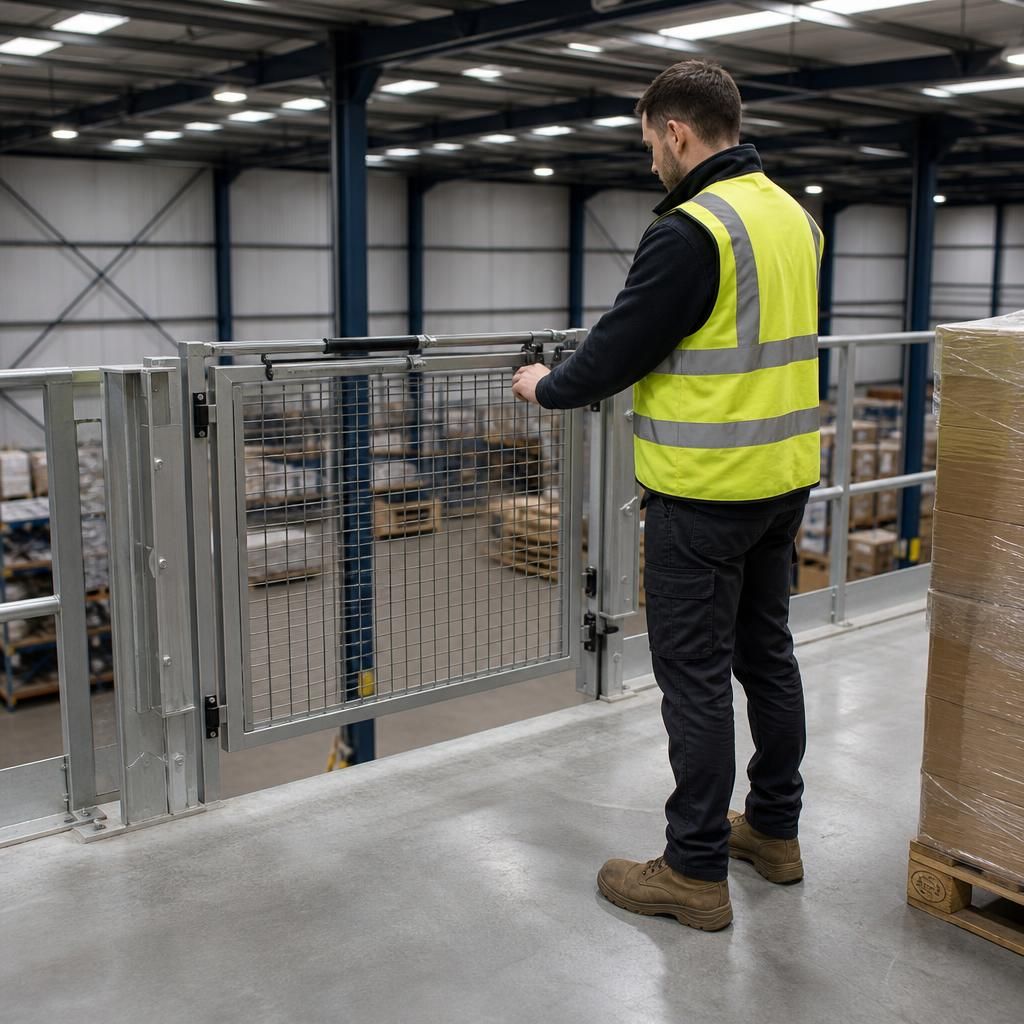
Choosing a mezzanine loading gate that suits the available space and handling method can improve safety and workflow. Hinged designs require room for the gate to swing, while vertical lifting and sliding gates can be more suitable where walkways, equipment or stored goods are close to the loading opening.
The gate must also accommodate the loads being transferred and keep the exposed platform edge protected when the opening is not in use. Assess the clear opening, movement of pallets or trolleys, visibility for operators, potential impact and the gate’s closing action before selecting a design. A competent site assessment helps ensure the chosen gate supports efficient loading without encouraging obstruction, bypassing or unsafe manual handling.
Discuss the right mezzanine loading gate for your site
Contact our experienced team to discuss the most suitable mezzanine loading gate for your site, considering the available space, handling equipment, loading process and required safety controls.