
What types of safety testing are conducted on mezzanine floor gates to ensure compliance with regulations?
Safety testing for mezzanine floor gates typically includes visual inspections, checks of structural fixings and protective components, assessment of load capacity where relevant, and tests confirming that the gate opens, closes and secures correctly. These checks help verify that the gate remains suitable for its intended use and complies with applicable workplace safety requirements.
Safety testing for mezzanine floor gates involves a documented inspection of the gate’s structure, fixings, guarding and operation, followed by any necessary load or functional checks. The purpose is to confirm that the gate remains suitable for its intended use, protects people from falls and can safely handle the way goods are transferred at the edge of the raised floor. Testing should be carried out by a competent person and assessed against the original design, manufacturer’s instructions, workplace risks and applicable UK requirements.
Visual and condition inspection
The inspection begins with a close examination of the gate and surrounding protection. The assessor looks for bent or distorted components, cracked welds, damaged mesh or panels, corrosion, sharp edges, loose parts and signs of impact. The adjacent handrails, kickboards, posts and floor edge are also checked because a defect in the surrounding protection can affect the overall safety of the gate.
Particular attention is given to damage that could prevent the gate from closing fully or leave an unprotected opening. Any unauthorised alterations, missing components or repairs that do not match the original design should be recorded and investigated before the gate is returned to service.
Structural and fixing checks
Bolts, welds, brackets, hinges, posts and connections are checked for security and signs of movement. Where accessible, fixings may be examined for looseness, elongation of holes or damage to the supporting structure. The assessor considers whether the gate is correctly aligned and whether loads are being transferred into the supporting steelwork as intended.
Testing should not rely solely on tightening a loose bolt or visually judging a weld. If there is evidence of impact, movement or structural damage, a competent engineer may need to carry out a more detailed assessment and specify an appropriate repair.
Dimensional and guarding checks
The gate is checked against the intended design dimensions and the requirements of the risk assessment. This can include the height and continuity of the barrier, the size of gaps, the position of the opening and the protection provided at the floor edge. The arrangement must prevent people or materials from passing through an unsafe gap while still allowing the gate to be used for its intended handling activity.
The assessment also considers whether the gate creates additional trapping, crushing or falling-object risks. For example, moving sections should have adequate clearance, and the design should prevent a person from bypassing the protection during normal use.
Opening, closing and securing tests
Operational testing confirms that the gate moves smoothly through its full range, does not bind or drop unexpectedly, and returns to its intended safe position. Latches, catches, hinges, counterbalance mechanisms and any interlocking device are tested for reliable operation.
A gate should remain secure when closed and should not be capable of being left partly open without the user receiving a clear indication or the design preventing the unsafe condition. Where a self-closing feature is fitted, it is checked under normal operating conditions rather than assumed to work because the mechanism appears intact.
Load and impact assessment
Where the gate is designed to resist a defined load, the inspection confirms that its stated capacity is appropriate for the goods, handling equipment and working method. Load testing or engineering verification may be required where the design information is unavailable, the gate has suffered an impact, its use has changed or there is doubt about its condition.
Any test must follow a controlled method based on the gate design. An improvised test using excessive weight can damage the structure and create unnecessary risk. A competent engineer should determine the test method, acceptance criteria and whether the gate, supporting steelwork and floor can safely withstand the anticipated forces.
Interlock and control checks
Some installations include interlocks or other controls intended to ensure that the gate cannot be opened into an unsafe condition, or that access and goods handling take place in the correct sequence. These controls are tested under normal and foreseeable misuse conditions. A visual check alone is not sufficient if safe operation depends on an interlock, sensor or mechanical sequence.
The assessor should also confirm that controls are clearly identifiable and that users can operate them without needing to defeat a safety feature. Any bypassed, damaged or unreliable device requires immediate attention and may require the gate to be taken out of use.
Assessment of the working environment
Testing considers how the gate is actually used, not just how it appears in isolation. The assessor reviews the loads being handled, the equipment used near the edge, pedestrian movements, visibility, lighting, housekeeping and the likelihood of impact. Changes to the floor layout, work process or type of goods can make an otherwise sound gate unsuitable.
Where the installation protects people from a fall, the assessment should be linked to the requirements of the Work at Height Regulations and the principles of the Provision and Use of Work Equipment Regulations where applicable. Relevant design and guarding standards may also assist the assessment, but the correct standard depends on the gate type, use and original design specification.
Records and remedial action
The completed inspection should record the gate’s location and identification, the checks carried out, defects found, photographs where useful, the risk classification and the required corrective action. It should also state whether the gate is suitable for continued use, requires monitoring, or must be isolated until repaired.
Repairs should be completed by suitably competent personnel using compatible components and an approved method. After repair, the affected operation and fixings should be rechecked before the gate is put back into service. Alterations that change the gate’s structure or method of use may require an engineering review rather than a routine repair.
How often should testing take place?
There is no single inspection interval that is suitable for every installation. The responsible person should set inspection and testing arrangements through a risk assessment, taking account of use, impact exposure, environmental conditions, manufacturer guidance and previous defects. Users should carry out basic pre-use checks, while formal inspections should be completed at a suitable risk-based frequency and after significant impact, alteration or prolonged disuse.
Keeping inspection records, acting promptly on defects and ensuring users understand the correct operating method are essential parts of compliance. A safety test provides evidence of the gate’s condition at the time of assessment; it does not replace regular checks, planned maintenance or safe working procedures.
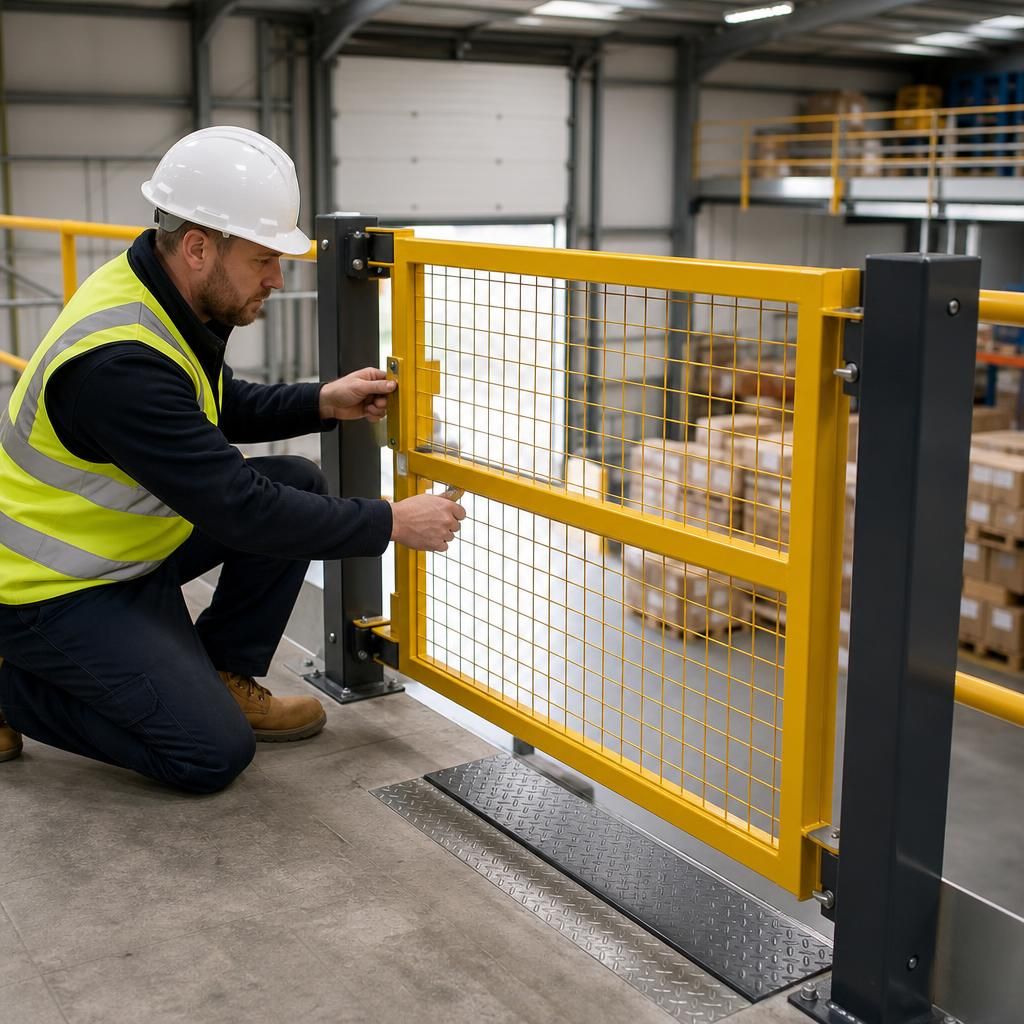
Functional testing confirms that a mezzanine floor gate operates as intended and protects the open edge during normal goods-handling activity. A competent inspector checks that the gate moves smoothly, closes fully, remains secure and cannot be left in an unsafe position.
Hinges, latches, catches, counterbalance mechanisms and interlocks are tested under normal operating conditions. Any sticking, unexpected movement, incomplete closure or unreliable safety device should be recorded and dealt with before the gate is returned to service.
Arrange a Mezzanine Floor Gate Safety Inspection
Arrange a mezzanine floor gate safety inspection with Able Racking to verify its condition, operation and compliance with applicable workplace safety requirements. Contact our experienced team to discuss your inspection needs.