
What are the key maintenance practices for mezzanine floor gates to ensure long-term safety and performance?
Long-term safety and performance depend on scheduled inspections of the mezzanine floor gate, checking hinges, locks, latches, safety barriers and fixings for wear, damage, looseness or corrosion. Keep moving parts clean and correctly lubricated, repair defects promptly, record each inspection and arrange competent maintenance whenever the gate has been impacted or no longer closes and secures correctly.
Mezzanine floor gate maintenance should combine planned inspections, functional checks, prompt defect repair and accurate records. Hinges, locks, latches, safety barriers, fixings and protective finishes must remain in good condition so the gate closes securely, prevents falls and continues to operate as intended.
Maintenance should follow the gate manufacturer’s instructions, the site’s risk assessment and the recommendations from the original installation. The frequency of checks depends on factors such as use, the working environment, impact exposure, dust, moisture and the type of gate. A competent person should review the inspection interval if operating conditions change or if defects are found repeatedly.
Carry out routine visual inspections
Routine inspections identify deterioration before it affects safe operation. Check the complete gate assembly for:
- Distortion, cracks, bent sections or other signs of impact damage.
- Loose, missing or damaged bolts, welds, brackets and other fixings.
- Corrosion, flaking coatings or surface damage that could weaken components.
- Gaps, obstructions or damage around the gate and adjacent edge protection.
- Signs that the gate has shifted, dropped or become misaligned.
- Unauthorised modifications, attachments or changes to the surrounding working area.
Visual checks should be made from all accessible sides. Damage may be less obvious on the rear of the gate, beneath hinges or around fixing points. Any issue that could affect containment or closing should be reported immediately rather than left until the next planned service.
Test closing, locking and interlocking functions
A gate must be checked in operation, not only inspected while stationary. Open and close it through its normal movement and confirm that it:
- Moves smoothly without excessive force, binding or uncontrolled movement.
- Returns fully to its designed position where self-closing action is provided.
- Engages securely with its latch, lock or retaining mechanism.
- Cannot be left partially open without the user noticing.
- Provides the intended protection when the loading side is in use.
Where the design includes an interlock or a sequence that controls access, test the complete sequence in accordance with the manufacturer’s instructions. Do not bypass a safety mechanism to keep work moving. A gate that does not close, latch or secure correctly should be taken out of service until it has been assessed and repaired.
Keep moving parts clean and correctly lubricated
Dust, packaging debris, product residue and other contamination can restrict hinges, rollers, latches and locking parts. Clean these areas using methods that will not damage the finish or introduce contamination into the mechanism. Apply only the lubricant specified or approved by the manufacturer, and use it sparingly. Excess lubricant can attract dust and may interfere with a latch or brake.
Do not lubricate a component simply to mask stiffness, noise or resistance. These symptoms can indicate distortion, worn bearings, damaged hinges or a loose fixing. The underlying fault should be identified and corrected by a competent person.
Inspect fixings, hinges and structural connections
Hinges and fixings experience repeated movement and vibration. Check for play, elongation of holes, worn pins, damaged threads and movement at the connection between the gate and its supporting structure. Fasteners should be tightened only in accordance with the specified procedure and torque requirements. Replacing a fixing with an unsuitable alternative can reduce the strength or change the gate’s alignment.
Welding, drilling, cutting or altering the supporting structure should not be carried out without suitable technical approval. Unauthorised changes may affect the original design and can create new hazards around the open edge.
Check barriers, edge protection and the surrounding floor area
Gate maintenance is not limited to the moving panel. Examine adjoining guardrails, toe protection, posts, floor connections and the surface immediately around the gate. The floor should be clear of debris and free from conditions that could cause slipping or prevent the gate from closing fully. Check that stored goods, equipment, cables or temporary materials cannot obstruct the gate or create a fall hazard.
Where the gate transfers loads between levels, confirm that its working area remains suitable for the intended handling method. The gate must not be used to support loads, people or equipment unless it has been specifically designed and approved for that purpose.
Respond promptly to impact or abnormal operation
Any collision, dropped load, excessive force or unusual movement requires an additional inspection, even if there is no obvious damage. Look for distortion, displaced fixings, cracked welds and changes in the closing position. If the gate has been struck, isolate the area where necessary and prevent further use until a competent person has confirmed that it remains safe.
Common warning signs requiring attention include repeated failure to latch, increased closing force, a gate that rebounds, scraping, rattling, visible movement at the posts or a latch that releases without the intended action. Temporary measures such as tying, wedging or propping a gate open are not suitable repairs.
Use competent repair and testing procedures
Repairs should be completed by a person with suitable knowledge, experience and access to the relevant technical information. Replacement parts should match the original specification or be approved as suitable. After repair, operate the gate repeatedly under controlled conditions and verify its alignment, closing action and locking function before returning it to service.
If the defect affects the gate’s supporting structure, load path or fall-prevention function, obtain an appropriate technical assessment. A repair should restore the intended performance rather than merely make the gate appear serviceable.
Keep clear maintenance records
Record routine checks, detailed inspections, defects, corrective actions, parts replaced and the date the gate was returned to service. Records should identify the particular gate or location and the person who completed the work. Retain relevant manufacturer information, inspection findings and repair evidence with the site’s safety documentation.
Good records help identify recurring problems, demonstrate that defects have been controlled and support decisions about inspection frequency. They also provide useful information when the layout, use or operating conditions change.
Review the maintenance arrangement regularly
Review the gate after changes to the working process, storage arrangements, traffic routes, floor use or handling equipment. A new impact risk, heavier use or a different method of transferring goods may require an updated risk assessment and more frequent checks. Staff who use the gate should know how it is intended to operate, what defects to look for and how to report a problem.
Planned maintenance does not replace formal safety inspections or a competent assessment where required. The safest approach is to combine user checks, scheduled technical inspections, prompt isolation of defective equipment and documented repairs. This keeps the mezzanine floor gate reliable, preserves its fall-protection function and supports ongoing compliance with the site’s duties for safe work equipment and work at height.
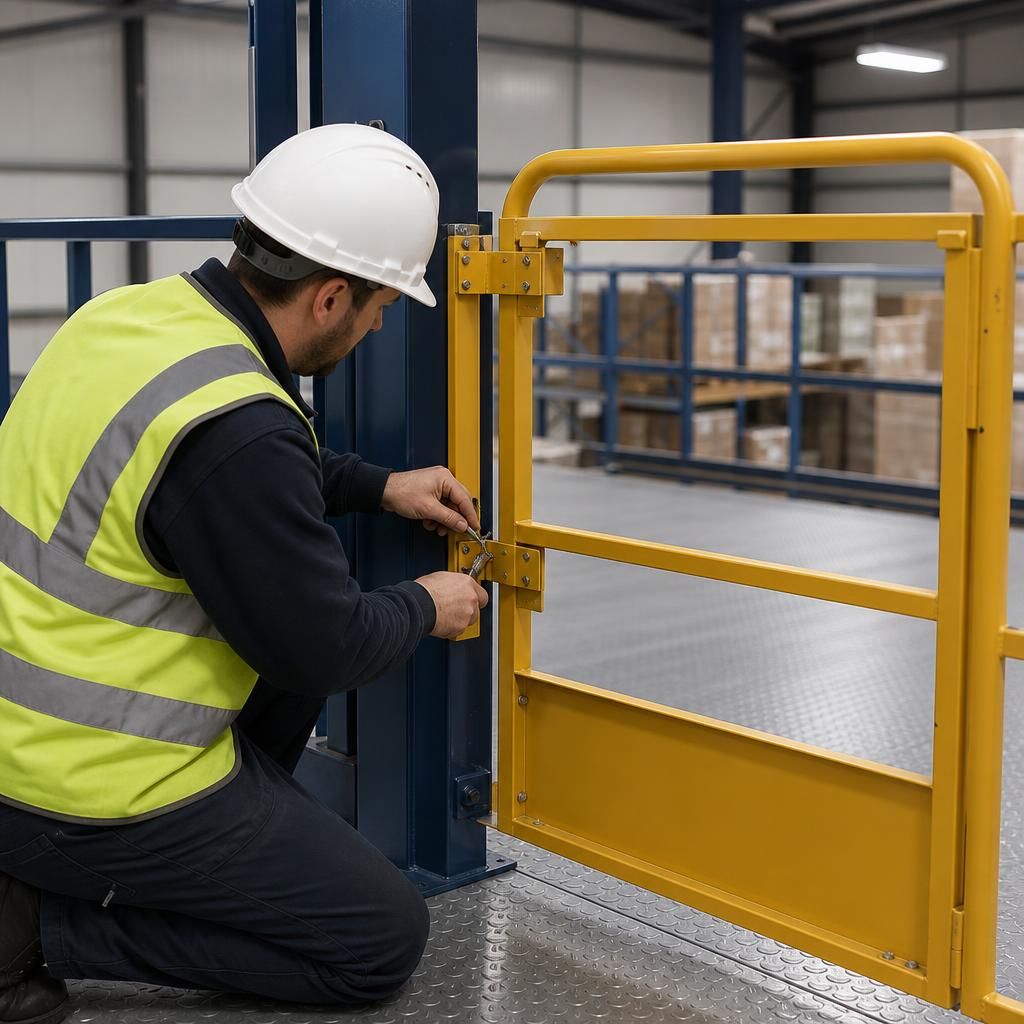
Post-impact inspection is a key maintenance practice for a mezzanine floor gate because damage may affect alignment, closing action or fall protection even when it is not immediately visible. Any collision, dropped load or unusual movement should prompt isolation of the gate and a thorough check by a competent person.
Inspect hinges, posts, fixings, welds, latches and surrounding edge protection for distortion, cracks, looseness or displacement. Do not return the gate to service until it closes fully, latches securely and operates without excessive force. Record the defect, inspection findings, repairs and return-to-service decision so recurring problems can be identified and controlled.
Arrange Expert Mezzanine Floor Gate Maintenance
Arrange expert mezzanine floor gate maintenance with Able Racking to assess defects, restore safe operation and verify the gate before it returns to service.