
How do mezzanine floor safety gates contribute to operational efficiency and safety compliance?
Mezzanine floor safety gates improve operational efficiency by controlling access to open edges during loading and the movement of goods, reducing disruption and the risk of falls. When correctly selected, installed, inspected and maintained, they also support compliance with applicable workplace safety requirements and site procedures.
Mezzanine floor safety gates contribute to operational efficiency and safety compliance by controlling access to open edges while goods are loaded, unloaded and transferred. A suitable gate allows authorised handling activities to continue without leaving an unprotected opening, helping to reduce fall risks, interruptions and unsafe workarounds.
How safety gates improve operational efficiency
A well-designed gate creates a defined transfer point between the floor below and the mezzanine level. Operators can place or remove loads at this point without relying on temporary barriers, improvised methods or manual handling arrangements that expose people to unnecessary risk.
Depending on the application, a gate may operate by lifting, pivoting, sliding or using a pallet gate arrangement. The important consideration is that the gate should provide protection when the loading area is not actively in use, while allowing goods to be moved through efficiently when required. The movement of the gate should be clear, controlled and suitable for the available space and handling equipment.
- Fewer interruptions: A clearly defined loading position helps operators follow a consistent process rather than stopping work to remove and replace temporary protection.
- Better traffic control: The gate helps separate people working at the edge from forklifts, pallet trucks and other handling activities below.
- Reduced damage: Properly positioned edge protection can help prevent loads, tools and materials from falling and causing damage to products, equipment or buildings.
- More consistent working methods: Operators can be trained to use the same sequence for opening, loading, closing and checking the gate.
- Improved use of floor space: A gate selected for the operating area can support material flow without creating unnecessary obstructions or requiring excessive clearance.
Efficiency depends on more than the gate itself. Its position, opening direction, operating force, compatibility with pallets and handling equipment, and relationship with pedestrian routes should all be considered during design and installation.
How safety gates support compliance
Open edges on raised working areas present a significant fall hazard. A safety gate forms part of the collective protective measures used to control that hazard, alongside suitable guardrails, toe boards, access arrangements and safe operating procedures. It should be selected following a suitable and sufficient risk assessment rather than treated as a standard item that is suitable for every site.
In the UK, the design and use of workplace access and loading arrangements should be considered in relation to applicable health and safety duties, including the Work at Height Regulations and requirements concerning the suitability, inspection and safe use of work equipment. The precise obligations depend on the workplace, the equipment used and the activities taking place. A gate does not by itself prove compliance; the complete installation and the way it is operated must be suitable.
For a safety gate to support compliance, it should:
- provide effective protection against falls when the loading opening is not in use;
- be strong and stable enough for the foreseeable loads, impacts and operating conditions;
- be compatible with the dimensions and handling method used at the transfer point;
- avoid creating trapping, crushing, striking or entanglement hazards;
- be positioned so that operators do not need to lean through an opening or work from an unsafe location;
- remain secure in its open and closed positions, where the design requires this;
- be clearly understood by the people who operate and work around it; and
- be included in the site’s inspection, maintenance and defect-reporting arrangements.
The importance of correct selection and installation
The most efficient gate is not necessarily the simplest or lowest-cost option. Selection should take account of the size and weight of loads, the frequency of transfers, the type of handling equipment, the available headroom, the space below, pedestrian movement and the need to prevent access to the exposed edge.
Installation should be completed by competent personnel in accordance with the design specification and the manufacturer’s instructions. Fixings, posts, hinges, counterbalance mechanisms, latches and protective infill all need to be suitable for the structure and the intended use. The surrounding edge protection must also remain continuous and effective when the gate is closed or being operated.
Where vehicles or mechanical handling equipment approach the gate, the risk of impact should be assessed. Physical separation, operating controls, communication arrangements and suitable barriers may be needed to prevent a vehicle from striking the gate or a person at the transfer point. The gate should not be used to compensate for poor traffic management.
Inspection, maintenance and operator behaviour
Regular checks help ensure that the safety benefit is maintained after installation. Users should report bent components, damaged mesh or rails, loose fixings, worn hinges, faulty latches, unusual movement and corrosion. A gate that does not close fully or remain secure should be taken out of service until it has been assessed and repaired.
Formal inspections should reflect the level of risk, frequency of use, working environment and history of damage. Records should identify the equipment inspected, findings, remedial actions and any restrictions placed on use. This provides useful evidence that the site is managing foreseeable risks rather than relying solely on the original installation.
Training should cover the normal operating sequence, the safe position of the operator, load placement, communication with people below, prohibited practices and the action to take if the gate is damaged. Supervisors should also check that the gate is not being left open, bypassed or used as a handhold during loading.
Practical outcome for warehouse operations
When properly specified and managed, a mezzanine floor safety gate makes a hazardous transfer activity more controlled and repeatable. It supports the safe movement of goods, protects people below and helps the business demonstrate that edge risks are being assessed, controlled, inspected and maintained. The best result comes from treating the gate as part of a complete system of edge protection, access control, traffic management, training and preventative maintenance.
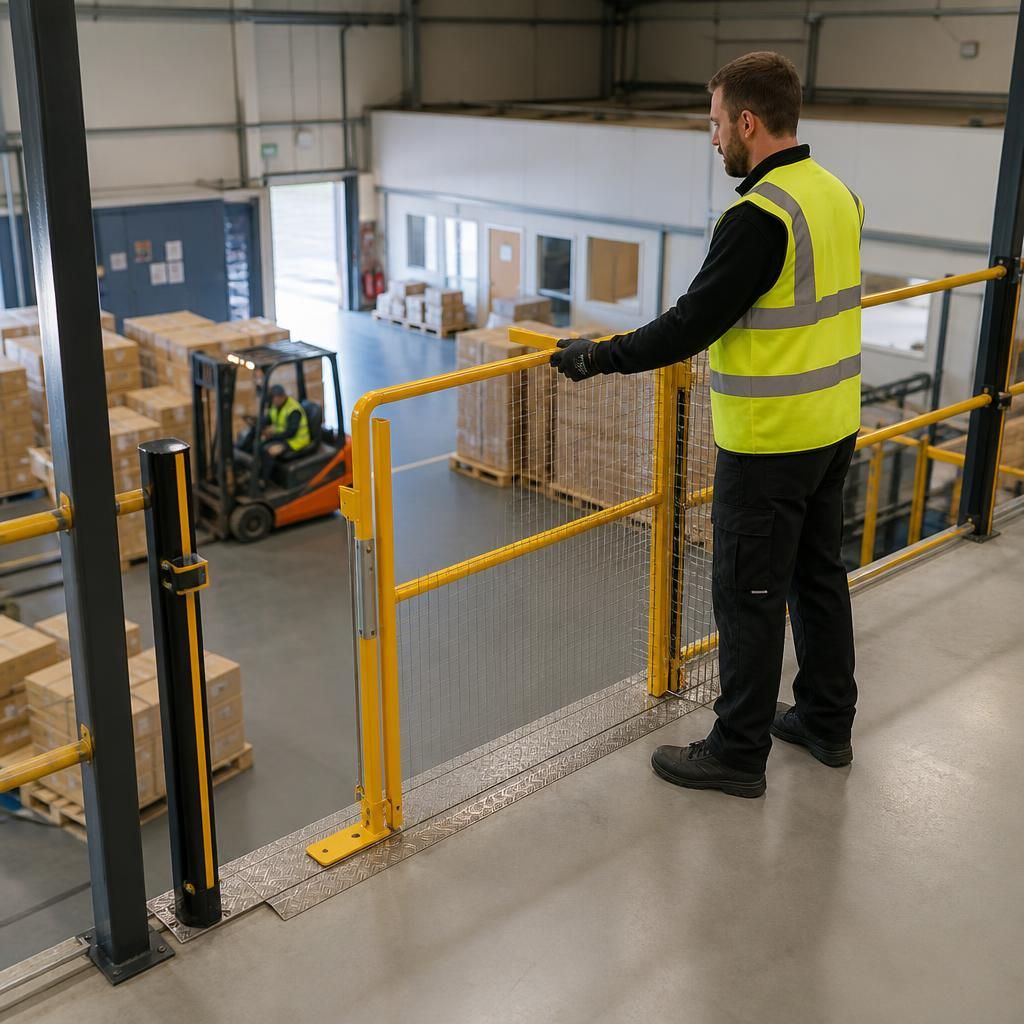
A mezzanine floor safety gate is a physical barrier that protects an open loading edge while allowing authorised personnel to transfer goods through a controlled point. By keeping the opening protected when it is not in use, the gate supports safer working practices without unnecessarily interrupting material movement.
Operational and compliance benefits depend on the gate being suitable for the task and used correctly:
- It provides a consistent loading process, reducing reliance on temporary barriers or improvised methods.
- It helps separate people at the edge from handling equipment and activity below.
- It reduces the likelihood of goods, tools or materials falling through an unprotected opening.
- It gives operators a clear sequence for opening, transferring goods, closing and checking the gate.
- It provides evidence of a planned control measure when included in risk assessments, inspections, maintenance and operator training.
The gate should be selected and installed around the loads, handling equipment, available space and surrounding traffic routes. Regular checks are also essential: damaged components, loose fixings, faulty latches or a gate that fails to close securely should be reported and addressed before the transfer point is used again.
Discuss your mezzanine floor safety gate requirements
Discuss your mezzanine floor safety gate requirements with Able Racking to review the loading arrangement, operating conditions and required protection. Our experienced team can help identify a suitable solution and advise on inspection and maintenance needs.