
What are the safety standards for warehouse racking inspections?
Warehouse racking inspections should follow HSE guidance and BS EN 15635, with regular visual checks by trained staff and a detailed inspection by a technically competent person at intervals of no more than 12 months. Any damage or safety concern must be recorded, risk-assessed and addressed promptly to protect employees and maintain a safe, compliant warehouse.
Warehouse racking inspections should follow the Health and Safety Executive’s guidance, the principles of BS EN 15635 and the manufacturer’s instructions. In practice, this means regular visual checks by trained employees, formal inspections by a technically competent person at intervals of no more than twelve months, and prompt action whenever damage or another safety concern is identified.
These standards are designed to identify defects before they cause a collapse, falling goods or an injury. They apply to the complete warehouse racking installation, including frames, beams, bracing, guards, connections, decking, load notices and the surrounding working area.
What the main standards require
BS EN 15635 sets out principles for the use, inspection and maintenance of steel static storage systems. It places responsibility on the warehouse operator to manage the installation safely, appoint suitable personnel and maintain an effective inspection system. The standard should be read alongside the supplier’s instructions and the site’s own risk assessments.
HSE guidance, including the principles covered by HSG76, expects employers to provide suitable storage equipment, protect people from foreseeable risks and keep systems in a safe condition. Although guidance and standards are not a substitute for a site-specific risk assessment, they provide a recognised framework for demonstrating that warehouse racking is being managed responsibly.
How often inspections should take place
- Employees should carry out routine visual checks at a frequency determined by the risk assessment. In busy or higher-risk areas, this may be daily or more frequently.
- A formal inspection should be completed by a technically competent person at intervals of no more than twelve months.
- Additional checks are needed after an impact, an alteration, a relocation, an unusual loading event or any report of damage.
- Inspections should continue even when the warehouse racking appears to be operating normally, as small defects can develop into serious failures.
The appropriate frequency depends on factors such as vehicle movements, loading practices, the condition of the floor, the age and design of the installation, the type of goods stored and the competence of the warehouse team. A risk assessment may therefore justify more frequent formal inspections than the maximum twelve-month interval.
What a formal inspection should cover
A competent inspector should assess the installation systematically rather than checking only the most visible damage. The inspection normally includes:
- uprights, frames, bracing and footplates for distortion, impact damage, corrosion or loosened components;
- beams, connectors, locking devices and support components for damage, displacement or signs of overloading;
- protective guards and barriers in areas exposed to vehicle or equipment impact;
- decking, pallets and other load-supporting components for unsafe deterioration or incorrect positioning;
- base plates, anchors, floor condition and the stability of the installation;
- load notices and other safety information, confirming that they are present, legible and suitable for the current configuration;
- clearances, access aisles and operating practices that could affect stability or safe use; and
- evidence that previous defects, repairs and recommendations have been properly closed out.
The inspector should also compare the installation with available drawings, specifications and load information. Changes to beam levels, bay layouts or component types can affect the safe capacity of the system, even when the alteration appears minor.
Damage classification and immediate controls
Inspection findings should be recorded clearly and prioritised according to risk. A serious defect may require the affected bay or area to be unloaded and taken out of service immediately. The area should be clearly identified so that it cannot be used accidentally, and goods should not be returned until a suitable repair or other corrective action has been completed.
Less serious damage still needs a defined action, owner and completion date. It should not be left unresolved simply because the installation remains in use. Repeated minor damage may also indicate a wider problem with traffic routes, operator training, protection measures or the way goods are loaded.
Repairs should use suitable, compatible components and follow the original design requirements or the advice of the manufacturer or a suitably qualified specialist. Straightening damaged structural members, welding without approval or mixing incompatible components can create further safety risks and may invalidate the original design assumptions.
Inspection records and responsibilities
A compliant inspection process depends on accurate records. The report should identify the location inspected, the date, the person completing it, the findings, the risk classification and the corrective action required. Records of repairs, re-inspections, alterations and load information should also be retained and made available to the people responsible for managing the warehouse.
The person with overall responsibility for the installation is often referred to as the Person Responsible for Rack Safety. This role involves arranging inspections, ensuring defects are controlled, communicating safe loading requirements and checking that only authorised changes are made. It does not remove the responsibility of employees to report damage or unsafe conditions as soon as they are noticed.
Routine checks by warehouse staff are valuable, but they do not replace a formal inspection. Employees should know what to look for and how to report it, while the formal inspection should be carried out by someone with the knowledge and practical experience to identify structural, loading and operational risks.
Training and safe working practices
People who use or work around warehouse racking should receive suitable instruction on:
- safe loading and unloading methods;
- load limits and the meaning of safety notices;
- recognising impact damage, missing components and other defects;
- reporting procedures and actions to take when damage is found;
- keeping aisles and access routes clear; and
- the risks associated with unauthorised alterations or unsuitable replacement parts.
Forklift and other materials-handling equipment operators should be trained to work without striking frames or beams. Good housekeeping, clearly managed traffic routes and appropriate protection can reduce the likelihood of impact damage, but they do not eliminate the need for inspections.
How to demonstrate compliance
There is no single inspection form that is suitable for every installation. A useful checklist should reflect the system’s design, the site’s activities and the risks identified in the assessment. It should make it possible to record precise locations and descriptions rather than relying on general comments such as “damage found”.
For a robust inspection system, ensure that:
- the warehouse racking has identifiable locations or bay references;
- routine and formal inspections are scheduled and completed on time;
- inspectors have suitable knowledge, training and practical experience;
- defects are risk-assessed and controlled without delay;
- repairs are completed by appropriately competent personnel;
- alterations are reviewed before they are introduced; and
- inspection, repair and training records are retained.
Following HSE guidance and BS EN 15635 provides a sound basis for safe warehouse racking management, but the correct approach must always reflect the installation and the work carried out on site. A competent inspection identifies defects, explains their significance and sets out practical corrective action, helping the business protect employees, maintain compliance and keep storage operations efficient.
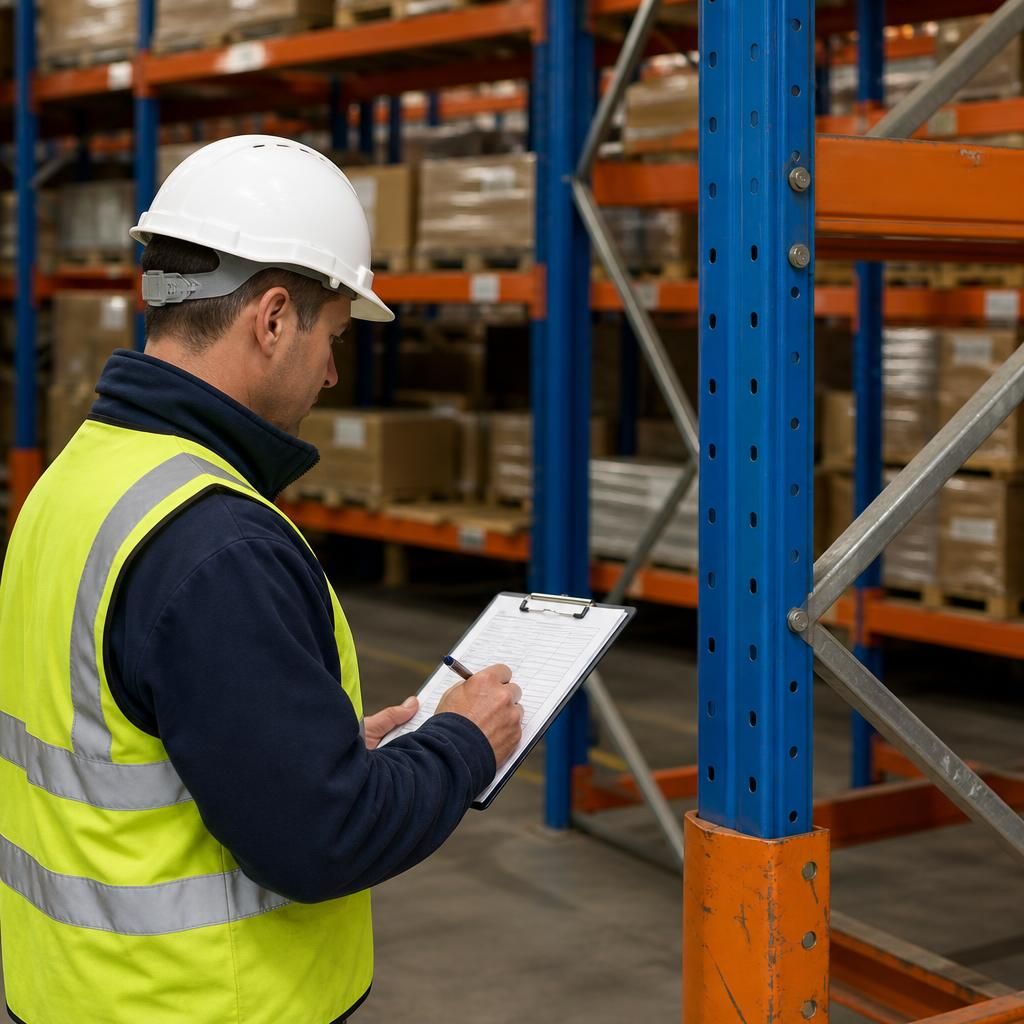
A formal warehouse racking inspection is a systematic assessment by a technically competent person, not simply a visual search for obvious damage. It should examine the structure, load-supporting components, protection, safety notices, floor condition, access routes and evidence that previous defects have been resolved.
Where damage could affect stability, the affected area should be identified, unloaded and taken out of service until a suitable repair or other corrective action is completed. Every finding should be recorded with its exact location, risk classification, required action and completion status. This creates a clear audit trail and helps prevent known defects from being overlooked.
Book Your Warehouse Racking Inspection
Book your warehouse racking inspection with Able Racking to identify defects, review compliance and keep your storage system safe to use. Contact our experienced inspection team to arrange a suitable assessment for your site.