
What should you do if defects are discovered during a warehouse racking inspection?
If defects are found during a warehouse racking inspection, report and record them immediately, assess their severity, and make unsafe areas or components unavailable until a competent person confirms the appropriate repair or replacement. Urgent damage should be addressed without delay, followed by a documented reinspection before the affected warehouse racking is returned to service.
When defects are discovered during a warehouse racking inspection, they should be recorded, assessed and controlled immediately. Any damaged warehouse racking, unsafe component or affected load position should be taken out of service where necessary, with suitable repairs or replacement completed by a competent person before it is returned to use.
The inspection report should identify the location and nature of each defect, its apparent severity and the action required. Do not rely on memory or verbal instructions alone. A clear record helps warehouse managers brief their teams, arrange repairs and demonstrate that safety concerns have been managed appropriately.
- Make the affected area safe. Prevent people from working beneath or beside seriously damaged warehouse racking, and stop pallets or other loads being placed in affected locations.
- Restrict access where required. Use suitable barriers, signage or an alternative operating procedure so that warehouse personnel and equipment cannot unintentionally use the affected area.
- Identify the defect accurately. Record the aisle, bay, level and component involved, together with photographs where useful. Note whether the issue affects an upright, beam, connector, bracing member, baseplate, guard or another part of the warehouse racking system.
- Assess the risk. Consider the type and extent of damage, the position of the defect, the loads stored nearby and whether the stability or load-bearing capacity of the warehouse racking may have been affected.
- Arrange suitable corrective work. Repairs, component replacement or partial dismantling should follow the warehouse racking manufacturer’s requirements and the recommendations of a competent warehouse racking specialist.
- Reinspect before use. The affected warehouse racking should not be returned to service until the required work has been completed and its condition has been checked and recorded.
Inspection findings are often prioritised according to their urgency. The terminology can vary between inspection providers, but a report may distinguish between defects requiring immediate action, defects requiring prompt attention and items that should be monitored or corrected through planned maintenance. The classification should be read alongside the inspector’s comments rather than treated as a substitute for them.
Serious or critical defects may include severely bent uprights, damaged beams, missing or failed locking devices, displaced components, significant instability, impact damage affecting a load-bearing member or any condition suggesting that collapse could occur. The affected warehouse racking should normally be isolated without delay. Loads may need to be carefully removed under a controlled procedure, but this should only be done where it is safe and where the method has been assessed by a competent person.
Less urgent defects still require action. Minor damage, missing protection, loose components, deteriorating floor fixings, poor housekeeping or signs of repeated vehicle impact can become more serious if ignored. The report should specify what needs to be corrected, who is responsible and when the work should be completed.
Do not attempt to straighten, weld, drill or modify damaged warehouse racking without approval from the manufacturer or an appropriately qualified specialist. A component that appears repairable may have lost its original strength or alignment. Unauthorised alterations can also affect the design assumptions, load notices and safe working capacity of the complete storage system.
Before repairs are arranged, check whether the warehouse racking is still correctly configured. Replacement beams, uprights, bracing and safety accessories should be compatible with the existing system and installed in the correct positions. If the layout, beam levels, loading arrangements or equipment used in the area have changed, a further design or suitability review may be needed.
Once work is complete, retain evidence of what was done. Useful records include the original inspection report, photographs, repair details, replaced component information, invoices or completion notes, and the follow-up inspection record. Update the warehouse racking register or site safety documentation so that outstanding defects are not carried forward incorrectly.
The cause of the defect should also be considered. Impact damage may indicate that vehicle routes, operator training, protection or housekeeping controls need improvement. Repeated overloading may point to unclear load notices or unsuitable storage planning. Loose fixings or recurring component failures may require a wider review rather than a single replacement.
Warehouse teams should be told which locations are unavailable and what signs to report while corrective work is pending. Continue routine visual checks and report new damage immediately. A formal warehouse racking inspection does not replace day-to-day awareness: operators are often the first people to notice an impact, displaced load or change in condition.
Where the extent of damage is uncertain, treat the situation conservatively. Stop use of the affected warehouse racking, preserve the inspection information and seek advice from a competent warehouse racking inspector or repair specialist. The final decision to return the area to service should be based on the completed corrective work and a documented confirmation that the warehouse racking is safe for its intended loads and use.
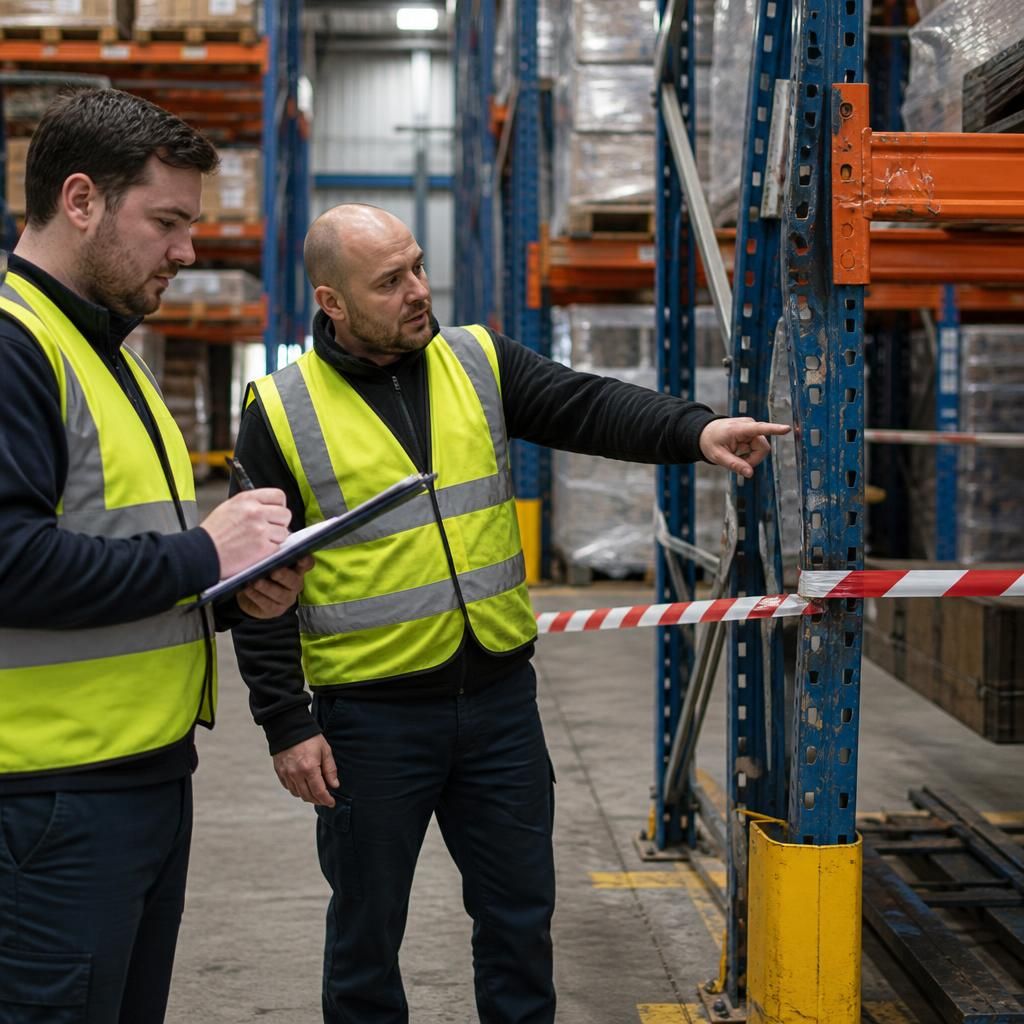
When a defect is found during a warehouse racking inspection, the affected area should be controlled immediately and the warehouse racking should not be used until the risk has been assessed. Stop loading or unloading the affected bay, prevent access where necessary and clearly record the aisle, bay, level and damaged component.
Do not straighten, weld or modify damaged warehouse racking without approval from the manufacturer or a competent specialist. Arrange the required repair or replacement, then have the completed work checked and documented before the warehouse racking is returned to service. This provides a clear record that the defect has been addressed and that the storage system remains suitable for its intended loads.
Need Help Addressing Warehouse Racking Defects?
If defects have been identified during a warehouse racking inspection, contact Able Racking for competent advice on the appropriate repair, replacement or follow-up inspection. We can help you control the affected area and confirm when it is safe to return the warehouse racking to service.