
What qualifications should a warehouse racking inspector have to ensure safety and compliance?
A warehouse racking inspector should be a demonstrably competent person with relevant training, practical experience and a sound understanding of HSE guidance, PUWER, applicable standards and manufacturer instructions. Look for recognised inspection training, such as SEMA Approved Rack Inspector status or an equivalent qualification, together with evidence that the inspector can identify damage, assess risks and produce clear, actionable reports.
A warehouse racking inspector should be a demonstrably competent person with relevant inspection training, practical experience and a sound understanding of workplace safety requirements. Recognised training, such as SEMA Approved Rack Inspector status or an equivalent qualification, is a useful indication of competence, but it should be supported by current experience, knowledge of applicable standards and the ability to produce clear, actionable reports.
There is no single UK licence that automatically qualifies someone to inspect every type of warehouse racking. Competence depends on the inspector’s training, technical knowledge and experience in assessing the particular storage system and the risks present in the workplace. Before appointing an inspector, check the following areas.
- Recognised inspection training: The inspector should have completed a relevant course covering warehouse racking inspection, common forms of damage, risk classification, safe working practices and reporting. SEMA Approved Rack Inspector training is one recognised route; an equivalent course should provide comparable technical coverage.
- Practical experience: Training must be reinforced by hands-on experience. A competent inspector should be able to identify damage to frames, beams, bracing, connections, protection and load-bearing components, while distinguishing between minor defects and conditions requiring immediate action.
- Knowledge of applicable guidance and standards: The inspector should understand the HSE’s workplace safety guidance, the principles of PUWER where applicable, BS EN 15635 and relevant manufacturer instructions. They should also understand the responsibilities of the warehouse operator, equipment users and the person responsible for the storage system.
- Structural awareness: An inspector does not necessarily need to be a structural engineer, but they must understand how warehouse racking behaves under load. This includes recognising the significance of impact damage, missing or loose components, uneven loading, unauthorised alterations, poor floor conditions and signs of instability.
- Risk assessment skills: The inspector should be able to assess the urgency of each finding and recommend proportionate action. Reports should clearly distinguish between issues requiring immediate isolation or unloading, defects requiring prompt repair and items that should be monitored or addressed through routine maintenance.
- Safe inspection methods: The inspector should be trained to work safely around warehouse traffic, materials handling equipment, stored loads and elevated components. They should use a systematic inspection method and avoid creating additional risks while examining the installation.
- Accurate reporting: A professional report should identify the location and type of defect, explain its significance, include suitable photographs or references where useful, and state the recommended corrective action. The findings should be sufficiently clear for responsible personnel to arrange repairs, unloading, isolation or further technical assessment.
It is also important to distinguish an inspection qualification from a repair or installation qualification. An inspector may identify that a damaged component needs replacement without being the person who carries out the repair. Where damage is significant, the inspector should recommend assessment by a suitably qualified technical specialist or the original equipment manufacturer before the warehouse racking is returned to service.
Independence is another useful consideration. The person carrying out the inspection should be able to record defects objectively rather than overlooking issues because they were involved in the original installation or a previous repair. Independence does not prevent the same specialist from providing follow-up maintenance, provided the inspection findings remain transparent and properly documented.
Competence should be maintained after the initial qualification. Ask whether the inspector receives refresher training, keeps up to date with changes to guidance and standards, and regularly inspects different warehouse racking configurations. Experience with adjustable pallet storage, drive-in systems, cantilever systems or other specialist arrangements can be particularly relevant where the installation has features that require additional knowledge.
Before booking an inspection, request evidence of the inspector’s relevant qualification, experience and insurance, and ask for an example of the information included in a completed report. Confirm that the scope will cover the full installation, including protection, load notices, structural components, connections, floors and visible signs of overloading or impact. The inspector should also be given information about the system’s design loads, known damage, previous repairs and any changes made since the last inspection.
A qualified inspector will not simply provide a pass-or-fail statement. They will explain the condition of the warehouse racking, identify hazards in a way that can be acted upon and advise when repairs, unloading, isolation or specialist review is necessary. This combination of recognised training, practical competence, current technical knowledge and clear reporting provides a reliable basis for maintaining a safe and compliant storage system.
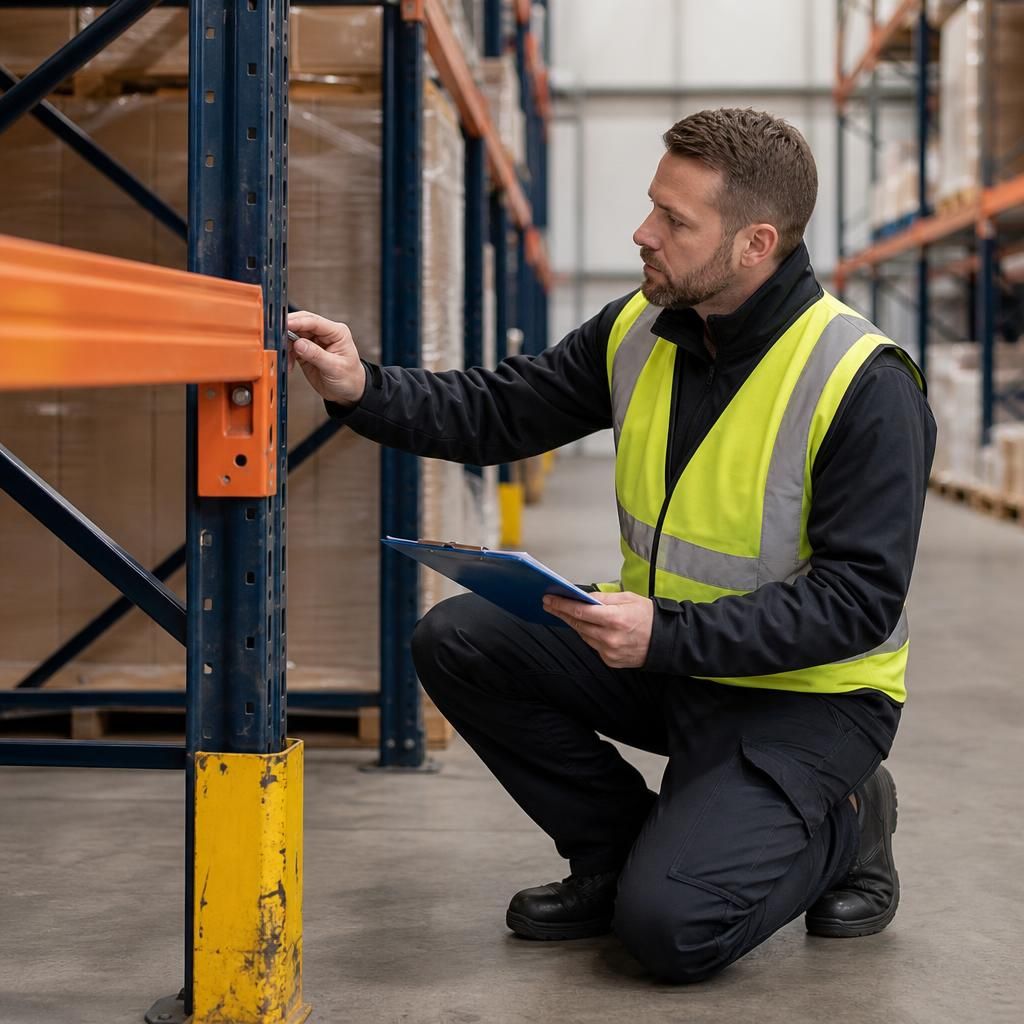
A recognised warehouse racking inspection qualification is an important starting point, but it does not by itself prove complete competence. The inspector should also have current practical experience identifying damage to frames, beams, bracing, connections and protective components, and assessing how each defect affects safety and load capacity.
When reviewing an inspector’s credentials, ask for evidence of relevant training, knowledge of BS EN 15635 and HSE guidance, suitable insurance, and examples of clear inspection reports. A competent report should record the location and severity of each defect, explain the required action and distinguish between items requiring immediate isolation, prompt repair or routine monitoring.
Book a qualified warehouse racking inspection
Arrange a qualified warehouse racking inspection with Able Racking to assess your system, identify defects and receive clear recommendations for any necessary action.