
How often should warehouse racking inspections be conducted to ensure safety?
Warehouse racking should receive a formal inspection by a technically competent person at least every 12 months, in line with UK workplace safety guidance. In addition, trained staff should carry out regular visual checks—typically weekly or at an interval determined by your risk assessment—and report any damage immediately.
A formal warehouse racking inspection should be completed by a technically competent person at least every 12 months, with more frequent inspections where the risk assessment, operating conditions or system history indicate that this is necessary. Trained warehouse staff should also carry out regular visual checks, commonly weekly or at an interval set by the site risk assessment, and report damage or other safety concerns immediately.
The annual inspection is the minimum recommended interval under UK workplace safety guidance, including the principles set out in HSE guidance for the safe use of warehouse racking. It is not a substitute for routine monitoring. Warehouse racking can be damaged between formal inspections by forklift impacts, falling loads, overloading, poor loading practices or changes to the working environment. A planned inspection programme combines frequent visual checks with a detailed independent assessment.
The appropriate inspection frequency usually includes the following:
- Routine visual checks: Trained, responsible employees should look for visible damage, displaced components, missing safety devices, unstable loads and other obvious hazards. These checks should follow a documented process and be carried out at a frequency determined by the risk assessment.
- Formal warehouse racking inspection: A technically competent inspector should examine the system at least annually. The inspection should cover the structure, protective equipment, connections, load signs, operating conditions and any previously reported defects.
- Immediate checks after an incident: An inspection should be arranged after a forklift impact, dropped load, structural alteration, significant overloading, fire, flood or other event that could have affected the system’s integrity.
- Additional inspections in higher-risk conditions: More frequent formal inspections may be appropriate where there is intensive vehicle movement, frequent stock changes, harsh operating conditions, a history of damage or difficulty maintaining safe loading and housekeeping standards.
Weekly visual checks are often suitable for a well-managed warehouse, but the correct interval must reflect the actual risks. A busy operation with frequent forklift traffic may need checks more often, while a lower-risk environment may follow a different documented schedule. The important point is that the frequency is justified by a suitable and sufficient risk assessment rather than selected arbitrarily.
Those carrying out routine checks should know what safe warehouse racking looks like and understand the site’s reporting and isolation procedures. They should look for bent uprights or beams, damaged bracing, loose or missing fixings, displaced components, damaged floor fixings, missing beam safety locks, leaning frames, excessive deflection and loads that appear unstable or exceed the stated capacity. They should also check that aisles remain clear and that pallets are suitable, correctly positioned and not damaged.
A formal inspection is more detailed than a visual check. The competent inspector assesses damage against recognised technical criteria, considers whether defects affect the safe use of the system and records the findings in a clear report. The report should identify the location and nature of each issue, assign an appropriate priority and state what corrective action is required. Photographs, marked-up layouts and comparison with previous findings can help the responsible person track recurring problems.
Inspection frequency should also be reviewed when warehouse operations change. Changes such as installing new equipment, altering load configurations, increasing storage density, changing pallet types or modifying traffic routes can introduce new risks. Any alteration to the warehouse racking system should be properly designed, approved and checked before use; components should not be removed, repositioned or replaced with unsuitable alternatives.
Where damage is found, the affected area should be assessed promptly and managed according to the severity of the defect. Serious damage may require the bay or section to be unloaded and taken out of service immediately. Repairs or replacements should be completed by a suitably qualified and experienced contractor, followed by a check that the system is safe before it is returned to use. Do not rely on a temporary repair, paint, strapping or an informal adjustment unless it forms part of an appropriate engineered solution.
Inspection records should be retained with the warehouse’s safety documentation. Keep the formal report, routine check records, defect photographs, repair details, reinspection evidence and relevant risk assessments together. Reviewing these records can reveal repeated impact points, training needs, unsuitable working practices or areas where physical protection and traffic management should be improved.
In practice, a sound programme is therefore based on three controls: regular staff checks, a formal competent-person inspection at least every 12 months, and an immediate assessment whenever damage or a significant change occurs. This approach helps identify defects before they develop into failures, supports compliance with workplace safety duties and keeps warehouse operations controlled between scheduled inspections.
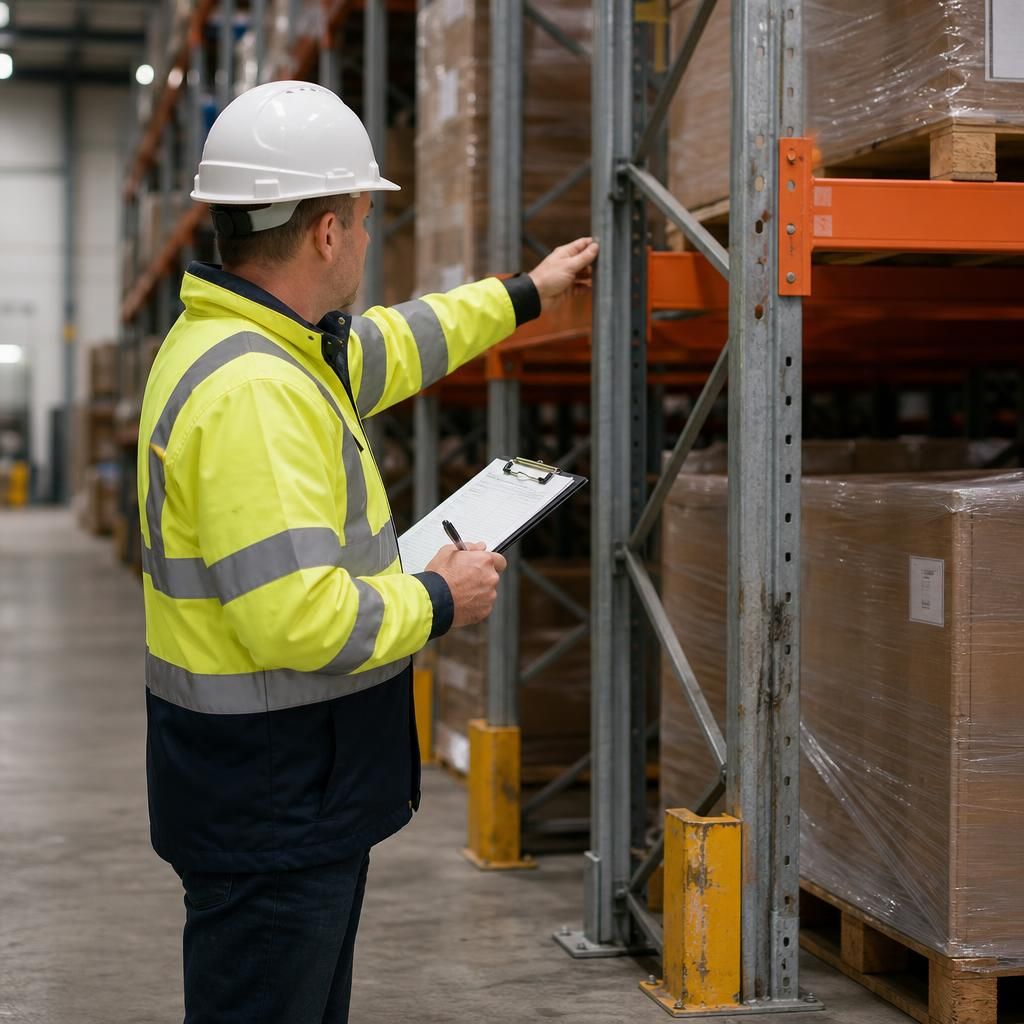
A formal warehouse racking inspection should be completed by a technically competent person at least annually, but the schedule should also reflect the risks of the site. Trained staff should carry out documented visual checks at the interval set by the risk assessment, while an immediate assessment is needed after an impact, dropped load, alteration or other event that may have caused damage.
This combined approach helps identify defects between formal inspections. Any damaged area should be assessed promptly, isolated where necessary and repaired before it is returned to service.
Arrange your warehouse racking inspection
Arrange your warehouse racking inspection with Able Racking to confirm that your system remains safe, compliant and suitable for current operating conditions. Contact our experienced team to discuss your inspection requirements.