
How can SEMA Racking Inspections prevent costly operational disruptions?
SEMA Racking Inspections identify damage, instability and non-compliance in warehouse racking before they lead to collapse, injury or an enforced shutdown. By prioritising defects for timely repair and documenting the condition of the system, inspections help prevent unplanned disruption, protect stock and keep warehouse operations compliant and productive.
SEMA Racking Inspections prevent costly operational disruptions by identifying damage, instability and unsafe conditions before they result in collapse, injury, stock loss or an enforced warehouse closure. A structured inspection provides a clear record of the condition of the system, prioritises defects by risk and allows corrective work to be planned before a minor issue becomes an operational emergency.
Warehouse racking can be affected by forklift impact, overloading, incorrect loading, building movement, corrosion, poor installation or unauthorised alterations. Some defects are immediately visible, while others develop gradually and may not be recognised during normal warehouse activity. An inspection provides an independent assessment of the structure and its use, rather than relying only on day-to-day observations by warehouse staff.
Early identification of damage
Impact damage to uprights, bracing, beams, guards and connections can reduce the load-bearing capability of a storage system. Even apparently minor distortion may affect how loads are supported or how the structure responds to further impact. During a SEMA Racking Inspection, defects are recorded so that they can be assessed and dealt with according to their severity.
Prompt action helps prevent progressive damage. For example, isolating a damaged bay and arranging a repair is generally more manageable than dealing with a collapsed section, damaged stock and restricted access after an incident. Clear defect records also help warehouse teams identify affected locations and prevent them from being used unintentionally.
Reducing the risk of unplanned closure
A serious structural defect may require part of a warehouse to be taken out of service while the risk is investigated and remedial work is completed. This can restrict picking routes, delay dispatches and require stock to be moved at short notice. Where damage is discovered early, repairs and temporary controls can often be planned around operational requirements.
Inspection findings can support a practical remedial plan that distinguishes between:
- Immediate hazards requiring the affected area to be unloaded, isolated or taken out of use.
- Defects requiring repair within a defined timescale.
- Lower-risk observations that should be monitored or corrected as part of planned maintenance.
This risk-based approach helps managers focus resources where they are most needed without treating every observation as an emergency.
Protecting stock, equipment and people
A failure in warehouse racking can damage stored goods, handling equipment and the building, as well as exposing employees and visitors to serious danger. The financial impact may include replacement stock, clean-up work, emergency repairs, lost productivity and delayed customer orders. Preventative inspections reduce the likelihood that these costs will arise from an unnoticed defect.
Inspections should be considered alongside safe operating practices. Correct loading, suitable load notices, competent forklift operation, maintained floor conditions and effective impact protection all contribute to the stability and safe use of warehouse racking. The inspection report can highlight where the physical condition of the system or the way it is being used creates additional risk.
Supporting compliance and accountability
Regular SEMA Racking Inspections provide documented evidence that the condition of the installation is being checked and that identified issues are being managed. This can be important when reviewing workplace safety arrangements, investigating an incident, responding to an insurer or demonstrating appropriate maintenance controls to an auditor or customer.
Documentation is most useful when it includes the inspection date, locations assessed, defects identified, risk classifications, photographs where appropriate and recommended actions. It should be retained with repair records and made available to responsible warehouse personnel. A report does not remove the need to correct defects, but it creates a reliable basis for deciding what must happen next.
Preventing repeat disruption
A good inspection process looks beyond individual damage. Repeated impact in the same aisle may indicate poor traffic management, inadequate protection or insufficient separation between handling equipment and storage areas. Overloaded levels or misplaced pallets may point to weaknesses in loading controls or staff training. Identifying these patterns allows the underlying cause to be addressed rather than repeatedly repairing the same component.
After an inspection, warehouse managers should review the findings with the people responsible for operations and maintenance. Actions may include arranging repairs, replacing unsuitable components, improving protection, updating load information, changing traffic routes or providing additional training. Follow-up checks should confirm that significant defects have been resolved before affected areas return to normal use.
Keeping inspections effective
SEMA Racking Inspections work best as part of a wider preventative maintenance programme. Staff should report new damage as soon as it is noticed, and routine visual checks should continue between formal inspections. The inspection frequency should reflect factors such as traffic levels, the type and condition of the installation, previous damage, loading practices and changes to the warehouse layout.
A competent inspector should assess the system against relevant SEMA guidance and applicable workplace safety duties, using a consistent method and providing findings that the site team can act on. The inspection should cover the installation in use, not just isolated components, so that structural condition, loading, protection and operational risks are considered together.
For existing Able Racking customers, the most effective next step after receiving an inspection report is to review any urgent findings immediately, assign responsibility for each action and record completion. This turns the inspection from a compliance exercise into a practical control that helps keep warehouse racking safe, available and productive.
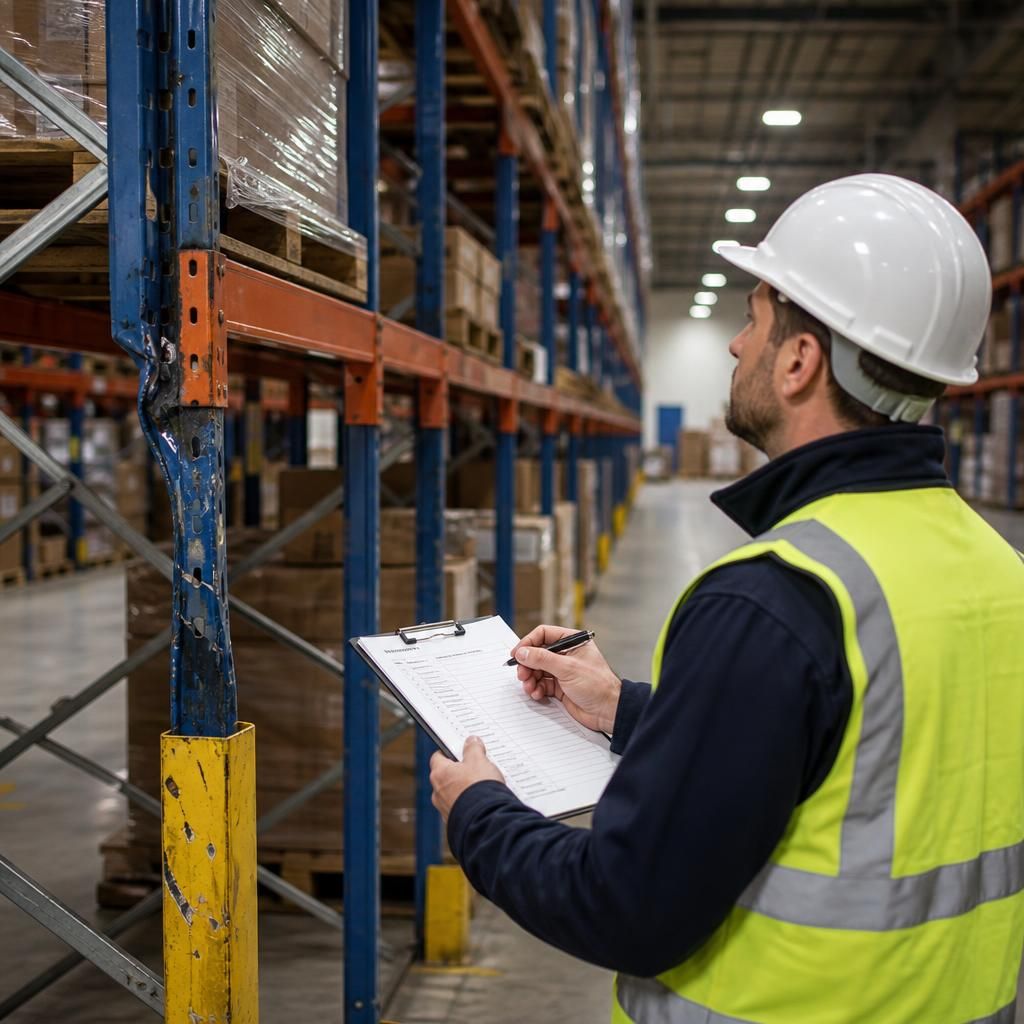
SEMA Racking Inspections help prevent operational disruption by identifying defects early and ranking them according to risk. This enables warehouse teams to isolate unsafe areas, arrange repairs and plan any necessary stock movements before damage develops into a collapse, injury or enforced closure.
A clear inspection report should distinguish between immediate hazards, defects requiring timely repair and lower-risk observations for planned maintenance. This gives the responsible team a practical action plan rather than a list of findings, helping keep safe areas available for picking, storage and dispatch.
After the inspection, assign responsibility for each action and retain evidence of completed repairs. Reviewing repeated impact, overloading or loading errors can also reveal operational causes, allowing preventative measures such as improved protection, revised traffic controls or additional staff training to reduce future disruption.
Book Your SEMA Racking Inspection
Book your SEMA Racking Inspection with Able Racking to identify defects early, prioritise corrective work and help prevent avoidable disruption to your warehouse operations.