
Can you explain your process for identifying potential risks in warehouse racking systems during inspections?
During a warehouse racking inspection, our SEMA Approved Inspectors systematically examine the structure, components, protection and surrounding operating conditions to identify damage, instability, overloading, poor installation and other hazards. They assess each finding against relevant safety requirements, record its location and severity, and recommend proportionate action to reduce risk and maintain safe operation.
Our warehouse racking risk inspection process is a systematic examination of the storage structure, its components, the loads it carries and the conditions in which it operates. A SEMA Approved Inspector looks for hazards such as impact damage, overloading, instability, missing components, poor installation, inadequate protection and unsafe working practices, then records each finding, assesses its significance and recommends suitable corrective action.
The inspection is intended to identify risks before they develop into structural failure or an incident. It is not limited to a visual check of the most accessible frames. The inspector considers how the warehouse racking has been designed, installed, loaded, altered and used, as well as whether its current condition remains suitable for the operation.
Before examining the warehouse racking
The process begins with a review of available information and the operating environment. Where relevant, this includes layout drawings, load notices, installation records, previous inspection reports, repair records and details of any changes to the storage system. The inspector also discusses known issues with the responsible person, such as vehicle impacts, repeated damage, changes in stored goods or concerns raised by warehouse staff.
This initial review helps establish what the warehouse racking is intended to carry and whether the physical installation matches the available design information. It also identifies areas that need particular attention, including traffic routes, loading bays, high-activity locations, end frames and positions where damage has previously occurred.
Examining the structure and components
The inspector then works through the warehouse racking in a consistent, traceable manner. The examination normally covers:
- uprights, frames and bracing for dents, bends, twisting, corrosion, distortion or other signs of structural damage;
- beams and beam-to-frame connections for deformation, displacement, damaged locking devices or signs that a connection is not properly engaged;
- baseplates, anchors, shims and floor fixings for looseness, damage, movement or unsuitable installation;
- guards and barriers for impact damage, missing parts or insufficient protection at vulnerable positions;
- pallet supports, decking, panels and other accessories for damage, displacement, overloading or unsuitable use;
- connections between components for missing, loose or incompatible parts; and
- signage and load notices to confirm that the information is present, clear and consistent with the installed system.
Measurements may be taken where damage, deflection or alignment needs to be assessed more precisely. The inspector also checks for less obvious defects, such as a component that appears intact but has moved from its intended position, a fixing that no longer provides adequate restraint or a frame that is no longer plumb.
Checking loads, layout and use
Warehouse racking can be safe when used within its design limits but hazardous when loading or operating practices change. The inspector therefore compares the stored goods and pallet arrangements with the stated load information, where that information is available. They look for excessive load, unevenly distributed goods, pallets projecting into operating spaces, incompatible pallet sizes and loads placed on damaged or unsuitable supports.
The assessment also considers clearances, access routes and the interaction between warehouse racking and vehicles or handling equipment. Repeated contact from lift trucks, restricted manoeuvring space, poor visibility, obstructions and unsafe loading methods can all increase the likelihood of damage. Changes to the layout, beam levels or stored goods are reviewed because even a structurally sound installation may become unsuitable if it is used differently from its original arrangement.
Identifying installation and alteration risks
Some risks arise from how the warehouse racking was installed or subsequently modified rather than from normal wear. The inspector checks whether the system appears to have been assembled correctly, whether required bracing and fixings are present and whether components have been mixed, replaced or altered in a way that could affect performance.
Unauthorised changes can include moving beams, removing bracing, substituting components, cutting members, adding accessories or changing the arrangement without confirming its suitability. Where the available evidence does not demonstrate that an alteration is appropriate, it is recorded for review rather than assumed to be safe.
Assessing the significance of findings
Each defect is considered in context. The inspector looks at its type, location, extent and likely effect on the stability or safe use of the warehouse racking. A minor cosmetic mark is not treated in the same way as a bent upright, displaced beam connector or missing anchor. The surrounding load, traffic level and likelihood of further impact are also relevant.
Findings are normally prioritised so that the responsible person can act in the correct order. An immediately dangerous condition requires the affected area to be taken out of use or otherwise made safe without delay. A serious defect requires prompt corrective action, while lower-risk damage or deterioration should still be monitored and repaired within an agreed timescale. The exact response depends on the condition found and the inspector’s professional assessment.
Where a risk cannot be confirmed from visual evidence alone, the report should identify what further information, measurement, design review or specialist assessment is needed. This prevents uncertain conditions from being overlooked or given an unjustified level of confidence.
Recording locations and evidence
Clear records are essential because a warehouse may contain many similar frames and components. Findings are linked to identifiable locations using the layout, aisle references, bay positions or other site markings. Photographs and descriptions are used where they help explain the defect, its position and the action required.
A useful record describes what was observed rather than relying on a general statement such as “racking damaged”. It should indicate the affected component, the nature of the damage, the location, the relevant risk and the recommended next step. This allows warehouse managers, maintenance teams and repair specialists to locate the issue quickly and confirm when it has been addressed.
Producing the inspection report
Following the inspection, the findings are set out in a written report. This typically identifies the areas examined, the limitations of the inspection, the defects observed, their priority and any recommended remedial measures. The report may also highlight good practices or wider controls that need attention, such as inspection arrangements, operator awareness, load information or protection at impact-prone locations.
The report is a management tool rather than simply a record of defects. It helps the responsible person decide whether to isolate an area, unload a location, arrange a repair, obtain technical advice, improve protection or review working practices. Repairs should be carried out by competent people using suitable components and methods. Damaged warehouse racking should not be returned to service merely because it has been straightened or appears stable.
Following up and preventing recurrence
Risk identification is most effective when findings are followed through to completion. After corrective work, the affected warehouse racking should be checked to confirm that the repair or replacement is suitable and that the original risk has been controlled. Any underlying cause, such as repeated vehicle contact, poor pallet quality or unclear load information, should also be addressed.
Regular visual checks by trained site personnel support the formal inspection process by identifying new damage promptly. Staff should know what to look for, how to report concerns and when to prevent use of an affected location. A planned inspection programme, clear responsibility and accurate records help maintain warehouse racking safety between formal assessments.
Our SEMA Approved Inspectors apply this structured approach to provide practical, evidence-based findings. The aim is to identify potential failure mechanisms early, distinguish urgent hazards from routine maintenance issues and give the responsible person clear information for keeping the warehouse racking safe, compliant and suitable for continued operation.
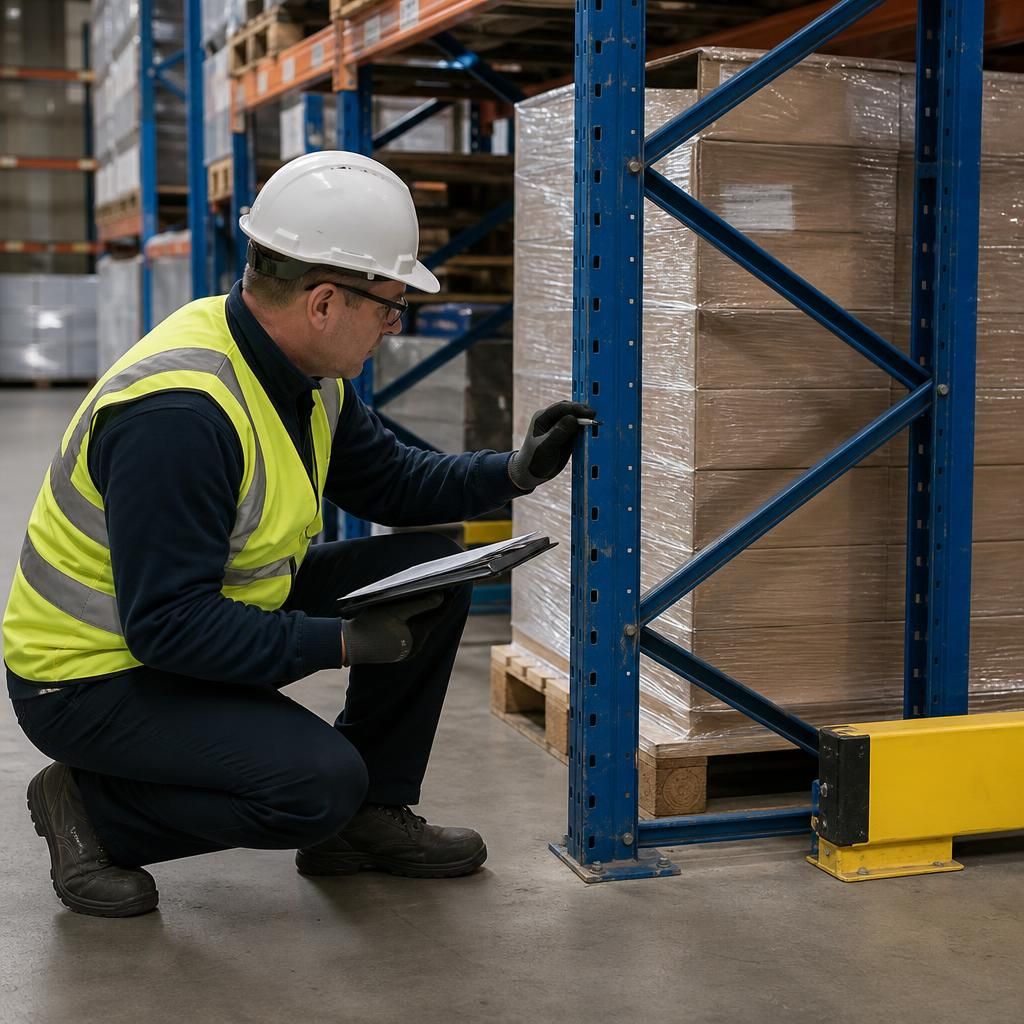
A warehouse racking inspection must assess the severity of each defect, not simply record that damage exists. The inspector considers the affected component, its location, the load carried, nearby vehicle activity and the potential effect on structural stability or safe use.
Findings are then prioritised so the responsible person knows what action is required. An immediately dangerous condition may require the affected area to be isolated or unloaded without delay. Serious defects need prompt corrective work, while lower-risk damage should be monitored and repaired within an agreed timescale. Clear descriptions, location references and photographs help the warehouse team identify the issue and confirm that suitable action has been completed.
Arrange a warehouse racking risk inspection
Arrange a warehouse racking risk inspection with our SEMA Approved Inspectors to identify hazards, assess their priority and receive clear recommendations for corrective action.