
What are the consequences of neglecting regular warehouse racking safety inspections?
Neglecting regular warehouse racking safety inspections can allow damage, overloading and instability to go unnoticed, increasing the risk of racking collapse, falling goods, serious injuries and costly stock or facility damage. It can also cause operational downtime, invalidate safety procedures and make it harder to demonstrate compliance with relevant workplace safety requirements.
Neglecting regular warehouse racking safety inspections allows damage, overloading and instability to remain undetected. The consequences can include falling goods, partial or complete warehouse racking collapse, serious injury, stock and building damage, operational disruption, and difficulty demonstrating that suitable safety controls are in place.
Undetected damage can worsen over time. Impact from forklifts, pallet trucks or other handling equipment may bend uprights, beams, bracing or protective components without causing an immediate collapse. A damaged component may continue to deteriorate as loads are placed and removed. Without a competent inspection, seemingly minor defects can be missed until the warehouse racking is no longer capable of safely supporting its intended loads.
Regular inspections help identify issues such as:
- Impact damage to frames, uprights, beams and bracing
- Missing, displaced or damaged locking pins and safety devices
- Loose, damaged or inadequate floor fixings
- Unstable or uneven warehouse racking
- Overloaded or incorrectly distributed bays
- Missing, inaccurate or unreadable load notices
- Damaged pallets or goods projecting into access routes
- Unauthorised alterations or unsuitable replacement components
- Corrosion, wear, poor housekeeping or obstructions around the installation
Collapse and falling goods present serious safety risks. When a load-bearing component fails, stored goods may fall into aisles or work areas. A local failure can also place additional force on adjacent bays, creating a wider collapse. This may expose employees, contractors, visitors and vehicle operators to crushing, impact or trapping hazards. The risk is greater where pedestrian routes, picking areas or vehicle movements are close to the affected warehouse racking.
Neglect can cause significant financial loss. A warehouse racking incident may damage stock, handling equipment, floors, doors, lighting, services and other parts of the building. The business may also face the cost of emergency isolation, clearance, disposal, replacement components, specialist repairs and reinspection. These costs are often greater than the planned cost of identifying and addressing defects during routine inspections.
Operational disruption is another common consequence. Unsafe bays may need to be taken out of service immediately. This can reduce available storage capacity, interrupt picking and replenishment, delay despatches and require stock to be relocated. If an incident affects access routes or essential warehouse racking, normal operations may remain restricted until the area has been made safe and the cause has been investigated.
Failure to inspect can weaken the business’s evidence of effective safety management. Employers and duty holders must take reasonably practicable steps to protect people who may be affected by workplace activities. A planned inspection programme, clear defect records and evidence of completed remedial work help demonstrate that warehouse racking risks are being actively managed. Where inspections have been missed or records are incomplete, it may be more difficult to show that appropriate precautions were taken following an accident, near miss or enforcement enquiry.
Insurance and contractual requirements may also depend on the business following documented maintenance and inspection arrangements. The exact requirements vary between policies, sites and customer agreements, so the relevant terms should be checked rather than assumed. An inspection record does not remove the need to correct defects, but it provides an important part of the overall safety evidence.
Neglect can also allow unsafe working practices to become established. If damaged components, overloaded locations or incorrect loading methods are not addressed, operatives may treat them as normal. Poor housekeeping, unauthorised changes and unsuitable pallets can then become recurring problems. Inspections are most effective when findings are explained to the people using the warehouse racking and followed by practical corrective action.
It is important to distinguish a routine visual check by warehouse staff from a formal warehouse racking safety inspection by a competent person. Employees should report impacts, visible defects, leaning frames, displaced loads and other concerns immediately. A competent inspection provides a more systematic assessment of the installation, its use, its environment and the condition of relevant components. The findings should be recorded, prioritised and tracked through to completion.
When a defect is identified, the affected area should be controlled without delay. Depending on the severity, this may involve unloading the bay, preventing access, installing temporary protection, reducing the load or taking the warehouse racking out of service. Repairs should be carried out using suitable components and an appropriate method, followed by confirmation that the installation is safe to return to use. Simply moving stock or painting over damage does not resolve a structural defect.
A practical inspection and maintenance approach should include:
- Daily reporting of impacts, visible damage and unsafe loading conditions by warehouse personnel
- Planned warehouse racking safety inspections at an appropriate frequency for the site and its use
- Clear records identifying each defect, its priority, the action required and the person responsible
- Prompt isolation or restriction of seriously damaged areas
- Repairs and alterations carried out by suitably competent specialists
- Follow-up checks confirming that remedial work has been completed properly
- Periodic review of loading practices, traffic management, training and warehouse racking configuration
Regular warehouse racking safety inspections cannot prevent every incident on their own. They must be supported by correct loading, suitable pallets, impact protection, competent installation, staff training, good housekeeping and a process for reporting damage. Together, these controls reduce the likelihood that a small defect or unsafe practice develops into a serious failure.
The central risk of neglect is not simply a missed maintenance task; it is the loss of reliable information about whether the warehouse racking remains suitable for safe use. Planned inspections provide that information early, allowing defects and unsafe conditions to be controlled before they cause injury, damage or disruption.
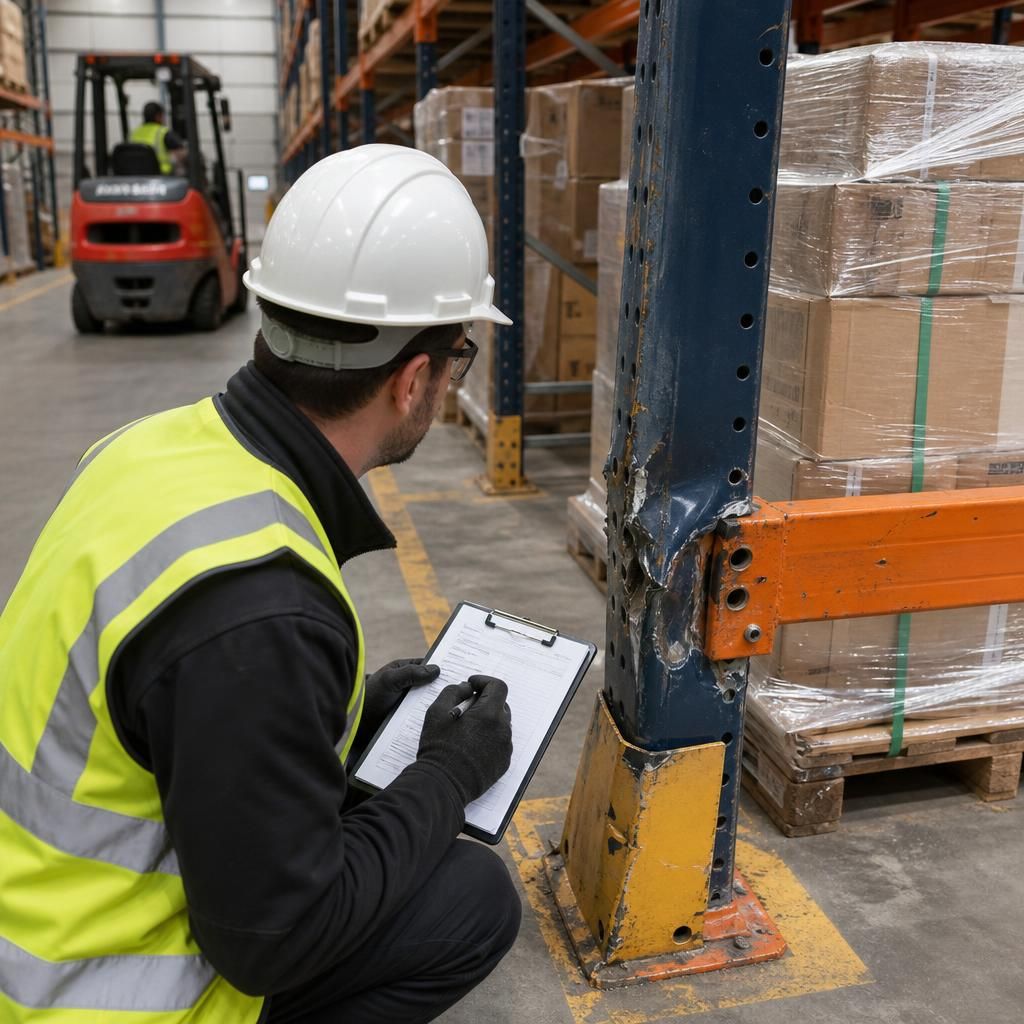
Neglecting regular warehouse racking safety inspections allows damage, overloading and instability to remain undetected until they affect the safe performance of the installation. Forklift impacts, damaged beams, loose fixings, missing safety pins and poorly distributed loads can worsen over time, increasing the risk of falling goods, collapse, injury and costly operational disruption.
A competent inspection identifies defects early so affected bays can be isolated, unloaded or repaired before they create a more serious hazard. Findings should be recorded, prioritised and followed through to completion. This provides practical control of warehouse racking risks and helps demonstrate that suitable safety arrangements are being actively maintained.
Arrange a Warehouse Racking Safety Inspection
Arrange a competent warehouse racking safety inspection with Able Racking to identify defects, control risks and support the safe operation of your storage system.