
How often should warehouse racking safety inspections be conducted?
Warehouse racking should receive a formal safety inspection by a technically competent person at least every 12 months, in line with HSE guidance and the manufacturer’s recommendations. In addition, trained staff should carry out regular visual checks—typically weekly or at an interval based on the risk assessment—and report damage immediately for assessment and repair.
A formal warehouse racking safety inspection should be carried out by a technically competent person at least every 12 months, in line with Health and Safety Executive guidance and the warehouse racking manufacturer’s recommendations. This annual inspection is not a replacement for routine checks: trained warehouse staff should complete visual inspections at an interval determined by the risk assessment, commonly weekly, and report damage immediately.
The correct inspection frequency depends on how the warehouse racking is used and the risks present. A warehouse with frequent vehicle movements, heavy or irregular loads, high traffic levels or a history of impact damage may require more frequent checks than the minimum annual inspection. The risk assessment should consider the layout, operating conditions, equipment used nearby, staff competence and the consequences of a warehouse racking failure.
A suitable inspection programme normally includes:
- Routine visual checks: trained employees should look for visible damage, displaced components, missing safety devices, leaning frames, overloaded beams and other signs of deterioration.
- Regular documented inspections: the frequency should be set by the risk assessment and may be weekly or another appropriate interval. Findings should be recorded, including the location, condition and any action required.
- Formal expert inspections: a technically competent inspector should assess the complete warehouse racking system at least annually, or more often where the risk assessment or manufacturer requires it.
- Immediate reporting: damage or suspected instability should be reported as soon as it is identified, rather than waiting for the next planned inspection.
- Post-incident checks: warehouse racking should be assessed after an impact, overloading event, alteration, structural change, unusual movement or other incident that could affect its safety.
Routine visual checks are intended to identify obvious problems early. They should cover uprights, bracing, beams, connectors, baseplates, floor fixings, guards, safety pins, load notices and the condition of stored loads. Staff should also look for signs that the warehouse racking has been struck by handling equipment, including dents, bends, splits, loose fixings or components that have moved from their intended position.
Employees carrying out these checks should know what defects to look for and how to escalate them. They are not expected to make structural engineering judgements or decide that damaged warehouse racking is safe to use. Where there is doubt, the affected section should be isolated or unloaded in accordance with the site’s procedures until it has been assessed by a competent person.
The formal annual inspection is more detailed. The inspector should examine the warehouse racking system systematically, review previous inspection records and consider whether identified defects have been addressed. The inspection should also take account of changes to the workplace, such as new handling equipment, revised load configurations, changes in operating practices or alterations to the warehouse racking layout.
There is no single interval that is suitable for every warehouse. A risk assessment may justify inspections more frequently than once a year where the system is exposed to repeated impacts, demanding working conditions or significant changes in use. Conversely, a lower-risk environment may still need a documented routine-check process even when no problems have previously been found. A clean inspection history does not remove the need for ongoing checks.
Inspections should be brought forward when any of the following occurs:
- the warehouse racking has been hit by a forklift, pallet truck or other handling equipment;
- loads have fallen, shifted or exceeded the stated capacity;
- components have been removed, replaced or altered;
- the layout, floor conditions or surrounding operations have changed;
- there is visible corrosion, cracking, distortion or deterioration;
- the warehouse racking has been subjected to an unusual load or incident; or
- staff report vibration, movement, instability or repeated damage.
Every inspection should produce a clear record. This should identify the warehouse racking inspected, the date, the person completing the inspection, defects found, the risk category or required priority, and the corrective action taken. Records help demonstrate that the inspection programme is active and allow recurring damage or unresolved repairs to be identified.
Inspection frequency should be reviewed whenever the risk assessment changes, after a significant incident or when operating conditions develop. The manufacturer’s instructions, the system’s design and the advice of a technically competent inspector should also be considered. Keeping the annual formal inspection, routine staff checks and prompt defect reporting together provides a more reliable approach than relying on any one inspection alone.
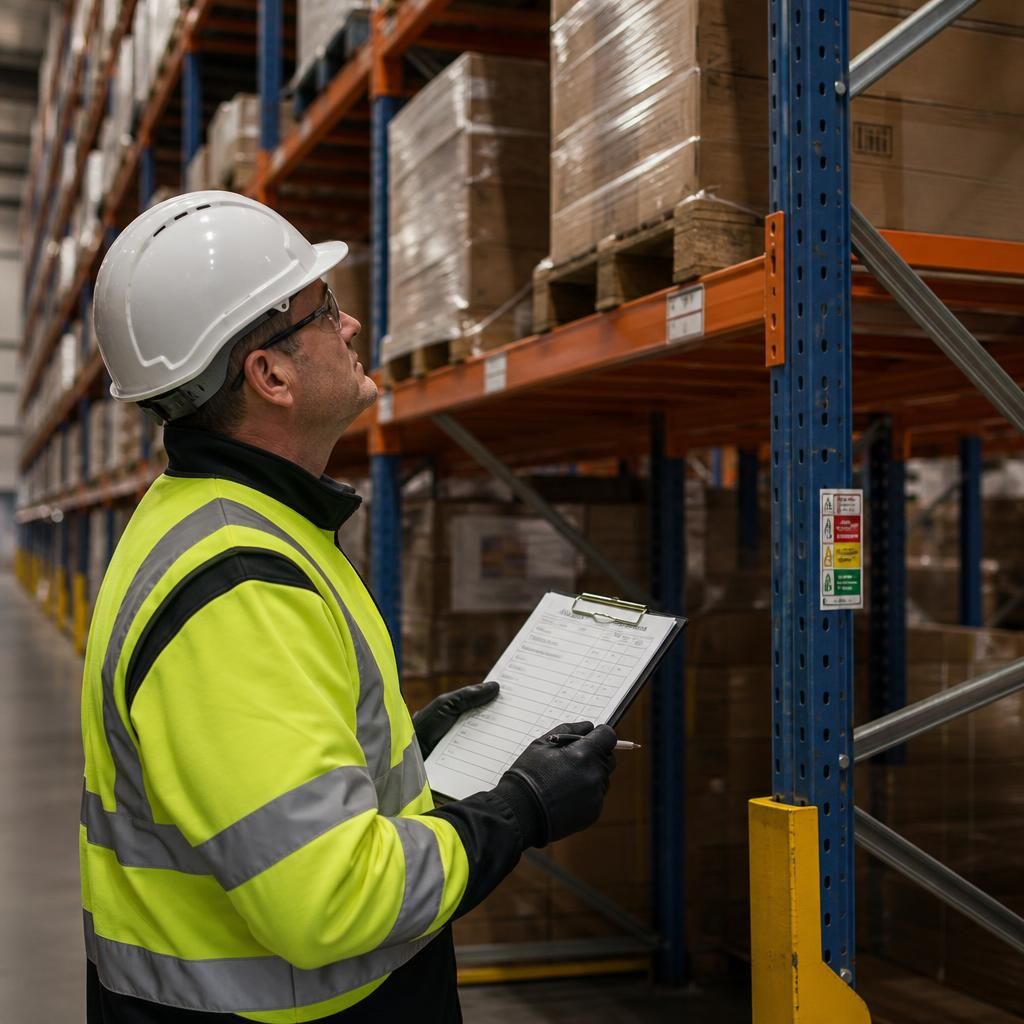
Warehouse racking should undergo a formal inspection by a technically competent person at least every 12 months, with the exact frequency adjusted to the risks identified at the site. This annual assessment should be supported by routine visual checks from trained staff, particularly where vehicle movements, heavy loads or previous impact damage increase the likelihood of defects.
Inspections should also be brought forward after an impact, overload, alteration, unusual movement or other incident that could affect stability. Any damaged area should be reported immediately and isolated or unloaded in line with site procedures until a competent person has assessed it. Keeping clear records of findings and corrective actions helps confirm that defects are dealt with promptly rather than waiting for the next scheduled inspection.
Book your next warehouse racking safety inspection
Book your next warehouse racking safety inspection with Able Racking to confirm your system remains safe, compliant and fit for use. Contact our experienced inspection team to arrange an assessment suited to your site’s operating conditions and risk profile.