
How often should warehouse racking inspections be conducted to maintain safety and compliance?
Warehouse racking should receive routine visual checks at intervals based on your risk assessment, with a recorded expert inspection carried out at least every 12 months. Arrange additional inspections after impact, structural changes, relocation, unusual loading or any event that could affect warehouse racking safety.
Warehouse racking should be checked routinely according to the site-specific risk assessment, with a recorded expert inspection carried out at least every 12 months. More frequent inspections may be necessary where there is heavy forklift traffic, high turnover, demanding loading conditions, previous damage or other significant risks. An additional inspection should be arranged after an impact, structural alteration, relocation, unusual loading or any event that could affect warehouse racking safety.
The inspection frequency should form part of the warehouse’s documented safety arrangements. The responsible person should consider the type, age and condition of the warehouse racking, the way it is loaded and used, the competence of operators, traffic routes, environmental conditions and the consequences of a failure. A risk assessment should then define the appropriate checking and inspection schedule rather than relying on a fixed interval alone.
Daily or ongoing checks
Warehouse racking should be observed during normal operations so that obvious problems can be identified promptly. Operators should report impacts, displaced loads, missing components, bent members, loose connections and other changes as soon as they are noticed. These checks are not a substitute for a formal inspection, but they help prevent a minor defect from becoming a serious safety issue.
Staff carrying out routine checks should know what to look for and how to report it. They should not attempt to straighten, remove or repair damaged warehouse racking unless they are authorised and suitably competent to do so. Any unsafe area should be assessed immediately, with loads removed or access restricted where necessary.
Regular visual inspections
A suitably trained person should complete regular visual inspections at the interval set by the risk assessment. The frequency may need to increase in areas exposed to frequent vehicle movements, repeated impacts, high or unstable loads, harsh conditions or intensive operational change. The inspection should be recorded, including the date, areas examined, defects found, actions required and the person responsible for completing those actions.
Regular visual inspections commonly consider the condition and alignment of frames, uprights, beams, bracing, connectors, guards, floor fixings and load-supporting components. They should also check for overloading, poor load distribution, protruding goods, unauthorised alterations and changes that could affect the safe use of the warehouse racking.
Expert inspections
A recorded inspection by a technically competent warehouse racking inspector should take place at least annually, or more often where the risk assessment requires it. The inspector should assess the installation systematically, review reported damage and identify defects that may not be apparent during routine operational checks. The findings should be documented in a clear report, with priorities and recommended remedial action.
An expert inspection does not remove the need for day-to-day vigilance. It provides a structured assessment of the warehouse racking and helps confirm whether existing controls, maintenance arrangements and operating practices remain suitable.
When an additional inspection is required
- After a collision involving a forklift, pallet truck or other vehicle.
- When a load has fallen, shifted or exceeded the stated capacity.
- Following alterations, extensions, relocation or changes to the layout.
- When components have been replaced, removed or modified.
- After an unusual event such as fire, flooding, significant vibration or building movement.
- When repeated defects, unsafe loading practices or poor housekeeping are identified.
- Before returning an affected area to normal use after repairs or isolation.
Any visible damage should be assessed without waiting for the next planned inspection. Where the condition could compromise stability or safe loading, the affected section should be taken out of service or clearly isolated until a competent person has determined the appropriate action. Repairs should follow the manufacturer’s requirements and be completed by suitably qualified personnel; damaged components should not be improvised or altered on site.
Keeping the inspection programme effective
Inspection records should be retained with the warehouse’s safety documentation and reviewed when operating conditions change. The responsible person should confirm that reported defects are closed out, repairs have been checked and any recurring damage has prompted a review of traffic management, operator training, load control or protection measures.
In practice, the safest approach is a layered programme: routine observations by warehouse staff, documented visual checks at risk-based intervals and a formal expert inspection at least every 12 months. This approach supports ongoing compliance with UK workplace safety expectations while allowing the inspection schedule to reflect the actual risks and use of the warehouse racking.
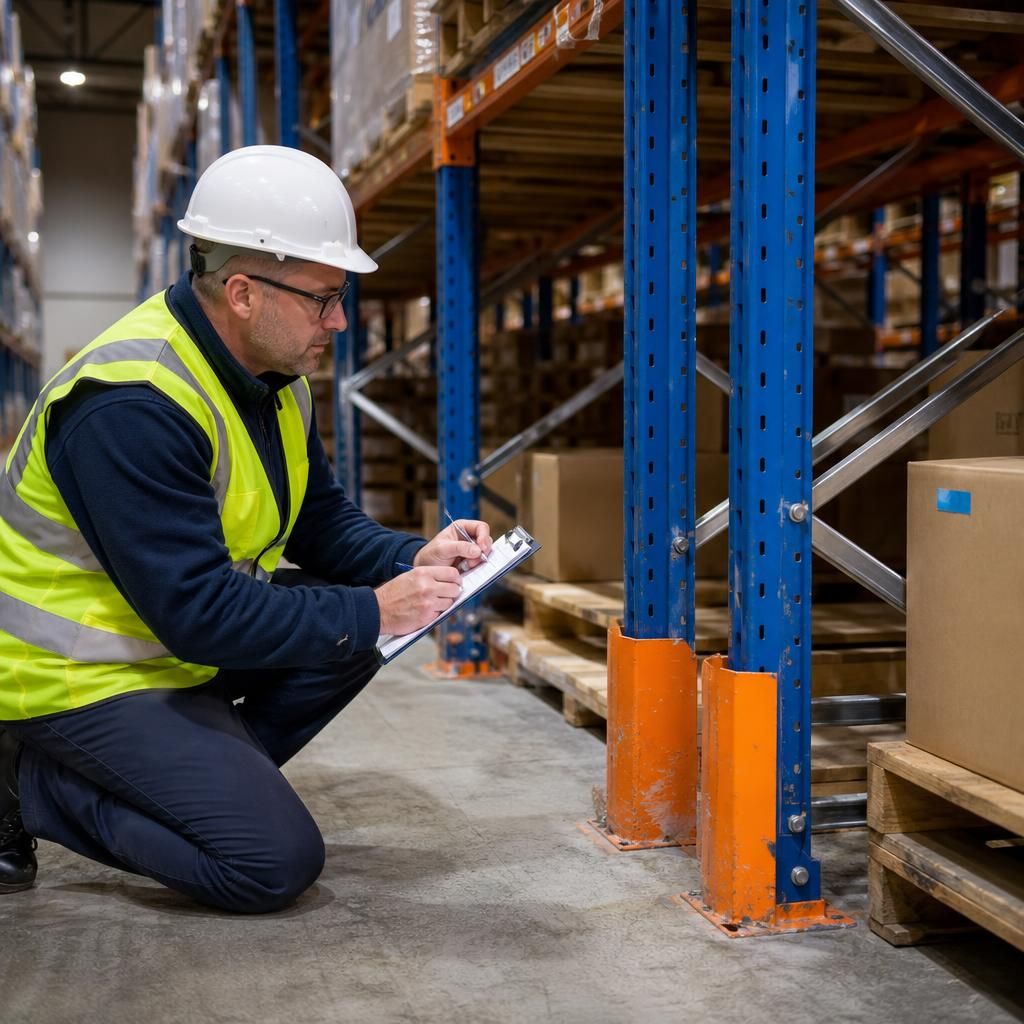
Warehouse racking inspections should follow a risk-based schedule, with routine visual checks during normal operations and a recorded inspection by a technically competent inspector at least every 12 months. Higher-risk areas may require more frequent checks where there is heavy vehicle movement, repeated impact, demanding loading or a history of damage.
An additional inspection is necessary after any collision, dropped or shifted load, alteration, relocation or other event that could affect stability. If damage is visible, isolate the affected area and arrange an assessment immediately rather than waiting for the next planned inspection.
Arrange Your Warehouse Racking Inspection
Arrange your warehouse racking inspection with Able Racking to confirm that your storage systems remain safe, compliant and fit for use. Contact our experienced inspection team to discuss your requirements and schedule a suitable assessment.