
What are the common hazards identified during HSE warehouse racking inspections that businesses should be aware of? Common hazards include impact damage, overloading, missing or damaged components, inadequate protection, unstable loads and poor housekeeping. Identifying these issues early helps prevent collapses, protect staff and maintain compliance.
Common hazards identified during HSE warehouse racking inspections include impact damage, overloading, missing or damaged components, inadequate protection, unstable loads and poor housekeeping. Finding these issues early helps prevent structural failures, protect employees, reduce product damage and support ongoing compliance.
The common hazards identified during HSE warehouse racking inspections are impact damage, overloading, missing or altered components, inadequate protection, unstable loads, poor housekeeping and unsafe working practices. These defects can reduce the structural stability of warehouse racking, increase the risk of falling goods or collapse, and expose employees and visitors to avoidable harm.
A competent inspection assesses the condition and use of the complete warehouse racking system, not just visible damage to the frames. Inspectors consider the design, loading information, protection measures, operating environment, previous repairs and the way warehouse staff use the installation. The findings should be recorded clearly, prioritised according to risk and followed by suitable corrective action.
Impact damage to frames and components
Forklift and other materials-handling equipment impacts are among the most frequent hazards. Damage may affect uprights, bracing, beams, footplates, guards and connections. A frame can remain standing while its load-bearing capacity has been reduced, so apparently minor dents, bends, splits or dislodged components should not be dismissed.
Inspectors look for damage at floor level, at aisle ends and at locations where vehicles manoeuvre or place loads. They also check whether previously damaged components have been properly replaced rather than straightened or improvised. Where damage presents an immediate risk, the affected area may need to be unloaded, isolated and repaired before it is returned to service.
Overloading and incorrect load distribution
Warehouse racking is designed for defined loads, beam spans, bay arrangements and loading conditions. Hazards arise when pallets exceed the stated capacity, loads are concentrated unevenly, beam levels are altered without assessment or the safe working load information is missing. Overloading can cause excessive deflection, connection failure or progressive collapse.
Inspectors compare the installation and its use with the available design and load information. They consider pallet weight, size, condition and placement, along with the number of levels being used. Load notices should be present, legible and consistent with the actual configuration. Staff should never rely on estimates where load limits are uncertain; the capacity should be confirmed by a suitably qualified person.
Missing, loose or incompatible components
Warehouse racking depends on correctly fitted frames, beams, braces, locking devices, baseplates and fixings working together. Missing beam locks, loose anchors, displaced braces or incompatible replacement parts can weaken the system. Unauthorised alterations, including removing a beam or changing its position, may also invalidate the original design assumptions.
An inspection checks that components are present, correctly seated and suitable for the system. It also considers evidence of unauthorised modifications and whether repairs have used approved parts. Components should not be substituted or modified on site without technical approval and, where necessary, a review of the design.
Inadequate protection and poor floor conditions
Where vehicles operate close to warehouse racking, insufficient protection can leave uprights and corners vulnerable to repeated impact. Inspectors assess the suitability, position and condition of frame guards, end-of-aisle protection, barriers and other protective measures. Protection that is detached, damaged or incorrectly positioned may provide little practical benefit.
The floor and anchorage arrangements are also relevant. Cracked or uneven surfaces, inadequate fixings, settlement or water damage can affect alignment and stability. Inspectors consider whether the installation remains plumb and whether its foundations and connections are appropriate for the working environment.
Unstable, damaged or poorly placed loads
Loads that overhang, lean, shift or project into an aisle create risks even when the warehouse racking itself appears undamaged. Broken pallets, loose packaging, unsupported goods and unsuitable pallet sizes can allow products to fall. Loads placed too close to an aisle edge may also be struck by handling equipment or obstruct safe movement.
Inspectors check that pallets are suitable for the beam arrangement, positioned correctly and supported adequately. They look for gaps, excessive overhang, damaged pallets and goods stored above the permitted level. Appropriate load restraints, decking or other measures may be needed where the stored products cannot remain stable without additional support.
Obstructed aisles and poor housekeeping
Waste packaging, spillages, loose goods and stored items in access routes can restrict inspections, emergency movement and materials handling. Poor housekeeping also increases the likelihood of vehicle impacts and makes damage harder to identify. Blocked fire equipment, emergency exits or pedestrian routes should be treated as an immediate safety concern.
A suitable inspection considers whether aisles are kept clear, floor surfaces are maintained and stock is stored within designated areas. Good housekeeping is a continuing control rather than a one-off repair. Supervisors should address recurring obstructions, not simply remove them when an inspection is due.
Unsafe use and inadequate operating controls
Unsafe practices can create hazards even where the physical installation is in good condition. Examples include climbing on warehouse racking, placing loads by striking beams, using unsuitable handling equipment, exceeding designated operating clearances and allowing pedestrians to mix with vehicle movements without effective controls.
Inspectors may identify whether signage, traffic routes, access arrangements and working procedures are consistent with the installation. They may also highlight the need for operator training, supervision or a review of the risk assessment. Employees should understand load limits, damage-reporting arrangements, exclusion zones and the action to take when a defect is found.
Corrosion, deterioration and environmental damage
Corrosion, moisture, chemical exposure, heat and poor lighting can affect components and make defects more difficult to see. These conditions may be particularly important in areas exposed to leaks, cleaning processes, temperature changes or aggressive substances. Inspectors assess whether deterioration has affected the strength, visibility or serviceability of the system.
They also consider lighting and visibility in aisles, since inadequate illumination can contribute to loading errors, vehicle impacts and missed damage. Remedial measures may include improving housekeeping, controlling moisture, replacing affected components or obtaining a technical assessment of the remaining capacity.
What businesses should do when a hazard is found
- Record the defect, its location, the affected bay or component and any relevant photographs.
- Assess whether the risk requires immediate unloading, isolation or restricted access.
- Use the inspection findings to classify defects by urgency and assign responsibility for each action.
- Replace damaged components with suitable, approved parts rather than carrying out unapproved repairs.
- Reinspect repaired areas before loading them again, where the repair process or risk assessment requires this.
- Review loading practices, traffic management, training and supervision if the defect resulted from how the system is being used.
- Keep inspection, repair and alteration records so that the condition of the installation can be monitored over time.
HSE warehouse racking inspections are most effective when their findings lead to prompt, documented action. A clear inspection report should distinguish between damage requiring immediate attention, defects requiring repair within a defined period and lower-risk observations that still need monitoring. Regular visual checks by trained staff, supported by competent formal inspections, help identify new hazards before they become more serious.
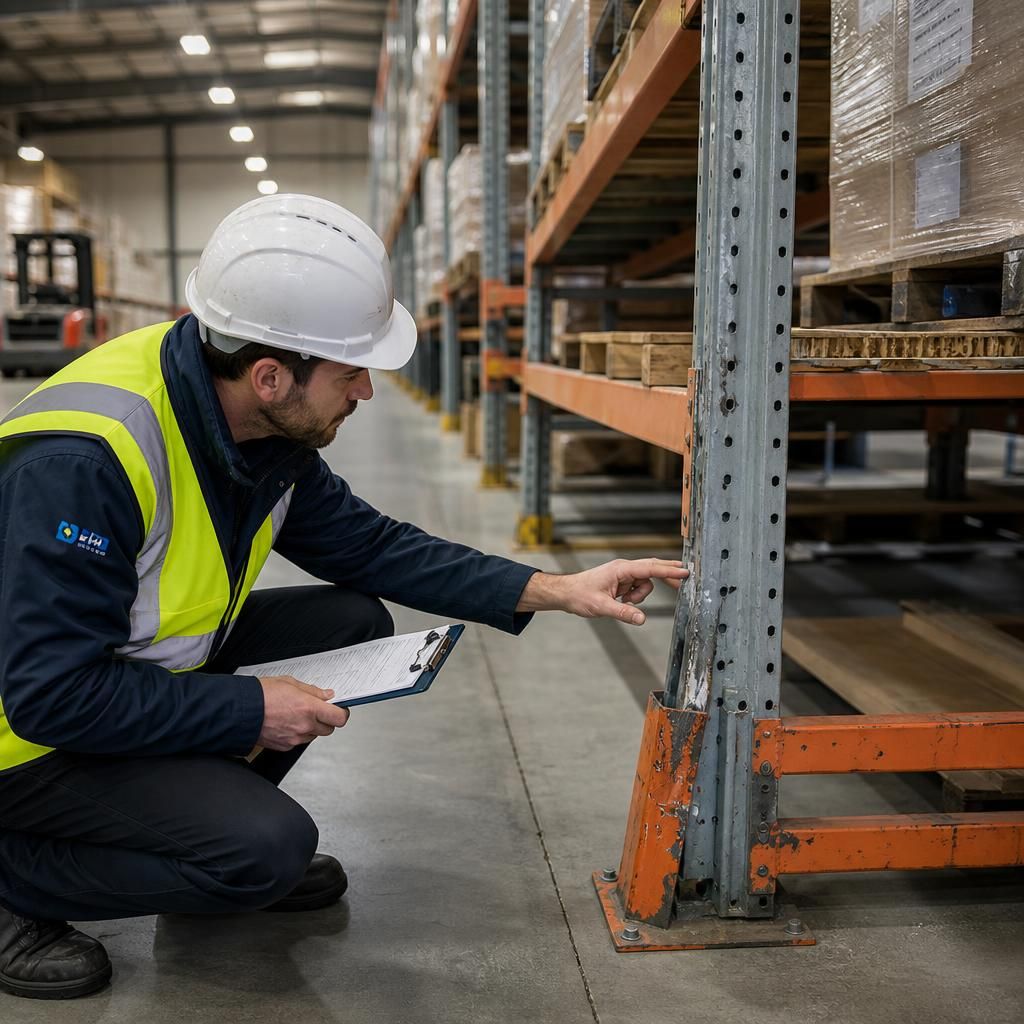
Impact damage is one of the most important hazards identified during HSE warehouse racking inspections. Forklift contact can bend uprights, loosen connections or damage bracing without causing an immediate collapse. Inspectors assess the location and severity of damage, then advise whether the affected bay should be unloaded, isolated or repaired before it is used again.
Damaged components should not be straightened or altered on site. They should be replaced with suitable, approved parts, followed by a check that the repair has restored the warehouse racking to a safe and serviceable condition.
Book Your HSE Warehouse Racking Inspection
Book your HSE warehouse racking inspection with Able Racking to identify hazards, prioritise remedial work and support safe, compliant operations.