
How frequently should warehouse racking safety inspections be conducted?
Warehouse racking safety inspections should include routine visual checks at intervals based on your risk assessment, with a thorough inspection by a technically competent person at least every 12 months. Inspect immediately after any impact, significant change, or reported damage, and follow the manufacturer’s guidance and HSE recommendations.
Warehouse racking safety inspections should be carried out at intervals determined by a documented risk assessment, with routine visual checks throughout normal operations and a thorough inspection by a technically competent person at least every 12 months. An inspection should also take place immediately after any impact, significant alteration, abnormal event or report of damage. The exact frequency should reflect the condition and use of the warehouse racking, rather than relying on a fixed timetable alone.
UK health and safety guidance expects employers to maintain warehouse racking in a safe condition and to arrange regular systematic inspections. The inspection programme should be based on factors such as:
- the type, age and condition of the warehouse racking;
- the loads stored, including their weight, size and stability;
- the frequency of forklift truck and other vehicle movements;
- the level of activity, traffic and risk of impact;
- the working environment, including temperature, damp, corrosion and housekeeping;
- any previous damage, recurring defects or repair history; and
- changes to the layout, beams, frames, load configuration or operating arrangements.
Routine visual checks should be completed by people who have been instructed to recognise obvious damage and unsafe conditions. These checks can be incorporated into normal warehouse supervision and should cover upright frames, beams, bracing, connectors, protection, decking, baseplates, floor fixings and load signs. The person carrying out the check should look for impact damage, distortion, missing components, loose fixings, corrosion, overloading, displaced loads and any signs that the warehouse racking is unstable.
Routine checks are not a replacement for an independent or suitably competent inspection. Their purpose is to identify problems promptly between formal inspections. Staff should know how to report concerns and what action to take if damage is found. Where a defect could affect stability or safe use, the affected area should be isolated or unloaded in accordance with the site’s safety procedure until it has been assessed.
Formal inspections should be completed at least annually by a technically competent person with suitable knowledge and experience of warehouse racking safety. The inspector should assess the system systematically, consider the findings of routine checks, identify the likely seriousness of defects and provide a written report. A competent inspection is more than a visual walk-through: it should consider the design, loading arrangements, protection measures, operating environment and whether the warehouse racking continues to be suitable for the way it is being used.
The annual interval is a minimum commonly used for a thorough inspection. A shorter interval may be appropriate where the risk assessment identifies higher exposure to impact or deterioration. For example, more frequent formal inspections may be necessary in a busy distribution environment, where forklift movements are concentrated around access points, or where previous damage has been identified. The responsible person should review the inspection frequency when working methods, storage requirements or site conditions change.
Additional inspections are required after specific events. Do not wait for the next planned inspection if warehouse racking has been struck by a forklift truck, loading equipment or stored goods. An assessment should also be arranged after an alteration, relocation, change in loading requirements, structural event, fire, flood or other incident that could affect its condition. Any reported concern from an operative should be investigated promptly, even if the damage is not immediately visible.
Inspection findings should be recorded and tracked through to completion. A useful record identifies the location and component affected, describes the defect, states the risk classification or required priority, names the person responsible for action and confirms when the issue was resolved. Keep inspection reports, photographs, repair records, load information and relevant manufacturer documentation together so that the condition and history of the warehouse racking can be reviewed over time.
Where damage is found, repairs should be carried out by a suitably experienced person using compatible components and an appropriate method. Straightening or improvised repairs should not be used unless they have been assessed and approved as suitable. Following repair, the affected warehouse racking should be checked before it is returned to service, and any revised loading or operating restrictions should be communicated to the warehouse team.
A written inspection schedule should therefore include:
- routine visual checks at a frequency justified by the risk assessment;
- a documented thorough inspection at least every 12 months by a technically competent person;
- immediate checks following impact, damage, alteration or another significant event;
- clear reporting and escalation arrangements for defects;
- records showing inspection findings and completed corrective action; and
- a review whenever the warehouse operation or storage system changes.
Following this approach helps maintain HSE compliance, identify deterioration before it becomes a serious hazard and protect people, stock and warehouse operations. If the risk assessment does not clearly justify the current interval, it should be reviewed by a competent warehouse racking safety professional rather than assuming that an annual inspection alone is sufficient.
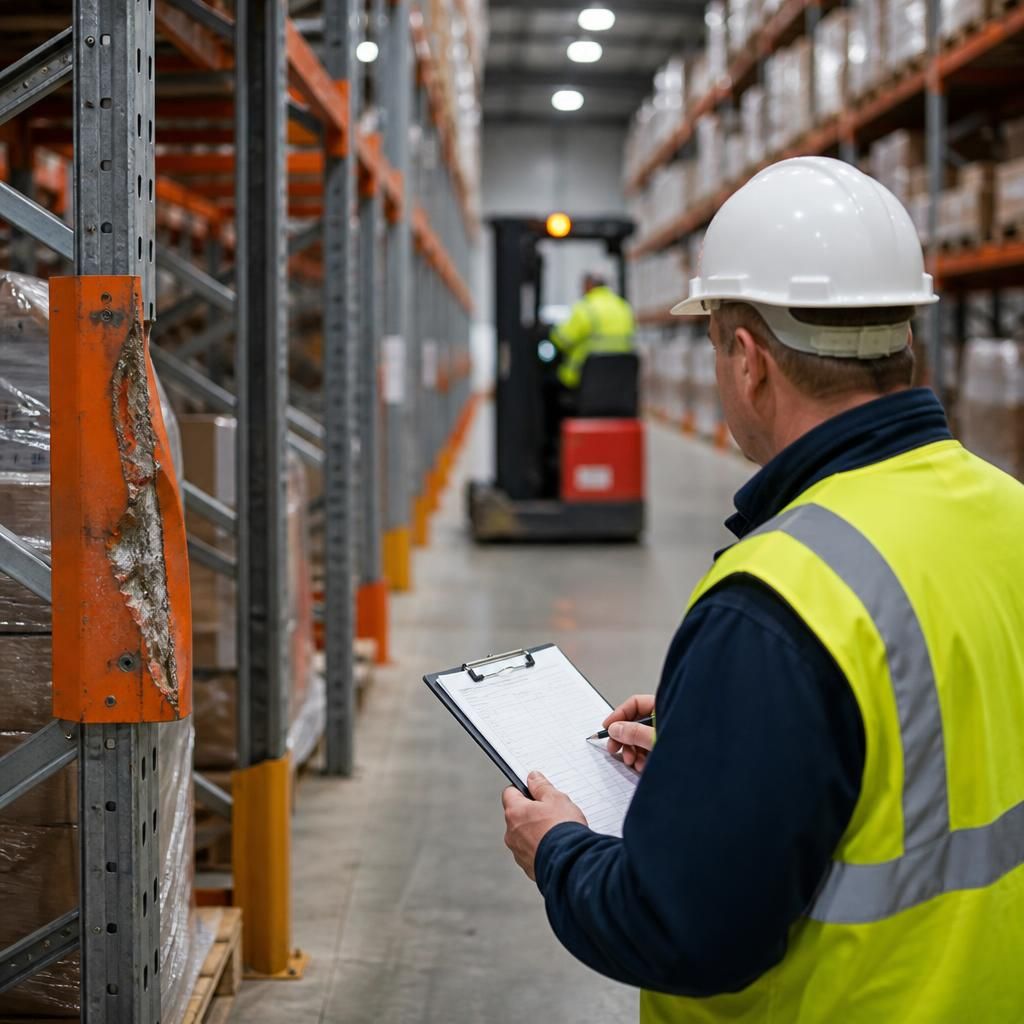
Warehouse racking should be checked immediately after a forklift impact, significant alteration, abnormal event or report of damage; do not wait for the next scheduled inspection. Even damage that appears minor can affect the stability of frames, beams, connectors or protective components.
Where a defect could affect safe use, isolate the affected area or unload it in line with your site procedure until a technically competent person has assessed it. Record the finding, arrange suitable repairs and confirm the warehouse racking is safe before returning it to service.
Arrange your warehouse racking safety inspection
Arrange your warehouse racking safety inspection with Able Racking to confirm that your system remains safe, compliant and suitable for current operations. Contact our experienced inspection team to discuss your requirements and the appropriate inspection frequency.