
What specific certifications and training should warehouse racking repair technicians have?
Warehouse racking repair technicians should have documented competence in racking systems, relevant manufacturer or SEMA training, and a sound understanding of HSE guidance, PUWER and BS EN 15635. Where the work requires specialist access or hot work, they should also hold appropriate IPAF, PASMA or welding qualifications and be trained to follow risk assessments, safe systems of work and site procedures.
Warehouse racking repair technicians should have documented competence in the type of storage system being repaired, relevant manufacturer or SEMA training where applicable, and a working knowledge of HSE guidance, PUWER and BS EN 15635. They should also be trained to follow risk assessments, method statements, permit systems and site rules. Additional qualifications are needed where the work involves specialist access equipment, work at height, welding or other higher-risk activities.
There is not one universal certificate that makes a person competent to repair every warehouse racking system. Competence depends on the technician’s knowledge, practical experience, supervision, understanding of the particular system and ability to recognise when a repair is outside their authority. A responsible contractor should be able to provide training records, evidence of experience and details of the procedures used to control the work.
Relevant training and competence normally include:
- Storage system training: Technicians should understand the construction and behaviour of pallet, drive-in, cantilever and other warehouse racking systems they work on. This includes identifying frames, beams, bracing, baseplates, anchors, guards and load-bearing components.
- Manufacturer or specialist training: Training from the system manufacturer, a recognised industry body or an appropriately experienced specialist helps technicians understand approved components, tolerances, repair limitations and installation requirements. SEMA-related training may be relevant where it matches the technician’s role and the system involved.
- BS EN 15635 awareness: Technicians should understand the principles in BS EN 15635 for the use and maintenance of steel static storage systems. This includes damage classification, reporting, isolation of unsafe areas, load notices, inspection arrangements and the need to use suitable replacement components.
- Health and safety training: Technicians need to apply the Health and Safety at Work etc. Act, the Management of Health and Safety at Work Regulations and relevant HSE guidance in practice. They should understand risk assessments, safe systems of work, emergency arrangements and communication with warehouse personnel.
- PUWER awareness: Where powered tools, lifting equipment or other work equipment are used, technicians should understand the Provision and Use of Work Equipment Regulations and the associated inspection, maintenance and safe-use requirements.
- Work-at-height training: Repairs carried out above ground level require suitable work-at-height training, including selecting safe access equipment, preventing falls and controlling dropped objects. IPAF training may be appropriate for mobile elevating work platforms, while PASMA training may be appropriate for certain forms of mobile access tower.
- Manual handling and lifting training: Technicians should know how to plan the movement of beams, frames and replacement components, use mechanical aids correctly and avoid destabilising the surrounding structure during a repair.
- Tool and equipment training: This should cover the safe use of drills, torque tools, cutting equipment, lifting accessories and any other equipment used during the work. Inspection and pre-use checks should be understood and recorded where required.
- Hot-work or welding qualifications: If a repair involves welding, burning or other hot work, the operative should hold suitable welding competence for the process and materials involved. The work should also be controlled through a hot-work permit, fire precautions and post-work monitoring where the site requires these measures.
- Site-specific induction: Technicians should be briefed on vehicle routes, pedestrian segregation, warehouse traffic, fire procedures, emergency contacts, isolation arrangements and local operating rules before starting work.
Technicians should also be able to distinguish between a minor, controlled repair and damage that requires the affected bay or area to be unloaded and taken out of service. They must not simply straighten, drill, weld or replace a component without checking the cause and extent of the damage. A competent repair assessment considers whether frames have moved, anchors or floors have been affected, connected components remain secure and the repaired system will continue to carry its stated load safely.
For many repairs, the technician will work from an approved method statement or manufacturer’s instructions. These documents should identify the components being replaced, the equipment required, the sequence of work, exclusion zones, temporary stability measures, torque requirements and final checks. If the proposed repair changes the design, capacity or configuration of the system, it may require review by the manufacturer or a suitably qualified storage equipment designer rather than an improvised site modification.
Evidence of competence should be current and relevant to the task. Useful records include training certificates, refresher training, toolbox talks, equipment authorisations, manufacturer instructions, previous repair experience and supervisor sign-off. Certificates alone are not enough if the operative has not carried out comparable work recently or cannot demonstrate that they understand the system and the associated hazards.
Before work begins, the repair technician should be able to explain the planned controls and identify when the job must stop. This includes unexpected damage, missing components, unstable loads, concealed services, unsuitable access, unsafe traffic conditions or a discrepancy between the installation and the available drawings. Escalating these issues is an important part of competence and helps prevent an unsafe repair from being treated as complete.
After the repair, a competent technician should check that the correct components have been installed, fixings and anchors are secure, protective measures are reinstated and the area is safe to return to service. The completed work should be documented with the repair details, any limitations, photographs where appropriate and recommendations for further action. The warehouse operator should also be told if inspections, unloading, monitoring or additional remedial work remains necessary.
When selecting a repair contractor, ask for confirmation of the technicians’ relevant training, access and equipment qualifications, manufacturer or specialist experience, supervision arrangements and repair documentation. It is also sensible to check that the contractor’s risk assessments and safe systems of work address the particular warehouse environment rather than relying on a generic document. Able Racking uses experienced operatives and structured safety procedures to ensure that repairs are assessed, carried out and recorded in line with the requirements of the installation and the working conditions on site.
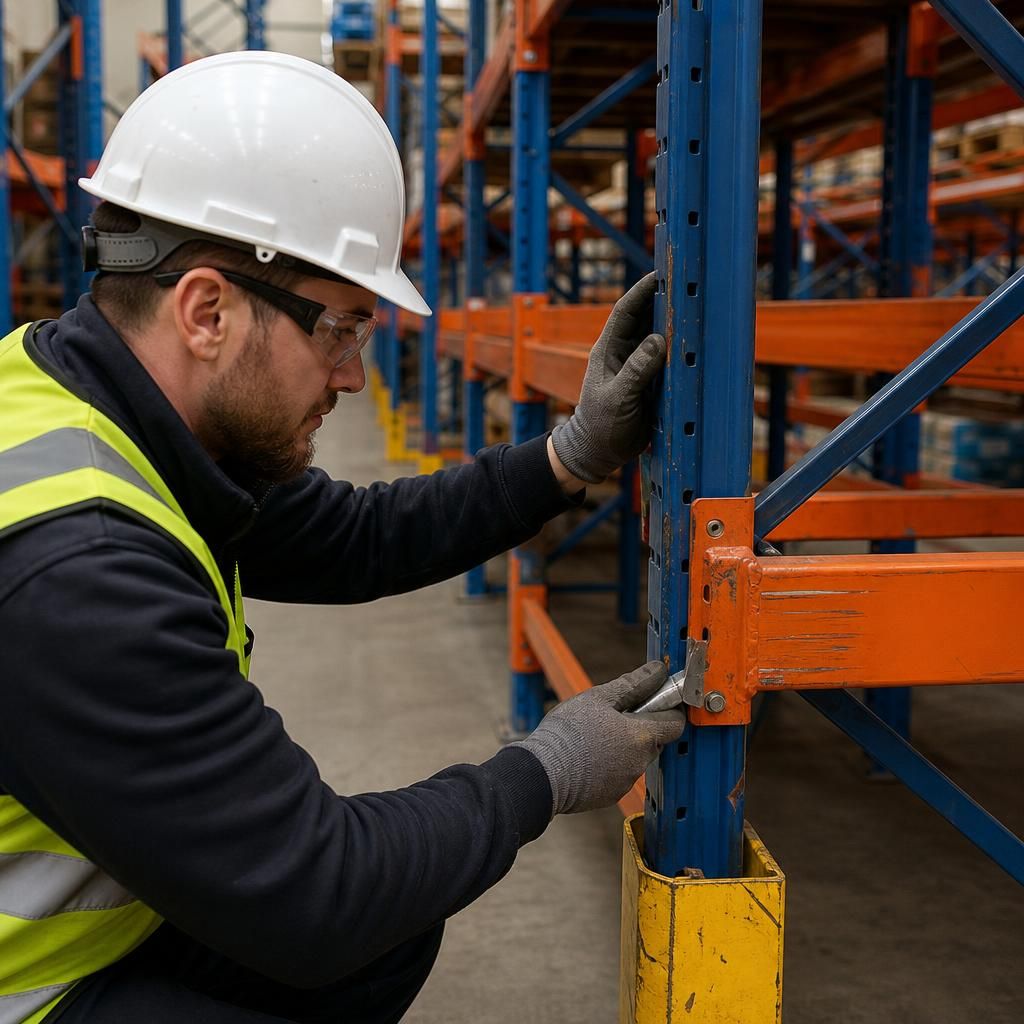
Certification is only one part of a warehouse racking repair technician’s competence. The technician should also have relevant practical experience, understand the specific storage system being repaired and know how to apply BS EN 15635 principles, manufacturer instructions and site safety procedures.
Before work starts, the contractor should be able to provide suitable training records, equipment authorisations and evidence of comparable repair work. Additional training may be necessary for work at height, powered access, lifting equipment, hot work or welding. Certificates should be current and relevant to the task rather than treated as a substitute for practical ability.
A competent technician will also recognise when a repair must stop or be escalated. Unstable loads, significant frame movement, damaged anchors, missing components or changes affecting load capacity may require specialist assessment before the warehouse racking is returned to service. The completed repair should be checked, documented and clearly communicated to the warehouse operator.
Discuss Your Warehouse Racking Repair Technician Requirements
Speak to Able Racking about your warehouse racking repair technician requirements, including relevant training, practical experience and task-specific competence. We can help confirm the appropriate qualifications and safety controls for your repair work.