
How does the repair process align with current safety standards and industry guidelines for warehouse racking?
Warehouse racking repairs should follow a documented risk assessment, the manufacturer’s instructions, relevant UK health and safety requirements, HSE guidance such as HSG76, and applicable standards including BS EN 15635. A competent technician should assess the damage, specify an appropriate repair or replacement, control the affected area, complete the work correctly and record the inspection and sign-off before the system returns to service.
Warehouse racking repairs align with current safety standards when they are controlled through a documented risk assessment, completed by competent technicians and verified before the affected storage system is returned to service. The process should follow the rack manufacturer’s instructions, relevant UK health and safety duties, HSE guidance such as HSG76, and applicable standards including BS EN 15635 and relevant SEMA guidance.
Compliance is not achieved simply by replacing a visibly damaged component. The repair must address the cause and extent of the damage, preserve the design capacity of the warehouse racking system and provide a clear record showing what was found, what action was taken and who authorised the return to service.
How the repair process supports compliance
- Initial reporting and isolation: Damage should be reported to the person responsible for warehouse racking safety as soon as it is identified. The affected bay, aisle or section should be assessed and controlled immediately. Where damage presents a serious risk, the area may need to be unloaded, isolated or taken out of use until a competent assessment has been completed.
- Competent inspection: A suitably trained and experienced technician examines the damaged frame, upright, beam, connector, bracing, protection or associated component. The inspection considers deformation, cracking, missing or loose parts, impact marks, corrosion, instability and any effect on the surrounding structure.
- Risk classification: The observed condition is assessed according to its severity and likely effect on structural performance. BS EN 15635 provides a recognised framework for reporting damage and prioritising corrective action. Serious damage generally requires immediate control, while less severe damage still needs a defined repair timescale and continued monitoring where appropriate.
- Technical decision: The technician determines whether the component can be repaired using an approved method or must be replaced. This decision should take account of the original design, load capacity, component compatibility, manufacturer’s requirements and the condition of connected parts. Straightening, welding, drilling or improvised reinforcement should not be used unless it has been specifically designed and approved as suitable.
- Safe repair or replacement: Work is planned to protect employees, contractors, stock and handling equipment. The affected area is controlled, loads are removed where necessary and suitable access equipment and personal protective equipment are used. Replacement parts should be compatible with the existing system and installed in accordance with the relevant technical instructions.
- Post-repair verification: On completion, the repaired area is checked for correct fit, secure connections, alignment, stability, protection and any remaining damage. The system should not be returned to normal use until the competent person is satisfied that it is safe and suitable for its intended loading.
- Documentation and communication: Findings, photographs where useful, repair details, replaced components, outstanding actions and sign-off information should be recorded. Any revised loading information or operational restriction must be communicated clearly to the people using the warehouse racking.
Standards and guidance considered during an assessment
BS EN 15635 sets out principles for the use and maintenance of steel static storage systems. It supports a systematic approach to damage reporting, inspections, risk evaluation, repair and documentation. It also reinforces the importance of appointing a person responsible for warehouse racking safety and arranging regular expert inspections alongside routine internal checks.
HSG76 Warehousing and storage provides HSE guidance on managing risks in storage and warehouse operations. Its principles are relevant to traffic management, loading practices, safe working methods, inspection and maintenance. Repairs should therefore be considered alongside the activities that caused the damage, such as vehicle impact, overloading, poor load placement or inadequate aisle control.
The Health and Safety at Work etc. Act and the Management of Health and Safety at Work Regulations require risks to employees and others affected by the work to be assessed and controlled. In practice, this means the repair process should include suitable planning, competent people, safe access, appropriate supervision and effective communication.
Other requirements may apply depending on the work and the site. These can include the Provision and Use of Work Equipment Regulations where work equipment is used, the Work at Height Regulations where elevated access is involved, and the Control of Substances Hazardous to Health Regulations where substances such as coatings, cleaning products or welding-related materials are present. The applicable requirements should be confirmed through the site-specific risk assessment and method statement.
Why manufacturer information matters
Warehouse racking systems are designed as engineered assemblies. Components that appear similar may have different dimensions, steel grades, connection details or load characteristics. A compliant repair therefore uses the original manufacturer’s specifications wherever available, or a technically justified alternative assessed by a suitably competent person.
Load notices must remain accurate after repair or component replacement. If the configuration, beam levels, frame arrangement or component specification changes, the permitted load information should be reviewed before the system is used. Stock should never be reloaded on the assumption that a repaired bay has the same capacity without verification.
How repairs are controlled on site
- The reported damage is logged and the affected location is identified.
- The area is made safe, with stock or access restricted where the risk assessment requires it.
- A competent inspection establishes the damage mechanism, severity and likely effect on the system.
- A repair, replacement or further engineering assessment is specified using suitable technical information.
- The work is carried out under an agreed safe system of work by appropriately trained operatives.
- The completed work is inspected, checked against the specification and formally signed off.
- Records are updated and any recommendations, monitoring requirements or changes to operating practice are passed to the responsible site team.
This approach also helps prevent repeat damage. If a forklift impact caused the failure, for example, the corrective action may need to include improved end protection, revised traffic controls, operator briefing or changes to loading practice. Repairing the component without addressing the underlying cause may leave the warehouse racking exposed to the same risk.
What customers should expect from the repair record
A useful repair record should identify the location and type of damage, the findings of the assessment, the risk controls applied, the parts or methods used, the person completing and checking the work, and any restrictions or follow-up actions. It should be retained with inspection and maintenance records so that the condition of the warehouse racking can be tracked over time.
Repairs do not replace the need for ongoing management. Routine visual checks by trained site personnel, periodic expert inspections, prompt reporting of new damage and good loading discipline all contribute to continued compliance. Able Racking can use the inspection findings and repair history to help identify recurring risks and recommend preventative measures appropriate to the site.
Where the damage affects the design integrity of the system, the correct outcome may be replacement rather than repair. A competent assessment provides the evidence needed to make that decision and helps ensure that safety, capacity and operational continuity are considered together.
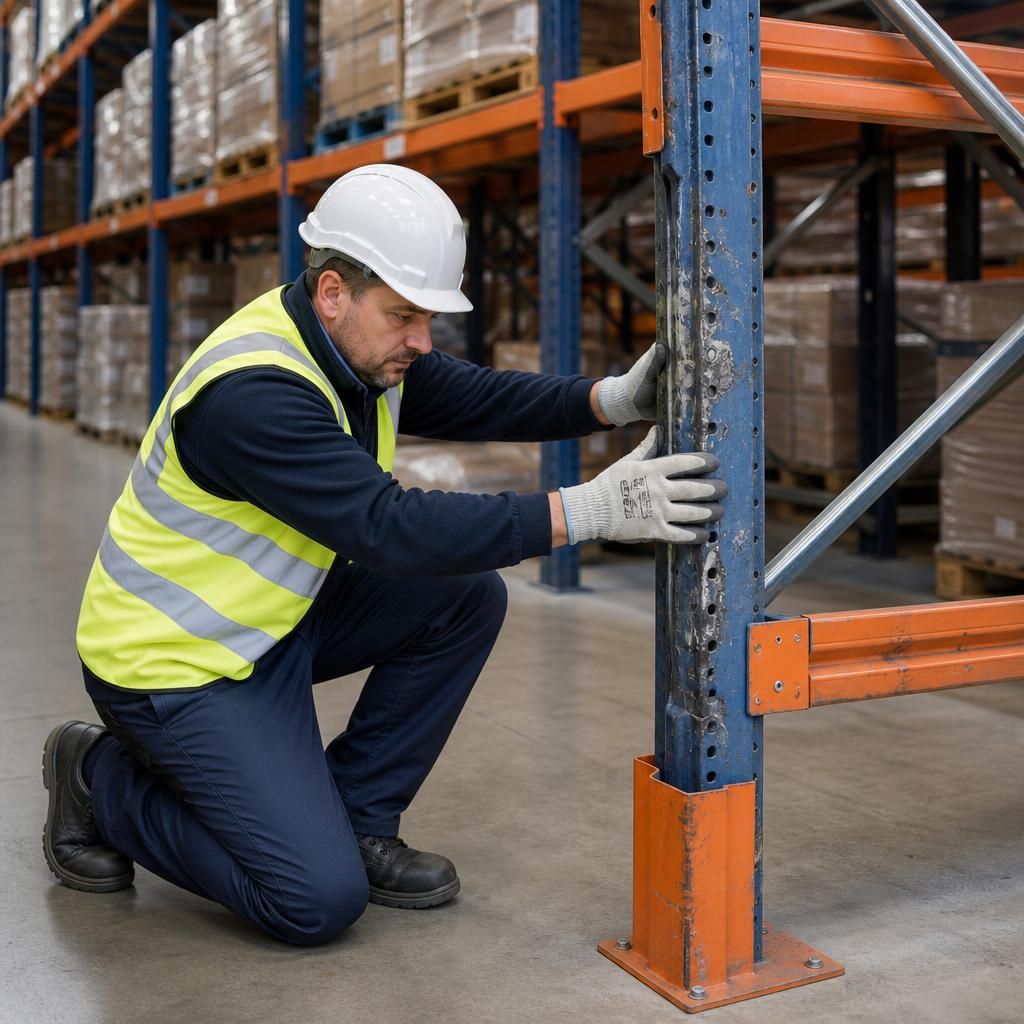
Warehouse racking repairs align with safety standards when the completed work is independently checked, recorded and authorised before the affected area returns to service. The final verification confirms that replacement components are compatible, connections are secure, the structure is stable and any loading restrictions are clearly understood.
A suitable repair record should include:
- the location and nature of the damage;
- the findings of the competent assessment;
- the repair or replacement method used;
- the components installed and relevant manufacturer information;
- any photographs, outstanding actions or operating restrictions; and
- the name of the person who completed and approved the work.
Keeping this information with inspection and maintenance records provides evidence that the repair was properly controlled. It also helps identify repeated impact, overloading or loading-practice issues so preventative measures can be introduced rather than simply repairing the same damage again.
Book Your Warehouse Racking Repair Assessment
Book your warehouse racking repair assessment with Able Racking to identify damage, confirm the appropriate corrective action and establish the controls needed before the affected area returns to service.