
What are the common signs that indicate a warehouse rack repair is needed?
Common signs that warehouse rack repair is needed include bent or twisted frames, damaged beams or braces, displaced components, loose fixings, missing safety pins, cracked welds and visibly leaning or unstable sections. Any impact damage, unusual movement or sudden change in load position should be reported promptly and the affected rack isolated until it has been assessed by a competent professional.
Warehouse rack repair is usually needed when a storage system shows physical damage, movement, missing protective components or any change from its inspected condition. Common warning signs include bent frames, damaged beams or braces, displaced components, loose fixings, missing safety pins, cracked welds and sections that lean or move. Any suspected damage should be reported promptly, the affected area isolated where necessary, and the warehouse racking assessed by a competent person before it is returned to service.
1. Bent, twisted or visibly damaged frames
Upright frames can be damaged by forklift impact, loading errors or contact with handling equipment. Look for bent uprights, twisted profiles, dents, buckling, splits, deformation around the base and damage to horizontal or diagonal bracing. Even apparently minor distortion can affect the frame’s ability to carry its intended load.
Do not attempt to straighten a damaged upright or conceal the damage with paint. The affected section should be clearly identified and assessed against the manufacturer’s requirements or applicable inspection criteria. Repair or replacement may be required, depending on the severity and location of the damage.
2. Damaged, bent or deflected beams
Beams may become bent after being struck by a forklift, overloaded or incorrectly loaded. Warning signs include a visible curve, dents in the beam profile, damaged end connectors, displaced beam levels and changes in the normal position of stored pallets. A beam that no longer sits squarely in its connector should be treated as a safety concern.
Some deflection can occur when a beam is loaded, but excessive or permanent deflection requires investigation. Compare the affected beam with adjacent levels and check that the stated safe working load has not been exceeded. Damaged beams should not be loaded while awaiting professional advice.
3. Missing or displaced safety pins and locking components
Safety pins, locking clips and other retaining devices prevent beams from being accidentally lifted or dislodged. A missing, bent or incorrectly fitted component can allow a beam to move during loading or unloading. Check that each connection is complete, properly seated and compatible with the storage system.
Never replace a missing component with wire, a bolt, a piece of metal or another improvised item. The correct replacement must be suitable for the rack design and fitted correctly. If a locking device has repeatedly worked loose, the connection and surrounding components should also be inspected for damage.
4. Loose, damaged or missing fixings
Loose anchor bolts, damaged floor fixings and missing fasteners can reduce the stability of a racking run. Signs may include movement at the base, enlarged holes, cracked concrete around an anchor, a gap between the upright and floor, or fixings that cannot be tightened correctly.
Fixings should be checked as part of a structured inspection rather than tightened without first identifying the cause of the problem. The floor, baseplate, anchor type and upright may all need to be examined. Repairs should use suitable components and follow the system manufacturer’s specification.
5. Cracked welds, splits or corrosion
Cracked welds and splits can weaken structural members and connections. Inspect welds around beam connectors, frame bracing, baseplates and other load-bearing areas for visible cracking, separation or unusual gaps. Corrosion, particularly where it has caused pitting or reduced the thickness of a component, is another reason to seek an assessment.
Surface rust does not automatically mean that a component must be replaced, but corrosion should not be ignored. Its extent, location and effect on the material need to be considered by a competent inspector. Cleaning or repainting alone is not a structural repair.
6. Leaning, unstable or unexpectedly moving sections
A warehouse racking run should remain stable and correctly aligned during normal use. A section that leans, rocks, sways, separates from adjacent runs or moves when pallets are placed or removed may have damaged frames, loose fixings, an uneven base or an overloaded configuration.
Remove people and equipment from the immediate area if there is a risk of collapse, and prevent further loading until the cause has been established. Do not rely on repositioning the pallets to make the section appear stable. The underlying defect must be identified and rectified.
7. Impact marks, displaced pallets or changes in load position
Fresh impact marks on uprights, beams, guards or bracing are a clear indication that the system may need repair, even if no major deformation is immediately visible. Pallets that sit lower, higher or further forward than usual can also indicate a damaged beam, altered beam level or displaced component.
After an impact, inspect the full affected bay and the surrounding structure. Damage can transfer through connected components and may not be confined to the point of contact. The area should be reported and controlled in line with the site’s safety procedure while an assessment is arranged.
Other changes that should be reported
- Loads no longer fit the allocated locations or exceed the displayed safe working load.
- Protective guards are damaged, detached or missing.
- Baseplates, shims or levelling components have moved.
- Bracing members are bent, loose or disconnected.
- There is unusual noise, vibration or movement during loading.
- Unauthorised alterations have been made to beam levels, frames or accessories.
- Previous repair work has failed, loosened or become damaged again.
What to do when damage is found
- Stop loading or unloading the affected bay if continued use could increase the risk.
- Report the damage through the site’s warehouse racking safety procedure.
- Use barriers, warning notices or other suitable controls to prevent access where required.
- Record the location, component, apparent damage and any known impact or loading event.
- Arrange an assessment by a competent warehouse racking inspector or repair specialist.
- Complete the specified repair, replacement or making-safe work before the area is put back into use.
- Update inspection records and communicate any revised loading or operating requirements to the warehouse team.
Warehouse racking should not be repaired by bending components back into position, welding without approval, drilling new holes or substituting non-approved parts. The correct action depends on the system design, the component affected, the damage classification and the manufacturer’s instructions. A competent inspection can establish whether the section requires immediate unloading, a temporary control, component replacement or a more extensive repair.
Regular visual checks by trained warehouse personnel help identify problems early, but they do not replace a formal expert inspection. Keep the inspection schedule, loading information and repair records up to date, and report any new damage promptly. Early action reduces the likelihood of further deterioration and helps keep the storage system safe, compliant and available for its intended use.
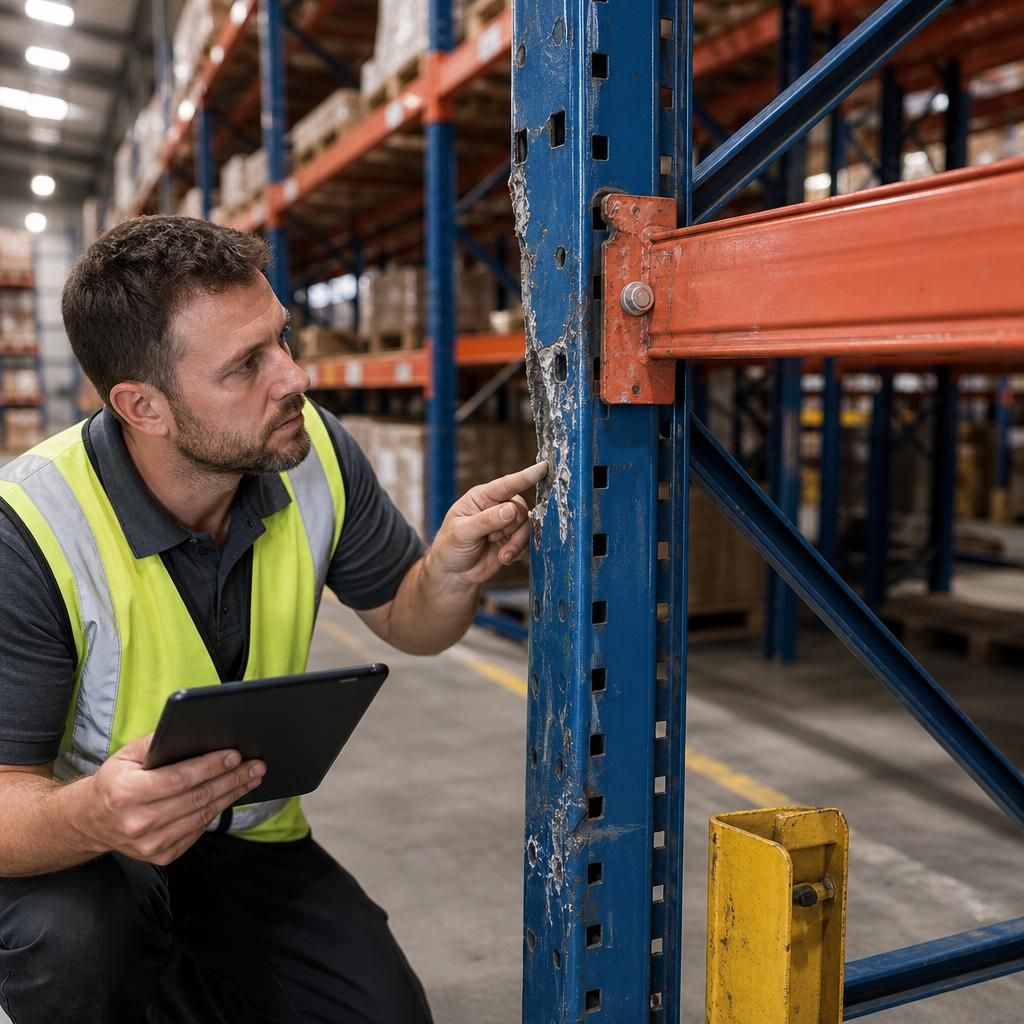
Fresh impact marks on an upright, beam, brace or protective guard can indicate hidden damage, even when the warehouse racking still appears stable. Forklift contact may distort connections, loosen fixings or transfer force to adjoining components, so the whole affected bay and nearby structure should be assessed rather than checking only the visible mark.
Stop loading the affected location, report the incident and use barriers or warning notices where necessary. Do not straighten damaged components or return the bay to service until a competent warehouse racking specialist has confirmed whether it needs repair, replacement or another control measure.
Arrange a Warehouse Rack Repair Assessment
If you have identified damage or movement, arrange a warehouse rack repair assessment before the affected area is returned to use. Our experienced team can assess the condition and advise whether repair, replacement or another safety control is required.