
How can warehouse rack repair services ensure compliance with safety regulations?
Warehouse rack repair services help ensure compliance by identifying damage, assessing its safety risk and completing repairs in line with the manufacturer’s guidance and applicable workplace safety requirements. A competent inspection and clear repair records also provide evidence that defects have been managed promptly, helping maintain safe, efficient warehouse operations.
Warehouse rack repair services support safety compliance by identifying damage, assessing the associated risk and completing corrective work in accordance with the manufacturer’s instructions, relevant UK workplace safety requirements and recognised warehouse racking guidance. A competent repair process also creates a clear record showing what was found, how it was assessed and how the defect was controlled.
Compliance is not achieved simply by replacing a visibly damaged component. The warehouse racking must be assessed as a complete storage system, including its configuration, load capacity, connections, protection, operating environment and condition. Repairs should therefore be based on a competent inspection rather than an informal visual decision or an attempt to straighten, weld or modify components without approval.
How repair services support compliance
- They identify defects before they become more serious. Inspections can reveal bent uprights, damaged beams, displaced safety pins, missing or ineffective protection, loose fixings, corrosion, impact damage and signs of instability.
- They assess the risk created by the damage. The effect of a defect depends on its location, severity, loading and relationship with the rest of the warehouse racking. A competent assessor can determine whether the affected area may remain in use, needs unloading or requires immediate isolation.
- They use suitable repair methods and components. Replacement parts should be compatible with the installed system and approved for its design. Unauthorised alterations, improvised repairs and mixed components can change the load capacity or structural behaviour of the installation.
- They restore the system to a safe, usable condition. This may involve replacing damaged components, correcting connections, reinstating protection, securing fixings or removing unsafe sections. The completed work should be checked before the affected bay is returned to service.
- They provide traceable evidence. Inspection reports, photographs, repair records, component details and completion notes help demonstrate that defects have been considered and managed. These records also support future inspections and maintenance planning.
The compliance process from inspection to completion
- Review the installation and its use. The repair provider should consider the type of warehouse racking, its layout, loading arrangements, operating equipment and any available design or manufacturer information. This establishes the context for the assessment.
- Inspect the affected area and surrounding bays. Impact damage can affect more than the component that was struck. The inspection should include adjacent frames, beams, bracing, floor fixings, safety devices and signs that loads or the structure have moved.
- Classify and control the risk. Where damage presents an immediate danger, the affected location should be unloaded, clearly identified and prevented from further use until suitable action is taken. Less serious defects should still be recorded, prioritised and monitored in line with the inspection findings.
- Specify the repair. The proposed work should identify the components, method and any restrictions on use. If the original design, loading information or manufacturer’s details are unavailable, further technical assessment may be needed before work proceeds.
- Complete the work safely. Repairs should be carried out by experienced operatives using appropriate access equipment, handling methods and work controls. The repair activity itself must not introduce additional risks to people, stored goods or nearby warehouse operations.
- Verify and document the result. After the repair, the area should be checked for correct fit, alignment, fixings, protection and safe loading arrangements. The report should record the completed work, any remaining limitations and whether the location is suitable to return to service.
Records that help demonstrate compliance
A useful repair report should identify the site and affected location, describe the defect, include photographs where appropriate, record the risk decision and state the recommended action. It should also note the parts used, work completed, any temporary controls and the person responsible for verification. Keeping these documents with inspection and maintenance records creates an auditable history for the warehouse racking.
Load notices and safe working instructions should remain accurate after a repair. If the repair changes the configuration, capacity or use of the warehouse racking, the information provided to warehouse staff must be reviewed before the area is used again. Staff should also know how to report further impacts or damage, rather than continuing to use an installation that may no longer be safe.
Why competent assessment matters
UK health and safety law places duties on employers and those responsible for workplaces to provide and maintain safe equipment and systems of work. HSE warehousing guidance and established industry practice emphasise competent inspection, planned maintenance, safe loading and prompt action when damage is found. The specific repair decision should reflect the installation, its use and the findings of the competent person; a repair service cannot replace the site operator’s responsibility for safe management.
A competent warehouse rack repair provider should be able to explain the basis for its recommendations, work to suitable technical information and distinguish between a repair, a replacement and a situation requiring further structural advice. It should not guarantee compliance solely because a component has been changed. Compliance depends on the condition of the whole installation, the way it is operated and the effectiveness of ongoing inspection and maintenance.
Following a repair, continue with planned visual checks, formal inspections and prompt reporting of impacts or defects. Inspection frequency should be based on the risk assessment, operating conditions and applicable guidance. Regular preventative care helps identify developing problems early and provides stronger evidence that warehouse racking safety is being actively managed rather than addressed only after an incident.
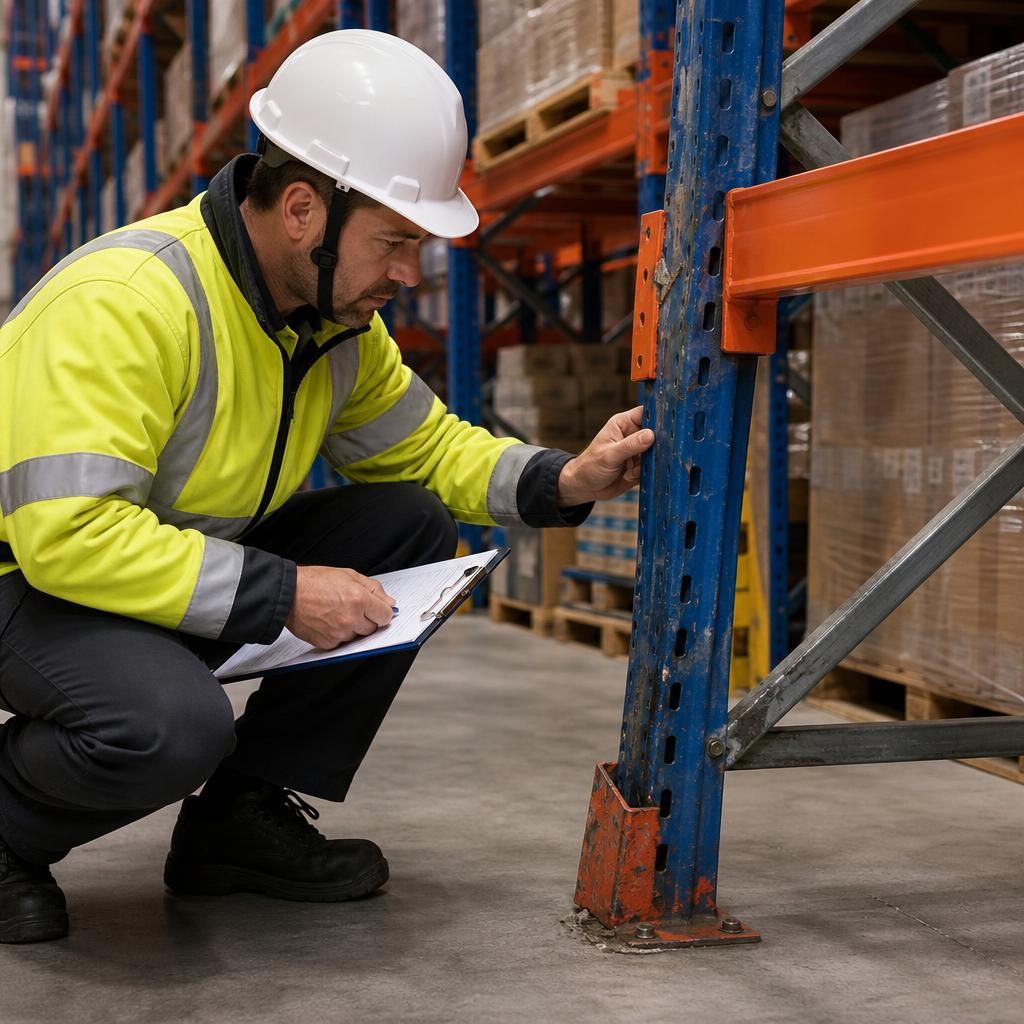
Warehouse rack repair supports safety compliance when every defect is assessed, controlled and documented from the initial inspection through to completion. A repair record should explain what was damaged, the risk it created, the action taken and whether the affected warehouse racking was safe to return to service.
Useful records may include photographs, the location of the defect, replacement component details, temporary controls and verification notes. They provide an auditable history for future inspections and help confirm that repairs followed suitable technical information rather than improvised methods.
After the repair, the surrounding warehouse racking should be checked for alignment, secure connections, protection and correct loading information. Any restrictions must be communicated to warehouse staff, with continued visual checks and formal inspections used to identify further damage promptly.
Book an expert warehouse rack repair assessment
Arrange an expert warehouse rack repair assessment with Able Racking to identify defects, control immediate risks and establish the appropriate corrective work.