
What safety standards should be followed during warehouse rack maintenance?
Warehouse rack maintenance should follow the manufacturer’s instructions, HSE guidance in HSG76, PUWER requirements and the relevant provisions of BS EN 15635, including planned inspections by a competent person, prompt reporting of damage and controlled repairs. Any unsafe warehouse racking should be taken out of service or safely unloaded until a suitably qualified professional has assessed and restored it.
Warehouse rack maintenance should follow the manufacturer’s instructions, the Health and Safety Executive’s guidance in HSG76, the applicable requirements of the Provision and Use of Work Equipment Regulations (PUWER), and the relevant provisions of BS EN 15635. In practice, this means warehouse racking must be inspected by a competent person, damage must be reported and assessed promptly, and repairs must be controlled, properly specified and recorded. Any unsafe warehouse racking should be isolated, clearly marked and unloaded where necessary until it has been assessed and made safe.
Follow the manufacturer’s instructions
The manufacturer’s design and operating instructions are the starting point for safe maintenance. They should be used to confirm the permitted load capacities, beam levels, frame configuration, anchorage requirements, compatible components and approved repair methods. Maintenance work should not alter the structure, loading arrangement or protection measures without a suitable technical assessment.
Unauthorised welding, drilling, cutting, straightening or substitution of components can affect the designed strength of warehouse racking. Replacement parts should be suitable for the specific system and installed in accordance with the manufacturer’s instructions. Where the original manufacturer’s information is unavailable, a suitably qualified specialist should establish the relevant design and loading requirements before work begins.
Apply HSG76 guidance
HSG76, Warehousing and storage: A guide to health and safety, provides practical guidance for managing risks associated with storage equipment and warehouse activities. It supports a structured approach that includes:
- carrying out a suitable and sufficient risk assessment;
- providing safe systems of work for inspection, maintenance and repairs;
- ensuring employees understand loading limits and safe operating procedures;
- protecting warehouse racking from vehicle impact and other foreseeable damage;
- keeping traffic routes, working areas and emergency access clear; and
- arranging inspections and corrective action at appropriate intervals.
Maintenance activities should be planned around the risks in the individual warehouse. These may include forklift movements, falling objects, work at height, stored loads, restricted access and the possibility of further impact while repairs are taking place.
Meet PUWER requirements
PUWER requires work equipment to be suitable for its intended use, properly maintained and inspected where deterioration could create a significant risk. Warehouse racking used as workplace storage should therefore be kept in an efficient state, maintained in good repair and checked by a competent person when required by the risk assessment or operating conditions.
Maintenance arrangements should cover the condition of frames, beams, connectors, bracing, baseplates, anchors, guards and other load-bearing or protective components. They should also address changes in use, repeated vehicle contact, unusual loading, environmental conditions and any evidence that the system is deteriorating.
Use BS EN 15635 as the inspection and maintenance framework
BS EN 15635 sets out principles for the use and maintenance of steel static storage systems. It requires responsibilities to be clearly allocated and supports a system of regular reporting, inspection, risk assessment and remedial action. A warehouse should nominate a person responsible for storage equipment safety and ensure that defects are communicated to the people who control the affected area.
Inspections should include routine visual checks by trained warehouse staff and periodic expert inspection by a technically competent person. The inspection should consider damage, deformation, missing or loose components, displaced loads, overloading, inadequate protection and any changes from the approved configuration. Findings should be classified according to their severity, with dangerous conditions dealt with immediately and other defects monitored or repaired within a defined timescale.
Control damaged warehouse racking immediately
Damage should never be ignored because a system appears stable or has continued to carry loads. Staff should report impact and defects promptly, using the site’s agreed reporting process. The affected location should then be identified and assessed. Depending on the severity and position of the damage, controls may include unloading the bay, isolating the aisle, installing temporary protection or stopping access until a competent person has completed an assessment.
Repairs should be carried out only after the cause and extent of the damage have been established. A repair is not automatically suitable because it restores the appearance of a component. Bent or weakened parts may require replacement, and repeated impact may indicate that vehicle routes, protection or working practices also need to be reviewed.
Use a safe system for maintenance work
Before work starts, the responsible person should confirm the scope of the task, hazards, required equipment and isolation arrangements. Loads should be removed where necessary, and the work area should be segregated from pedestrians and vehicles. Appropriate access equipment, personal protective equipment and lifting methods should be selected for the task. Work at height must be properly planned and carried out using suitable equipment by trained personnel.
Where repairs could affect the stability of adjacent bays or stored loads, the area should be assessed and controlled as a whole rather than treating the damaged component in isolation. Temporary supports or exclusion zones should be used only where they have been suitably specified. Warehouse operations should not resume until the repair has been completed, checked and released for use.
Maintain loading and safety information
Load notices should be present, legible and consistent with the current warehouse racking configuration. They should show the relevant safe working loads and any restrictions needed for safe use. If beam levels, bay layouts or components change, the loading information and inspection records should be reviewed rather than relying on older documentation.
Employees and equipment operators should understand the meaning of load notices, the correct placement of pallets and the procedure for reporting impact or damage. They should not attempt to straighten, remove or repair components themselves unless they have been specifically authorised and trained to do so.
Keep complete maintenance records
Records should show the date and scope of each inspection, the person who carried it out, defects identified, risk classifications, immediate controls, repair recommendations and the date on which corrective work was completed. It is also useful to retain photographs, repair specifications, component details and evidence of the final check.
Records demonstrate that the inspection and maintenance system is being managed, but they do not replace physical checks. Outstanding defects should remain visible to the responsible person until they have been verified as closed. Repeated defects should be analysed to identify underlying causes, such as vehicle impact, poor loading practice, unsuitable protection or changes in warehouse use.
Use competent people for inspection and repair
A competent person should have the knowledge, training, experience and authority needed to identify defects, evaluate risk and recommend appropriate action. The level of competence required depends on the complexity of the warehouse racking, the nature of the damage and the proposed repair. Routine observations by warehouse staff are valuable, but they do not replace an expert inspection where structural damage or stability concerns are present.
Following these standards creates a defensible maintenance process: the system is operated within its design limits, defects are identified early, unsafe areas are controlled and repairs are completed using appropriate methods. For an existing customer, Able Racking can help review inspection arrangements, assess reported damage, specify suitable remedial work and provide the documentation needed to support ongoing warehouse racking safety.
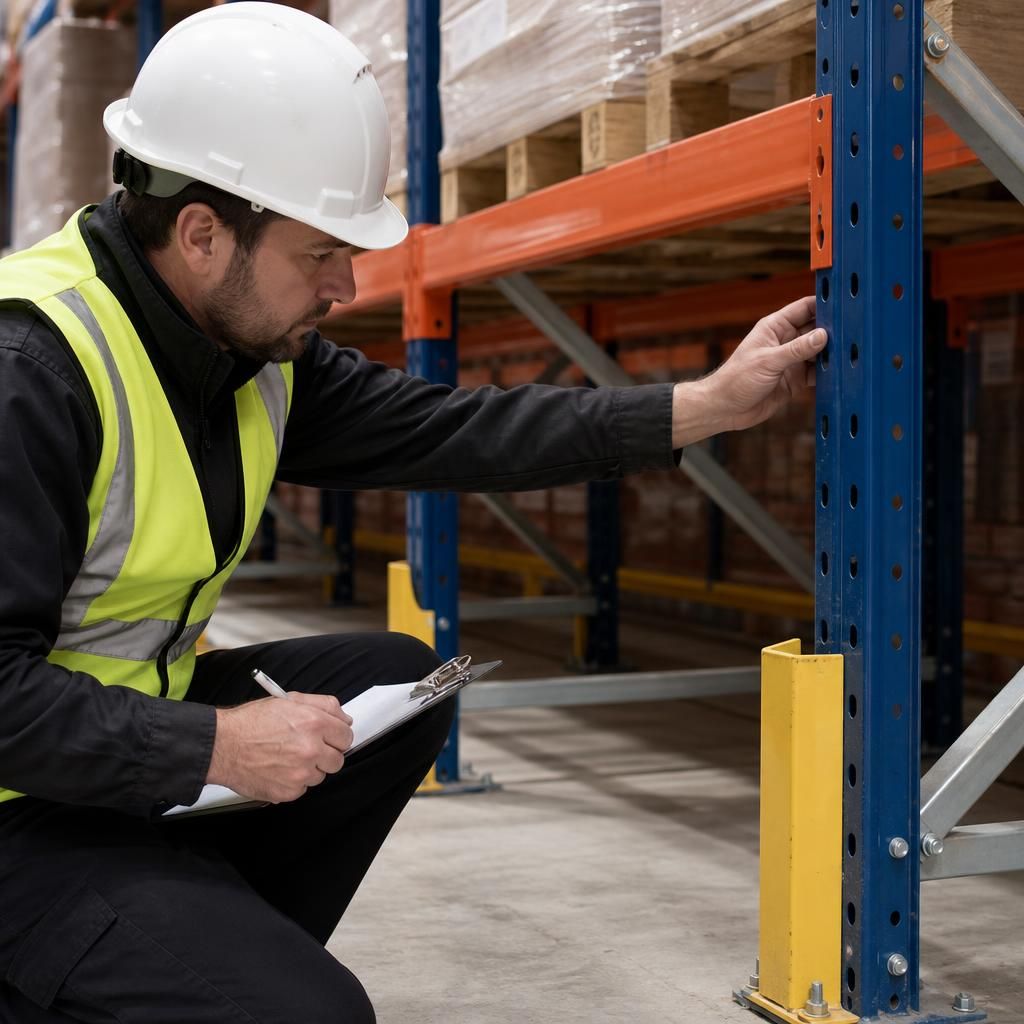
Damaged warehouse racking must be reported, isolated and assessed before it is returned to service. Affected bays should be unloaded where necessary, clearly marked and protected from further access or vehicle impact. Repairs should follow the manufacturer’s instructions or a suitable technical specification, and the completed work should be checked and recorded by a competent person before normal operations resume.
Review your warehouse racking maintenance arrangements
Review your warehouse racking maintenance arrangements with Able Racking to confirm that inspections, reporting, repairs and records support safe, compliant operation. Contact our experienced team to discuss any outstanding defects or maintenance requirements.