
What practical hands-on experiences does the pallet racking installer training provide?
Pallet racking installer training provides supervised, practical experience in assembling warehouse racking, positioning components, fitting braces and anchors, and working safely with installation equipment. You will also practise checking installations, identifying defects or risks, and applying corrective measures under expert guidance.
Pallet racking installer training provides supervised, practical experience in assembling warehouse racking, positioning components, fitting braces and anchors, using installation equipment and checking completed work. The training combines demonstrations with guided tasks so that you can develop the judgement, accuracy and safe working habits required for professional warehouse racking installation.
Working from installation information
Practical sessions normally begin with interpreting the relevant layout, component information and installation instructions. You will learn how to identify the required frames, beams, braces, protectors, fixings and accessories, then confirm that the components match the planned warehouse racking arrangement before assembly begins. This helps prevent incorrect parts being used and reinforces the importance of checking information rather than relying on assumptions.
You will also practise assessing the work area before installation. This includes considering access routes, floor condition, overhead obstructions, nearby activities, lighting, exclusion areas and the movement of materials. Planning these points in advance reduces avoidable risks and supports an organised installation sequence.
Assembling warehouse racking components
Under the direction of an experienced trainer, you will take part in the main stages of assembly. Depending on the course structure and the system being used, practical activities may include:
- Identifying upright frames, beams, braces and protective components.
- Positioning frames accurately in accordance with the layout.
- Fitting beams into the correct connection points and securing them properly.
- Installing bracing and checking that the frame is complete and correctly aligned.
- Fitting baseplates, anchors, shims and other specified fixings.
- Installing column guards, end-of-aisle protection and other safety accessories where required.
- Checking that locking devices and connections are correctly engaged.
The emphasis is on controlled handling, correct sequencing and consistent checking. Trainers can observe each task directly, correct technique where necessary and explain how small installation errors can affect the stability, usability or safety of the finished warehouse racking.
Using tools and installation equipment safely
The course gives you an opportunity to use the tools and equipment associated with warehouse racking installation in a controlled environment. You will practise selecting suitable tools, inspecting them before use, maintaining a stable working position and applying the correct method for tightening, fixing, levelling or aligning components.
Training also covers safe coordination when materials or equipment are being moved. You will learn how to communicate with colleagues, maintain exclusion areas and avoid placing yourself or others in a position of risk. Where work at height or lifting equipment is relevant to the course, the trainer will explain the required controls, limitations and responsibilities. Practical instruction does not replace any separate authorisation or specialist training required for particular equipment.
Levelling, alignment and accuracy checks
A significant part of the hands-on work involves checking whether the installed warehouse racking is straight, level, correctly spaced and securely fixed. You may use suitable measuring and checking methods to assess upright positions, beam levels, aisle dimensions, frame alignment and floor contact.
These exercises show why accuracy matters. Warehouse racking that appears complete may still require adjustment if it is out of alignment, incorrectly spaced or inadequately fixed. You will practise recording observations, raising concerns and making permitted corrections rather than concealing or working around a defect.
Recognising defects and unsafe conditions
Practical training includes identifying issues that could affect the safe use of warehouse racking. Examples include damaged or incompatible components, missing locking devices, loose fixings, incomplete bracing, impact damage, inadequate protection, poor alignment and signs that the floor or surrounding area is unsuitable.
You will learn to distinguish between a minor installation adjustment and a condition that requires the work to stop and be referred to a competent person. This is an important part of installer competence: an installer must know not only how to build the system, but also when the planned method or condition on site is outside their authority to resolve.
Making corrections and carrying out quality checks
After assembling a section, you will normally be expected to review your own work against the available instructions and checking requirements. This may involve revisiting connections, confirming fixings, correcting alignment, replacing unsuitable components and ensuring that protective features have been installed as specified.
Trainers use these checks to develop a methodical approach. You will be encouraged to complete tasks in a repeatable order, communicate incomplete work clearly and leave the installation safe for the next stage. This approach is particularly useful on active warehouse sites, where several people or trades may be working around the same installation.
Team-based installation exercises
Warehouse racking installation is usually collaborative, so practical exercises also develop communication and coordination. You may work with other learners to distribute components, control access to the work area, maintain safe handling practices and agree signals or instructions for positioning parts.
The exercises reinforce the need for clear communication when visibility is limited, loads are being moved or a task requires more than one person. They also demonstrate why each team member must understand their role and challenge an unsafe instruction when necessary.
Practical inspection and handover activities
Training may include a final inspection of the completed warehouse racking installation. You will practise looking at the system as a whole, checking for visible defects and confirming that the finished work reflects the intended layout and installation requirements. Where applicable, you may also practise recording outstanding items, reporting defects and communicating whether an area is ready for use.
Handover exercises help connect installation work with the ongoing inspection and maintenance of warehouse racking. A clear handover should identify what has been completed, what requires attention and any restrictions that apply before the system is used.
How practical competence is assessed
Assessment is based on how safely and accurately you perform the tasks, not simply on whether you can describe them. The trainer may observe your preparation, component identification, use of tools, assembly technique, checking process, communication and response to defects. You may also be asked to explain why a particular installation method or corrective action is appropriate.
Feedback is given during the exercises so that mistakes can be corrected and techniques repeated. If a task is not completed safely, further guidance and supervised practice can be provided before competence is confirmed. This ensures that practical ability is developed alongside the underpinning knowledge covered elsewhere in the pallet racking installer training.
By completing the practical elements, you should be better prepared to carry out warehouse racking installation in a controlled, methodical and safety-focused manner. You will understand the importance of following the specified layout, using compatible components, securing and aligning the system correctly, checking your work and escalating conditions that require further technical or supervisory input.
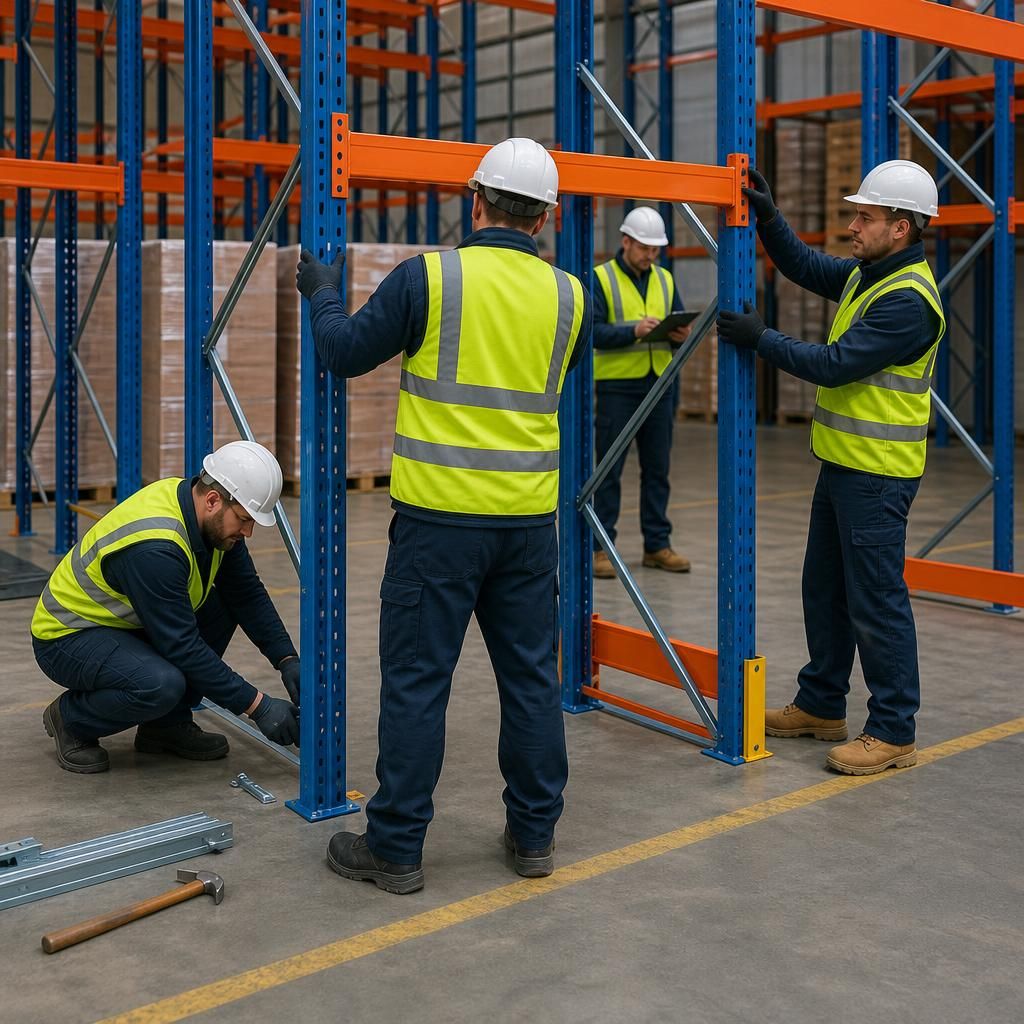
The practical part of pallet racking installer training gives you supervised experience in assembling warehouse racking and checking that each installation is safe, accurate and ready for inspection. You will work with the components, tools and installation information used in real warehouse environments.
Under expert guidance, you may practise positioning frames, fitting beams and braces, installing fixings and protective components, and checking alignment, levels and connections. Trainers can correct techniques as you work, helping you understand how poor alignment, missing locking devices, loose fixings or incompatible components may affect the completed warehouse racking.
Practical exercises also develop the judgement needed to recognise when work should stop and a concern should be referred to a competent person. You will practise recording defects, making permitted corrections, communicating with colleagues and completing a clear handover so that unfinished or restricted areas are not placed into use.
Book your pallet racking installer training
Book your pallet racking installer training with Able Racking to develop practical installation skills under expert guidance and prepare for safer, more accurate warehouse racking work.