
What measures are in place to ensure ongoing compliance and updates in workplace safety training content?
Ongoing compliance is maintained through regular reviews of legislation, HSE guidance and workplace risks, with competent trainers checking course content and updating it when requirements, equipment or working practices change. Document control, learner feedback, assessment reviews and recorded refresher training help ensure staff receive current, relevant guidance and that completion can be evidenced.
Ongoing compliance in workplace safety training is maintained through a documented cycle of legal monitoring, competent review, practical verification and controlled content updates. Training materials are checked against changes to legislation, HSE guidance, approved codes of practice, equipment, work processes and identified workplace risks. Where a change affects staff responsibilities or safe working methods, the relevant course content, assessments and refresher arrangements are updated and communicated.
Monitoring legal and operational changes
Workplace safety requirements can change because of new legislation, revised guidance, updated industry practice, enforcement priorities or changes to the equipment and tasks used at a site. An effective training provider monitors these sources and considers their relevance rather than relying on course content remaining suitable indefinitely.
Reviews should consider matters such as the Health and Safety at Work etc. Act, risk assessment duties, manual handling, work equipment, personal protective equipment, hazardous substances, working at height, fire safety and emergency arrangements where these apply to the course. The review also needs to reflect site-specific hazards, changes in operating procedures and findings from incidents, near misses, inspections or employee consultations.
Formal content review and approval
Course content should be reviewed by people with suitable technical knowledge and practical experience of the subject. This review checks that learning objectives, tutor guidance, presentations, handouts, videos, exercises and assessments remain accurate and consistent with current safe systems of work.
Changes should be approved before they are issued to learners. A controlled document process records what has changed, why it was changed, who reviewed it and when the updated version came into use. Obsolete materials are withdrawn so that trainers and learners do not use conflicting information. This is particularly important where printed documents, downloaded resources and online modules are used alongside one another.
Keeping training relevant to the workplace
Compliance is not achieved by quoting legislation alone. Training must explain how requirements apply to the tasks people actually carry out. For example, content may need to cover the correct use of work equipment, isolation arrangements, reporting procedures, emergency actions, inspection responsibilities or the limits of an employee’s authority.
Before an update is released, the content should be checked against the employer’s risk assessments, method statements, safe operating procedures and site rules. Managers and competent workplace representatives can help identify differences between written procedures and actual working practices. This provides an opportunity to correct outdated instructions and make sure training supports, rather than contradicts, the employer’s control measures.
Assessment and learner feedback
Assessments are reviewed as part of the content update process. Questions should test the knowledge and decisions required for safe work, not simply the learner’s ability to recall wording from a presentation. Practical demonstrations, verbal checks, written questions and observed tasks can be used where appropriate to the subject and level of risk.
Learner feedback, trainer observations, assessment results and recurring questions can highlight unclear explanations or topics that need more practical detail. Feedback does not replace a legal or technical review, but it helps identify where content is difficult to apply. Incident investigations and near-miss reports should also be considered, because they may show that a procedure is misunderstood or that a control requires further explanation.
Managing updates to eLearning and classroom materials
Online training should be managed so that the current version is clearly identified and older content can be removed or restricted. Updates may involve revised text, new illustrations, amended knowledge checks or a replacement module. Changes that materially affect learning outcomes should normally require the learner to complete the relevant updated content rather than relying on an earlier completion record.
Classroom materials require the same level of control. Trainers should receive update instructions and be made aware of changes before delivering the course. Where an update affects a practical activity or assessment, the trainer should understand how the revised requirement is to be demonstrated and recorded.
Refresher training and change-triggered updates
Refresher training should be based on the risk, the work involved, the employer’s arrangements and any applicable legal or industry expectations. A scheduled review does not remove the need for an earlier update when there is a significant change. Additional training may be required after an incident, following the introduction of new equipment, when duties change, or when monitoring shows that safe procedures are not being followed.
Refresher provision should reinforce critical controls without treating attendance alone as proof of competence. Where the work requires practical ability, this should be checked through observation or an appropriate practical assessment. Supervisors also need to know how to identify when an employee requires further instruction or supervision.
Records and evidence of compliance
Training records should show who completed the training, the subject covered, the version of the content used, the date of completion and the result of any assessment. Records of attendance, certificates, assessment outcomes, trainer competence and refresher requirements provide evidence that the training system is being managed.
These records should be retained in line with the employer’s document-control and data-retention arrangements and be available for internal reviews, audits or investigations where appropriate. A clear record also helps managers identify staff who need an update when course content or workplace controls change.
Practical assurance for customers
For each course, customers should be able to establish what the training covers, how it is kept current, who is responsible for reviewing it and how changes are communicated. Able Racking applies the same preventative approach used across its safety services: review the relevant requirements, check the practical application, record the outcome and address weaknesses promptly. This provides a structured basis for maintaining current training content and supporting ongoing compliance in the workplace.
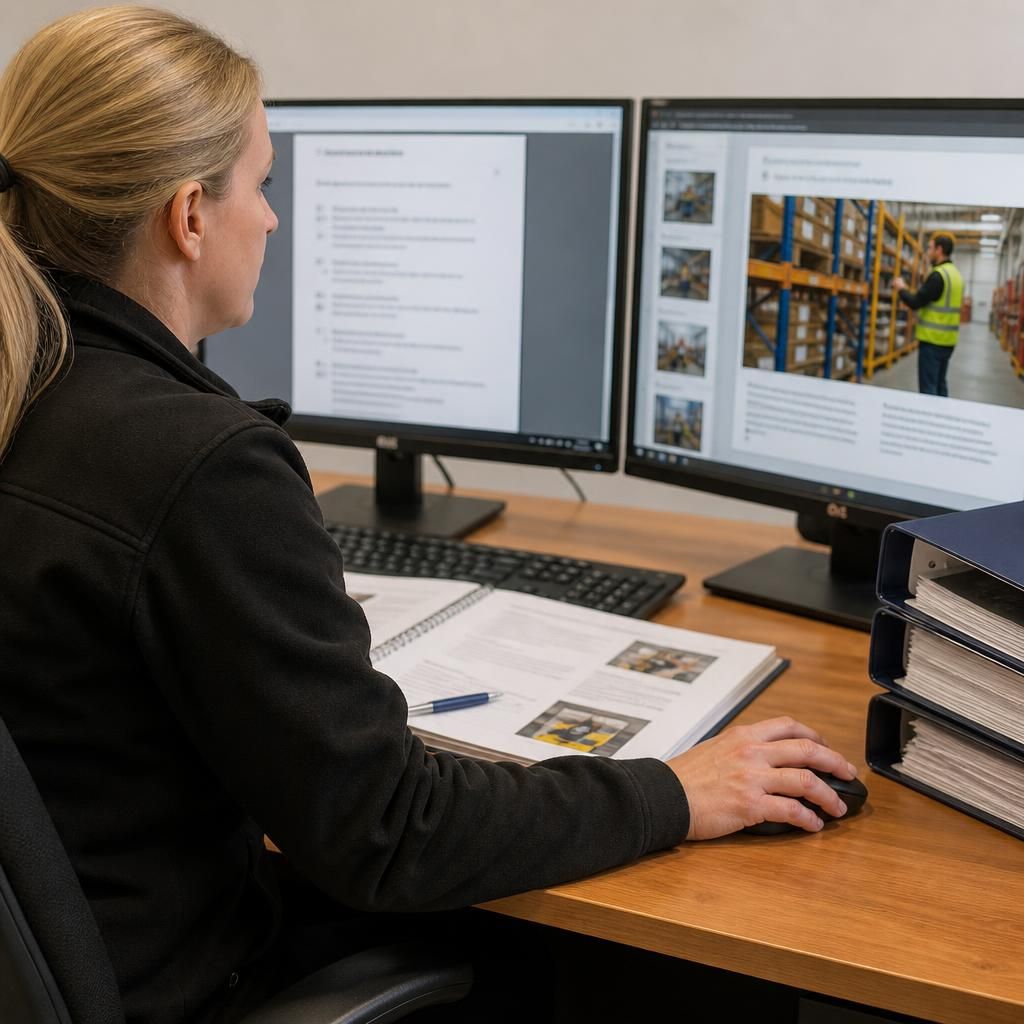
Ongoing compliance in workplace safety training means keeping course content aligned with current legal requirements, HSE guidance, workplace risks and safe operating procedures. Content should be reviewed through a documented process rather than assumed to remain suitable after its initial approval.
Each review should confirm that presentations, handouts, practical exercises and assessments reflect the work employees actually perform. Updates may be required when legislation or guidance changes, new equipment is introduced, procedures are revised, or an incident, near miss or inspection identifies a weakness in understanding.
- Changes are technically reviewed and approved before release.
- Old versions are withdrawn to prevent conflicting instructions.
- Trainers receive clear guidance before delivering updated material.
- Learner records identify the content version and assessment completed.
- Refresher or additional training is arranged where a change affects competence or safe working methods.
This combination of regulatory monitoring, practical review, controlled updates and accurate records provides evidence that workplace safety training remains current and relevant.
Review Your Workplace Safety Training Updates
Speak to Able Racking about reviewing your workplace safety training content, records and refresher arrangements to ensure they remain current and compliant.