
How does workplace safety training adapt to different occupational environments?
Workplace safety training adapts by addressing the hazards, equipment, legal duties and working practices specific to each occupational environment. Office training may focus on ergonomics, fire procedures and emergency response, while warehouse and construction training covers vehicle movements, lifting operations, work equipment, personal protective equipment and site-specific risk controls.
Workplace safety training adapts to different occupational environments by matching the content, examples, equipment and practical exercises to the hazards found in each setting. The core principles remain consistent—recognising hazards, assessing risk, following safe systems of work, responding to emergencies and reporting concerns—but the relevant controls differ between an office, warehouse, construction site, retail premises or industrial facility.
Training starts with the working environment
Effective training should reflect how people actually work rather than rely on generic information. Before a session, the trainer should consider the workplace layout, processes, equipment, substances, workforce experience, previous incidents and the findings of relevant risk assessments. This allows the content to address genuine exposure points and gives staff clear instructions that can be applied immediately.
Training may be adapted through site-specific examples, photographs, demonstrations, supervised practice, written procedures and question-and-answer exercises. The level of detail should also reflect the learner’s responsibilities. An operative may need to demonstrate safe equipment use, while a supervisor may need additional instruction on monitoring controls, reporting defects and responding to unsafe behaviour.
Office and administrative environments
Office-based training commonly covers display screen equipment, workstation setup, posture, manual handling of office items, slips and trips, fire procedures, first aid arrangements and emergency evacuation. It may also address electrical safety, workplace stress, lone working, security and safe use of shared areas.
For display screen work, practical guidance is more useful than a general warning about posture. Staff should understand how to adjust their chair and screen, organise their workstation, vary activities and report discomfort or equipment problems. Fire and evacuation training should explain alarm arrangements, escape routes, assembly procedures and the needs of anyone requiring assistance.
Warehouses and distribution environments
Warehouse training focuses on moving vehicles, pedestrians, loading and unloading, manual handling, storage systems, work equipment, packaging, slips and trips, emergency procedures and personal protective equipment. Where warehouse racking is used, staff should understand loading limits, safe access, the reporting of damage and the importance of keeping aisles and escape routes clear.
Practical instruction can include segregated pedestrian routes, vehicle movement controls, safe stacking, handling techniques and procedures for defective equipment. Operators may require role-specific training for lift trucks or other work equipment, with appropriate assessment and authorisation before use. Supervisors should also know how to identify unsafe conditions and escalate defects promptly.
Construction and maintenance sites
Construction training must account for changing site conditions, multiple contractors, temporary works and activities such as excavation, lifting, work at height, use of power tools and exposure to dust, noise or hazardous substances. Site induction should explain access arrangements, welfare facilities, emergency procedures, restricted areas and the site’s reporting process.
Training is often reinforced through task briefings and toolbox talks because the risks can change as work progresses. Workers need to understand the limits of their competence, the required controls and when work must stop. Supervisors require additional guidance on coordinating activities, checking controls and communicating changes to the workforce.
Manufacturing and industrial workplaces
Industrial training is adapted to the machinery, production process and materials in use. Typical subjects include machine guarding, isolation procedures, safe use of work equipment, maintenance activities, hazardous substances, noise, manual handling and emergency shutdown arrangements.
Demonstrations should use the actual controls and procedures followed on site wherever possible. Staff should be shown how to identify abnormal conditions, report faults and prevent unexpected start-up or release of energy. Training must distinguish between routine operation, cleaning, adjustment and maintenance, as each activity may require different controls.
Retail, hospitality and public-facing workplaces
Retail and hospitality training may cover slips and trips, customer interaction, manual handling, fire safety, use of cleaning chemicals, kitchen hazards, burns, cuts, violence and lone working. Content should reflect busy periods, deliveries, restricted storage areas and the interaction between employees, contractors and members of the public.
Scenario-based exercises can help staff practise responding to spills, aggressive behaviour, fire alarms, injuries and blocked escape routes. Managers may need further instruction on incident reporting, preserving evidence and arranging suitable follow-up action.
Healthcare, care and community settings
In healthcare and care environments, training commonly includes moving and handling people, infection prevention, personal protective equipment, challenging behaviour, medication-related responsibilities where applicable, slips and trips, fire safety and emergency response. It should recognise that workers may operate in hospitals, residential settings, community locations or service users’ homes.
Training must protect both workers and the people receiving care. This means combining technical instruction with dignity, communication, consent and awareness of individual needs. Practical assessments should confirm that staff can carry out procedures safely rather than simply recall information.
How delivery is adapted
- Content: examples and learning objectives are matched to the hazards, legal duties and job roles relevant to the site.
- Practical activities: learners practise using equipment, applying controls, selecting protective equipment or following emergency procedures in a controlled way.
- Language and accessibility: explanations, visual aids, translated materials or additional support are used where needed to ensure the instruction is understood.
- Group composition: separate sessions may be appropriate for new starters, experienced operatives, supervisors, contractors or those with specialist responsibilities.
- Location: classroom learning can be combined with supervised observation in the work area, provided this is done without creating additional risk.
- Assessment: understanding may be checked through questions, written tests, observation, practical demonstrations or scenario-based exercises.
Responding to changing risks
Occupational environments change when equipment, layouts, substances, processes, staffing or legislation changes. Training should therefore be reviewed after an incident, near miss, significant change, introduction of new equipment, change in duties or evidence that workers are not following the intended controls.
Refresher training should not be treated as a substitute for correcting unsafe conditions. If an assessment identifies inadequate guarding, poor housekeeping, damaged warehouse racking, unclear traffic routes or unsuitable procedures, the underlying issue must also be addressed. Training is most effective when supported by competent supervision, maintenance, inspections, clear communication and accessible reporting arrangements.
Checking that the training works
Evaluation should go beyond attendance records. Trainers and managers can check whether learners understand the controls, apply them correctly and know how to report concerns. Follow-up may include workplace observation, review of incident and near-miss reports, discussions with supervisors and confirmation that corrective actions have been completed.
Records should identify the subject covered, date, attendees, trainer, assessment method and any further action required. These records help demonstrate that suitable instruction has been provided and make it easier to identify when an individual or group needs additional support.
In every environment, the objective is the same: provide relevant instruction that people can understand, apply and maintain in their actual work. Adapting the training to the workplace makes safety procedures more practical, improves confidence in recognising hazards and supports continuing compliance with the employer’s responsibilities.
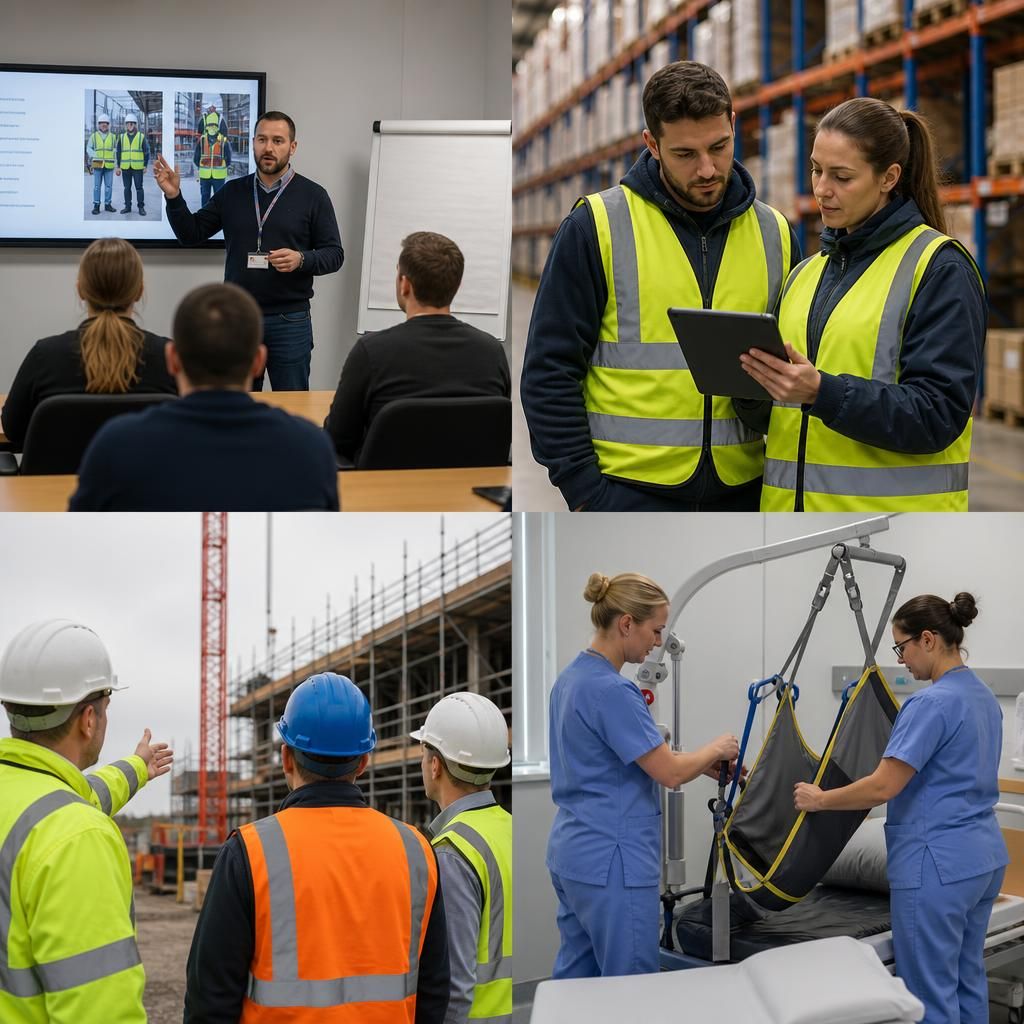
Workplace safety training adapts to an occupational environment by using the site’s actual hazards, equipment, procedures and job responsibilities as the basis for instruction. This makes the training practical: warehouse staff can apply controls for vehicle movements, manual handling and warehouse racking, while office staff may need guidance on display screen equipment, fire procedures and workstation ergonomics.
Effective delivery combines explanation with relevant demonstrations and supervised practice. Learners should be shown the correct controls in the context of their work, such as reporting damaged warehouse racking, following pedestrian routes, isolating machinery or responding to a chemical spill. Training should also be adjusted for new starters, experienced operatives, supervisors and contractors, as their responsibilities and competence requirements differ.
Understanding should be checked through questions, observation, practical demonstrations or scenario-based exercises. Follow-up workplace observations can confirm that staff are applying the training correctly and identify when procedures, supervision or refresher instruction need to be improved.
Discuss your workplace safety training requirements
Discuss your workplace safety training requirements with Able Racking to identify the right content, delivery format and assessment approach for your working environment.