
What topics are covered in the Racking Inspection Training Online course?
The Racking Inspection Training Online course covers warehouse racking safety checks, inspection procedures, common defects, legal duties, risk assessment, reporting requirements and recommended corrective actions. It also explains how to apply best-practice guidance consistently so inspection findings are accurate, clearly recorded and followed through.
The Racking Inspection Training Online course covers the knowledge and practical principles needed to inspect warehouse racking safely and consistently. Topics include inspection responsibilities, warehouse racking components, common damage and defects, risk assessment, legal duties, reporting procedures, corrective actions and best-practice inspection methods.
Warehouse racking systems and inspection principles
The course introduces the purpose and construction of common warehouse racking systems, helping participants recognise the function of frames, beams, bracing, protection, decking and associated components. It explains why each part matters to structural performance and how changes to the original configuration can affect safety.
It also covers the principles of a competent inspection. This includes preparing for the inspection, understanding the warehouse environment, following a consistent route, observing conditions carefully and recording findings accurately. The training explains the difference between routine visual checks, more detailed internal inspections and specialist assessment where damage or uncertainty requires further technical input.
Inspection responsibilities and legal duties
Participants learn how inspection duties are shared between employers, warehouse operators, supervisors, users and suitably competent inspectors. The course explains the importance of planned inspections, suitable risk controls, staff awareness and clear escalation arrangements.
Relevant workplace health and safety duties, risk management principles and recognised industry guidance are covered in practical terms. The training shows how legal compliance depends on more than completing a checklist: the inspection must be suitable, findings must be acted upon and records must demonstrate that safety concerns have been managed.
Common defects and damage
A substantial part of the course focuses on identifying conditions that may reduce the safety or capacity of warehouse racking. These include:
- Impact damage to upright frames, bracing, beams and guards.
- Bent, twisted, cracked or distorted components.
- Loose, missing or incorrectly fitted connectors, pins and locking devices.
- Displaced or damaged decking and support members.
- Overloaded, unevenly loaded or incorrectly positioned pallets.
- Unauthorised alterations, additions or changes to the layout.
- Corrosion, deterioration, poor housekeeping and obstructions.
- Signs that the warehouse racking is unstable, improperly used or no longer matches the intended design.
The course explains how to distinguish visible damage from less obvious concerns, such as repeated impacts, inadequate clearances or loading arrangements that place avoidable stress on the system. It also highlights when an inspector should avoid making assumptions and refer the matter to a suitably qualified person.
Risk assessment and severity classification
Inspection findings are considered in relation to the potential risk they create. The training covers how to assess the location, type and extent of damage, the likelihood of further impact, the load being supported and the possible consequences of leaving the issue unresolved.
Participants learn how severity classifications and site procedures can be used to prioritise action. The course emphasises that classifications must be applied consistently and in accordance with the relevant guidance, inspection criteria and the warehouse operator’s control arrangements. It also explains the need to isolate unsafe areas or remove loads where immediate controls are necessary.
Safe inspection procedures
The course sets out a methodical approach to inspecting warehouse racking without creating additional risks. This includes considering pedestrian and vehicle movements, working at a safe distance, observing loading activities and using appropriate personal protective equipment and access arrangements.
It explains what an inspector should look for at ground level and from suitable viewing positions, as well as the limitations of visual inspection. Participants are reminded not to climb storage structures, interfere with loads or carry out repairs unless they are specifically authorised, trained and equipped to do so.
Recording and reporting findings
Clear documentation is essential to effective safety management. The course covers the information that should be included in an inspection report, such as the location of the issue, the affected component, the type and extent of damage, the risk classification, supporting photographs and recommended action.
It also explains how accurate records help warehouse operators identify recurring damage, monitor outstanding work and demonstrate that inspections are being managed properly. Reports should be factual, easy to understand and sufficiently precise for the responsible person or repair team to locate the problem without ambiguity.
Corrective actions and follow-up
Identifying a defect is only one part of the inspection process. Participants learn how findings should be communicated, prioritised and followed through to completion. Possible controls may include removing or reducing a load, restricting access, protecting the area, arranging a technical assessment, replacing damaged components or reviewing operating practices.
The course stresses the importance of checking that corrective work has been completed appropriately and that temporary controls have not been left in place indefinitely. Where damage is recurring, the appropriate response may include reviewing traffic routes, protection measures, operator training, load handling or the suitability of the warehouse racking arrangement.
Loading, use and workplace conditions
Inspection topics include safe loading principles, visible load information, pallet condition, load placement and the effect of poor handling practices. The course explains why storage systems must be used within their designed parameters and why changes to beam levels, loads or configuration should be controlled and assessed.
Environmental and operational conditions are also considered. These include vehicle movements, pedestrian access, housekeeping, lighting, visibility, floor condition and activities that could expose the warehouse racking to impact or deterioration.
Practical examples and knowledge checks
Online lessons use realistic inspection situations to help participants apply the principles to common warehouse conditions. Examples may require the learner to identify a defect, decide whether further action is needed, select suitable control measures or determine what information should be recorded.
Knowledge checks reinforce the main topics throughout the course. They are intended to confirm understanding of inspection methods, responsibilities, risk decisions and reporting standards rather than replace practical experience or specialist judgement.
By completing these topics, participants gain a structured understanding of how to inspect warehouse racking, recognise conditions that require attention and communicate findings clearly. The training supports consistent workplace practice, while complex structural issues, repairs and design decisions should remain with appropriately qualified and authorised professionals.
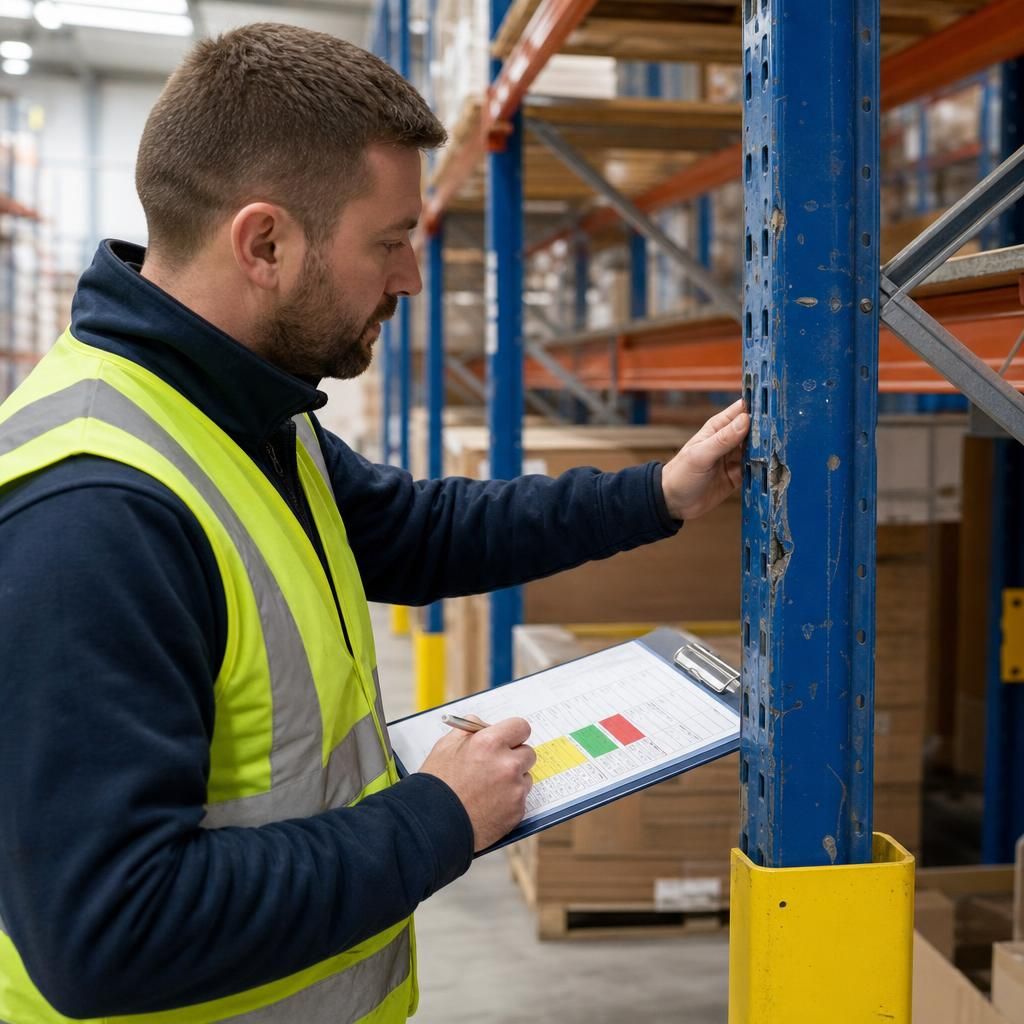
Accurate reporting is a central topic in the Racking Inspection Training Online course because an inspection only supports safety management when findings can be understood and acted upon. The training explains how to record the location, affected warehouse racking component, type and extent of damage, risk classification, photographs and recommended action.
Participants learn how to write factual reports that help the responsible person or repair team locate each issue without ambiguity. The course also covers how to communicate urgent concerns, apply site procedures, monitor outstanding actions and confirm that corrective work has been completed appropriately.
Enrol on the Racking Inspection Training Online course
Enrol on the Racking Inspection Training Online course to build a consistent understanding of warehouse racking inspections, defect identification and reporting requirements. Contact Able Racking if you need help choosing the right training for your team.