
What are the consequences of neglecting regular warehouse racking inspections and how can businesses mitigate these risks?
Neglecting regular warehouse racking inspections can allow damage, instability and unsafe loading to go unnoticed, increasing the risk of falling goods, injuries, operational disruption and non-compliance with workplace safety duties. Businesses can mitigate these risks by scheduling competent inspections, training staff to report defects, isolating unsafe areas promptly, completing necessary repairs and keeping clear inspection and maintenance records.
Neglecting regular warehouse racking inspections allows damage, instability, overloading and unsafe practices to remain undetected. The consequences can include falling goods, serious injury, structural collapse, stock losses, operational disruption, enforcement action and increased repair costs. Businesses can reduce these risks by arranging competent inspections, reporting defects promptly, isolating unsafe areas, completing suitable repairs and maintaining accurate inspection records.
How missed inspections create risk
Warehouse racking can be damaged by forklift impacts, unsuitable loading, alterations, corrosion, poor installation or changes to the working environment. Some defects are immediately visible, while others develop gradually. A bent upright, displaced beam, missing safety component or loose connection can affect the load capacity and stability of the wider system. Without regular checks, a minor defect may become a more serious failure.
Inspections are also important because warehouse conditions and working practices change. Stock profiles may alter, heavier pallets may be introduced, vehicles may use different routes, or storage levels may be adjusted. These changes can make an established layout unsuitable, even where the warehouse racking originally complied with its design requirements.
Potential consequences of neglect
- Falling products and materials: Damaged components, poorly positioned loads or missing protection can allow goods to fall into traffic routes or work areas.
- Structural instability: Impact damage, unauthorised alterations or excessive loading can reduce the ability of the system to support its intended loads.
- Injury or fatality: Employees, contractors and visitors may be struck by falling goods or exposed to unstable structures during normal warehouse activities.
- Damage to stock and equipment: A failure can affect stored products, handling equipment, floors, vehicles and nearby storage installations.
- Operational disruption: Unsafe areas may need to be closed at short notice, affecting picking, dispatch, production and access routes.
- Higher repair costs: Promptly correcting a minor defect is generally more straightforward than dealing with widespread damage or a structural failure.
- Compliance and enforcement concerns: Employers must take reasonably practicable steps to protect people at work. Inadequate inspection, maintenance and follow-up arrangements may form part of an investigation after an incident and can expose a business to enforcement action or civil claims.
- Insurance and reputational consequences: Poor records or evidence of unmanaged defects may complicate the handling of an insurance claim and undermine confidence among customers, employees and business partners.
Why visual checks alone may not be enough
Day-to-day checks by warehouse staff are valuable, but they are not a substitute for a planned inspection by a suitably competent person. Employees may identify obvious impact damage or displaced loads, but they may not recognise less apparent issues such as distorted components, unsuitable load configurations, deterioration of fixings or changes that affect the original design assumptions.
A competent warehouse racking inspector should understand the type of system being assessed, common failure modes, safe loading principles, protection measures and the relevant workplace duties. The inspection should be sufficiently detailed to identify defects, assess their significance and recommend proportionate corrective action.
How businesses can mitigate the risks
- Set a documented inspection programme. Establish routine checks by trained employees alongside periodic inspections by a competent specialist. The frequency should reflect the condition and age of the system, the intensity of use, vehicle movements, loading arrangements, the working environment and the findings from previous inspections. Manufacturer guidance and recognised industry guidance should also be considered.
- Define what must be checked. Inspection arrangements should cover uprights, beams, bracing, connectors, baseplates, anchors, guards, load notices, pallets, decking, safety devices, aisle clearances and signs of impact or corrosion. The surrounding floor, lighting, traffic routes and storage practices should also be considered where they affect safe use.
- Train employees to identify and report defects. Staff should know what damage looks like, how to report it, who is responsible for the response and when an area must be made safe immediately. Training should reflect the equipment and procedures used at the site rather than relying only on general awareness.
- Act immediately on serious defects. Where there is a risk of collapse, falling goods or further damage, the affected area should be isolated and unloaded where this can be done safely. The system should not be returned to service until a competent person has confirmed that the necessary action has been completed.
- Use a clear defect classification process. Findings should be prioritised according to their severity. Immediate hazards require prompt isolation and corrective work. Less urgent defects still need a named owner, a target date and confirmation that the work has been completed.
- Repair using suitable components and methods. Repairs should be compatible with the original design and load requirements. Improvised welding, straightening, drilling or substituting components can alter the system’s performance and should not be treated as an acceptable solution without appropriate technical assessment.
- Control alterations and loading changes. Changes to beam levels, bay arrangements, components, load types or vehicle routes should be reviewed before implementation. Load notices must reflect the actual configuration, and staff should understand the maximum permitted loads and any restrictions.
- Keep complete records. Records should identify the inspection date, areas examined, findings, photographs where useful, recommended actions, responsible persons, completion dates and any restrictions placed on use. Retaining evidence of follow-up is as important as recording the original inspection.
What a robust inspection process should achieve
An effective process does more than produce a report. It creates a practical chain from identifying a defect to controlling the risk and verifying the repair. The inspector should explain the significance of findings in clear terms, distinguish between immediate hazards and planned maintenance, and make recommendations that the site team can implement.
Inspection findings should also be reviewed for recurring patterns. Repeated impact damage in the same aisle may indicate inadequate vehicle separation, poor visibility, insufficient protection or a need to revise traffic management. Frequent damage to load supports may point to unsuitable pallets or loading methods. Using inspection results in this way helps prevent recurrence rather than simply correcting individual defects.
Responsibilities after an inspection
The site operator remains responsible for ensuring that reported defects are addressed and that warehouse racking is used within its design limits. An inspection provider can identify hazards and recommend action, but the business must put suitable controls in place, communicate restrictions and ensure repairs are completed by appropriately qualified personnel.
Where the inspection identifies uncertainty about load capacity, configuration or structural condition, the affected area should be treated cautiously until the matter has been assessed. Continuing to use an apparently unsafe bay because the defect has been recorded does not control the risk.
Regular warehouse racking inspections are therefore a preventative safety measure, not simply an administrative exercise. A planned programme, competent assessment, trained staff, prompt defect management and reliable records help protect people, reduce disruption and maintain the safe performance of the storage system. Able Racking’s experienced operatives can support businesses with detailed inspections, practical recommendations, repairs, installation support and tailored safety training across the UK.
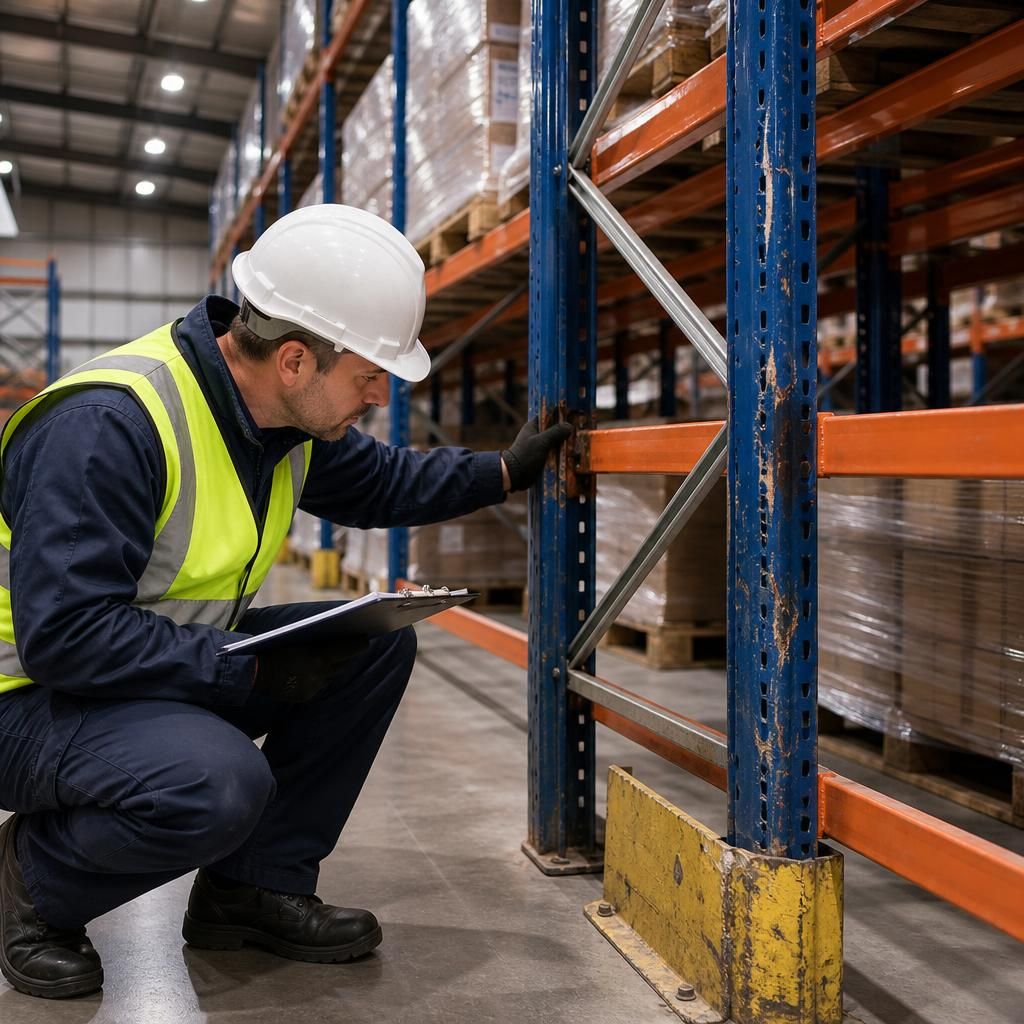
Prompt defect control is the process of identifying unsafe warehouse racking, restricting access where necessary, arranging suitable corrective work and confirming that the affected area is safe before it is used again. Recording a defect without controlling the risk leaves employees, stock and handling equipment exposed.
Where an inspection identifies a risk of falling goods, collapse or further damage, the affected bay or aisle should be isolated and unloaded only where this can be done safely. The finding should be assigned to a responsible person with a clear completion date. Repairs must use suitable, compatible components and methods; improvised straightening, welding or substitution can affect the system’s strength and should not be used without appropriate technical assessment.
Inspection records should show the defect, its priority, any use restrictions, the action taken and evidence that the repair has been completed. This creates a clear audit trail and helps prevent recurring problems, such as repeated vehicle impacts or unsuitable loading practices, from being overlooked.
Arrange a warehouse racking inspection
Arrange a warehouse racking inspection with Able Racking to identify defects, assess risks and receive clear recommendations for corrective action.