
What steps should be taken if damage is discovered during a warehouse racking inspection?
If damage is discovered during a warehouse racking inspection, immediately isolate the affected area, prevent further use of the damaged section and report the defect to the responsible person. A competent specialist should assess the damage, specify suitable repairs or replacement, and confirm the warehouse racking is safe before it is returned to service.
If damage is discovered during a warehouse racking inspection, the affected section should be taken out of service immediately, clearly isolated and reported to the responsible person. Loads must not be placed in, removed from or moved around the damaged area until a competent specialist has assessed the defect, specified the appropriate corrective action and confirmed that the warehouse racking is safe to use.
The response should be controlled and documented rather than based on an informal visual judgement. The following steps provide a suitable process for dealing with damage identified during a warehouse racking inspection:
- Make the area safe. Stop work in the affected location and prevent access by warehouse staff, visitors and equipment operators. Use suitable barriers, warning notices or an equivalent method of isolation. If there is an immediate risk of collapse, impact or falling goods, the surrounding area may also need to be cleared until the hazard has been assessed.
- Stop using the affected warehouse racking. Do not unload, reload, adjust or repair damaged components while the section remains in service. Where practical, loads should remain undisturbed until a competent person decides whether they can be safely removed. Moving goods without a planned method can increase instability and expose people to avoidable risk.
- Report the defect promptly. Notify the person responsible for warehouse racking safety, such as the warehouse manager, site manager or designated warehouse racking responsible person. The report should identify the location, the affected components, the apparent severity of the damage and any immediate controls already put in place.
- Record clear evidence. Record the inspection findings in the warehouse racking inspection report, including photographs where appropriate. Note the aisle, bay or location reference, component affected, type of damage, visible distortion, missing or loose parts, impact evidence and the action taken. Accurate records help the repair specialist understand the issue and provide evidence that the defect was managed appropriately.
- Obtain a competent technical assessment. A suitably experienced warehouse racking specialist should assess whether the damage affects the structural integrity, stability or safe load capacity of the installation. The assessment should consider the component involved, the extent of the damage, the surrounding structure, the loads being stored, any previous defects and the possibility of hidden damage.
- Apply the correct level of control. The specialist may recommend continued isolation, restricted use, urgent unloading, temporary measures or another specific control. A damaged component should not be classed as safe simply because it appears minor. The decision should be based on the condition of the complete warehouse racking section and the manufacturer’s technical information where available.
- Specify an appropriate repair or replacement. Repairs should follow a written technical recommendation and use compatible components and approved methods. Straightening damaged structural members, drilling new holes, welding, adding unapproved parts or making other unauthorised alterations can affect the design assumptions and should not be used as a substitute for a properly specified repair. Where a component cannot be reliably restored, replacement may be necessary.
- Use competent repair personnel. Work should be completed by operatives with the necessary experience, equipment and information for the warehouse racking system. The repair team should follow the approved method, protect nearby workers and ensure that the area remains controlled throughout the work. If loads need to be removed, unloading should be planned to avoid transferring instability to adjacent bays.
- Inspect the completed work before returning the area to service. The repaired warehouse racking should be checked against the repair specification. The check should confirm that components are correctly fitted, connections and protection are secure, the structure is plumb and stable where relevant, and no related damage has been overlooked. The area should remain isolated until the responsible competent person confirms that it can be used safely.
- Update records and communicate the outcome. Keep the original inspection report, photographs, technical assessment, repair details and completion confirmation together. Tell relevant staff what was found, what controls apply and when the warehouse racking can be used again. If load limits, operating arrangements or access restrictions have changed, these must be communicated clearly and reflected in site procedures.
- Investigate the cause. Damage commonly results from vehicle impact, poor operating practices, unsuitable loads, inadequate protection, alterations or repeated overloading. The site should identify the underlying cause and take preventative action, such as improving traffic management, renewing protection, reviewing load information, briefing operators or arranging further warehouse racking training. A repair alone does not prevent the same defect from recurring.
Not every damaged component requires the same response. Damage affecting an upright, frame, beam connection, bracing member, baseplate or other load-bearing part should be treated seriously because its effect may extend beyond the visibly damaged area. Missing safety pins, displaced components, loose fixings, damaged protection and signs of impact should also be recorded and assessed rather than corrected informally.
The warehouse racking responsible person should retain a clear audit trail from the original inspection through to isolation, assessment, repair and approval for reuse. This supports the site’s health and safety management arrangements and demonstrates that identified defects were acted on promptly. It also helps the next warehouse racking inspection focus on recurring problems and outstanding actions.
If the damage is significant, the origin is uncertain or the proposed repair is not supported by suitable technical information, keep the affected warehouse racking out of service and obtain specialist advice before taking further action. The safest outcome is not simply to remove the visible defect, but to establish that the complete installation is structurally sound, suitably controlled and safe for its intended use.
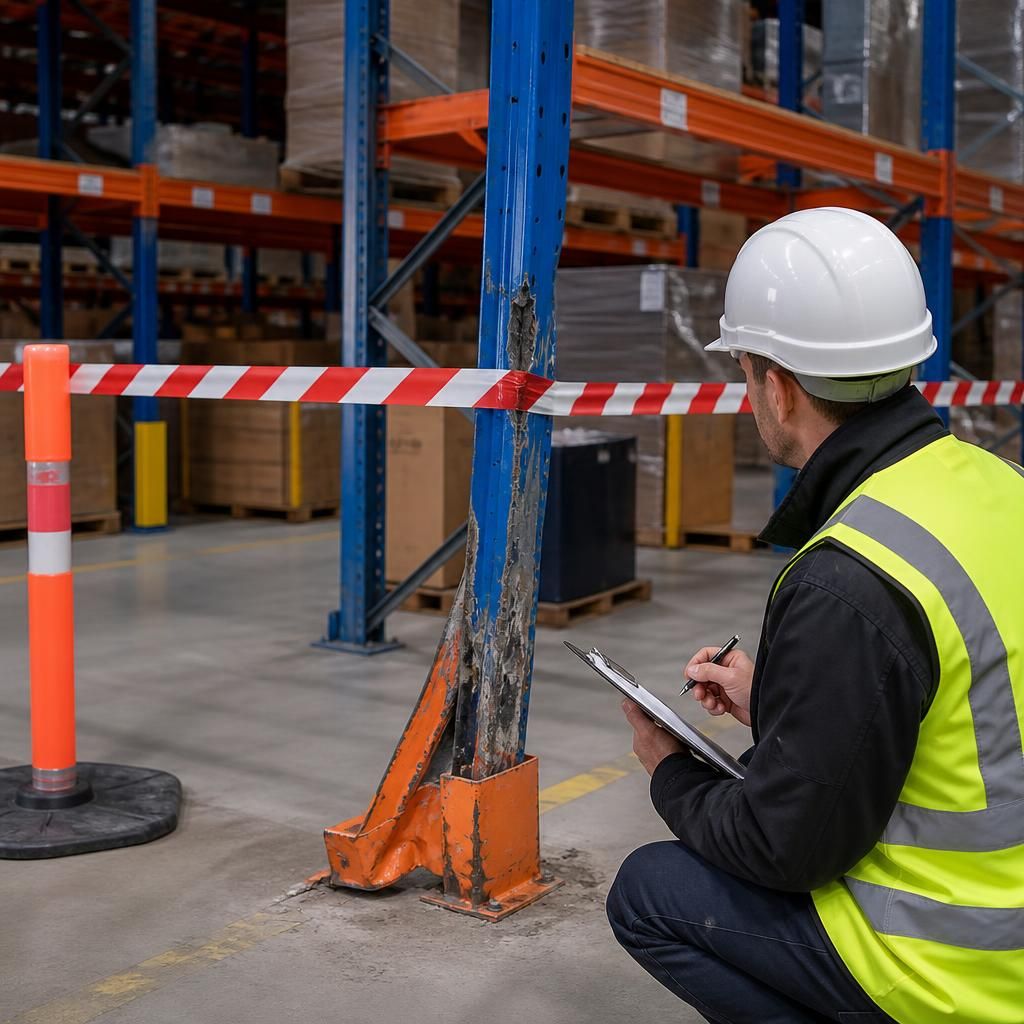
Damage identified during a warehouse racking inspection should be controlled immediately by isolating the affected area and preventing further use until a competent specialist has assessed it. Do not assume that a visibly minor bend, loose connection or missing safety component is harmless.
Keep people, vehicles and loads away from the affected section, then record the location, damaged components, photographs and actions taken. A technical assessment should establish whether the structure requires repair, replacement, unloading or continued isolation. Only return the warehouse racking to service after the completed work has been checked and the responsible person has confirmed that it is safe for use.
Arrange expert help with damaged warehouse racking
Contact Able Racking to arrange a competent assessment of damaged warehouse racking and receive clear advice on isolation, repair or replacement. We can help verify the completed work before the affected area is returned to service.