
What are the legal consequences of not complying with UK warehouse racking inspection regulations?
Failing to inspect and maintain warehouse racking can breach duties under UK health and safety law, including the Health and Safety at Work etc. Act 1974 and the Provision and Use of Work Equipment Regulations 1998. Depending on the circumstances, consequences may include improvement or prohibition notices, substantial fines, prosecution and civil claims if someone is injured or property is damaged.
Failing to inspect and maintain warehouse racking can place a business in breach of UK health and safety law. Depending on the circumstances and the seriousness of any risk or incident, consequences may include improvement or prohibition notices, substantial fines, prosecution of the business or individuals, and civil claims following injury or damage.
There is no single UK regulation titled the “warehouse racking inspection regulations”. Instead, inspection duties arise from several legal requirements and recognised guidance, including:
- Health and Safety at Work etc. Act 1974: employers must, so far as is reasonably practicable, protect employees and others who may be affected by their undertaking. This includes providing and maintaining safe work equipment and safe systems of work.
- Provision and Use of Work Equipment Regulations 1998 (PUWER): work equipment must be suitable, maintained in an efficient state, and inspected where deterioration could create a dangerous situation. Warehouse racking is generally treated as work equipment when it is used in the workplace.
- Management of Health and Safety at Work Regulations 1999: employers must assess risks, implement suitable preventive measures, and make appropriate arrangements for managing health and safety.
- Workplace (Health, Safety and Welfare) Regulations 1992: workplaces and routes used by people must be maintained so that they do not expose workers to avoidable risks.
HSE guidance, including HSG76 Warehousing and storage, recommends a planned inspection system. It distinguishes between regular visual checks by suitably trained personnel and a formal inspection by a technically competent person at intervals based on risk, with an interval of no more than 12 months commonly recommended. The appropriate frequency may need to be shorter where there is frequent impact, heavy use, poor operating conditions, changes to the warehouse layout or a history of damage. Guidance is not legislation in itself, but it can be used by an enforcement authority or court when considering whether reasonable precautions were taken.
Enforcement notices
If an inspector identifies a breach or a serious risk, the Health and Safety Executive or the relevant local authority may issue an improvement notice. This requires the business to remedy a contravention within a specified period. Failure to comply with an improvement notice is a separate offence.
A prohibition notice may be issued where an activity or use of equipment involves, or will involve, a risk of serious personal injury. This can require affected warehouse racking, an area or an operation to stop immediately until the risk has been controlled. A prohibition notice can disrupt picking, loading and storage activities, particularly where damaged components or overloading affect a significant part of the storage system.
Inspectors may also require records, risk assessments, maintenance information, training evidence and previous inspection reports. Missing or incomplete records do not automatically prove that an inspection was not carried out, but they can make it difficult to demonstrate that the business had an effective system of control.
Fines and prosecution
Where a serious breach is identified, the business may be prosecuted. Courts consider factors such as the level of risk, the likelihood and seriousness of harm, whether the breach continued, the organisation’s turnover and resources, and the extent to which the business fell below a reasonable standard of care. Fines can be substantial, particularly for larger organisations or where a breach has caused serious injury or death.
Individuals may also face prosecution where their consent, connivance or neglect contributed to an offence. This may include directors, managers or other people with responsibility for warehouse safety, depending on the evidence. The fact that a business appointed an external inspection provider does not remove its overall responsibility for managing risks, acting on findings and ensuring that repairs are completed properly.
Civil claims and other financial consequences
If a person is injured by a collapse, falling load, impact damage or another foreseeable failure, the business may face a civil claim for compensation. A claimant may rely on evidence such as inspection records, photographs, repair logs, training records, risk assessments, loading information and previous reports. Damage to stock, vehicles, handling equipment or the building may also lead to uninsured or recoverable losses.
Insurance policies may require the business to follow statutory duties, manufacturers’ instructions and recognised inspection and maintenance arrangements. Non-compliance does not automatically invalidate cover, but poor records, ignored defects or failure to follow a policy condition can complicate a claim. A serious incident may also result in increased premiums, policy restrictions, lost operating time, contractual disputes and reputational damage with customers or supply-chain partners.
Why inspection alone is not enough
A formal inspection is only one part of compliance. The responsible person should ensure that:
- the storage system is suitable for the loads, configuration and operating environment;
- load notices and other safety information are present, accurate and understood;
- employees receive suitable instruction and training;
- operators report impacts, defects and unsafe conditions promptly;
- damage is assessed by a competent person;
- unsafe areas or components are isolated, unloaded or taken out of use where necessary;
- repairs use suitable components and are completed to an appropriate standard;
- alterations are controlled and reviewed rather than made informally; and
- inspection, action and close-out records are retained and kept available.
Where damage is found, continuing to use the affected area without an assessment can increase both the physical risk and the legal exposure. The correct response depends on the severity and location of the damage, but may include unloading the affected bays, preventing access, installing temporary controls, arranging repair and carrying out a follow-up inspection before returning the area to service.
How to demonstrate compliance
A defensible compliance system should show a clear chain from risk assessment to inspection, action and verification. Keep formal inspection reports, daily or weekly check records where applicable, photographs, repair documentation, loading information, training records and evidence that recommendations were closed within suitable timescales. Records should identify the location and condition of affected components rather than relying on general statements that the warehouse racking was checked.
Inspection findings should be prioritised according to risk. A critical defect may require immediate unloading and isolation; a serious defect may require prompt remedial action and temporary controls; a lower-risk issue should still be monitored and corrected within a defined period. The person responsible for safety should confirm that actions have been completed, not simply assume that a report has been received.
Using a qualified and experienced inspector supports compliance, but it does not transfer the legal duty away from the employer or duty holder. The safest approach is a documented programme combining competent formal inspections, routine user checks, appropriate training, prompt repairs and effective management oversight. This provides practical protection for people and gives the business evidence that it took proportionate steps to meet its legal responsibilities.
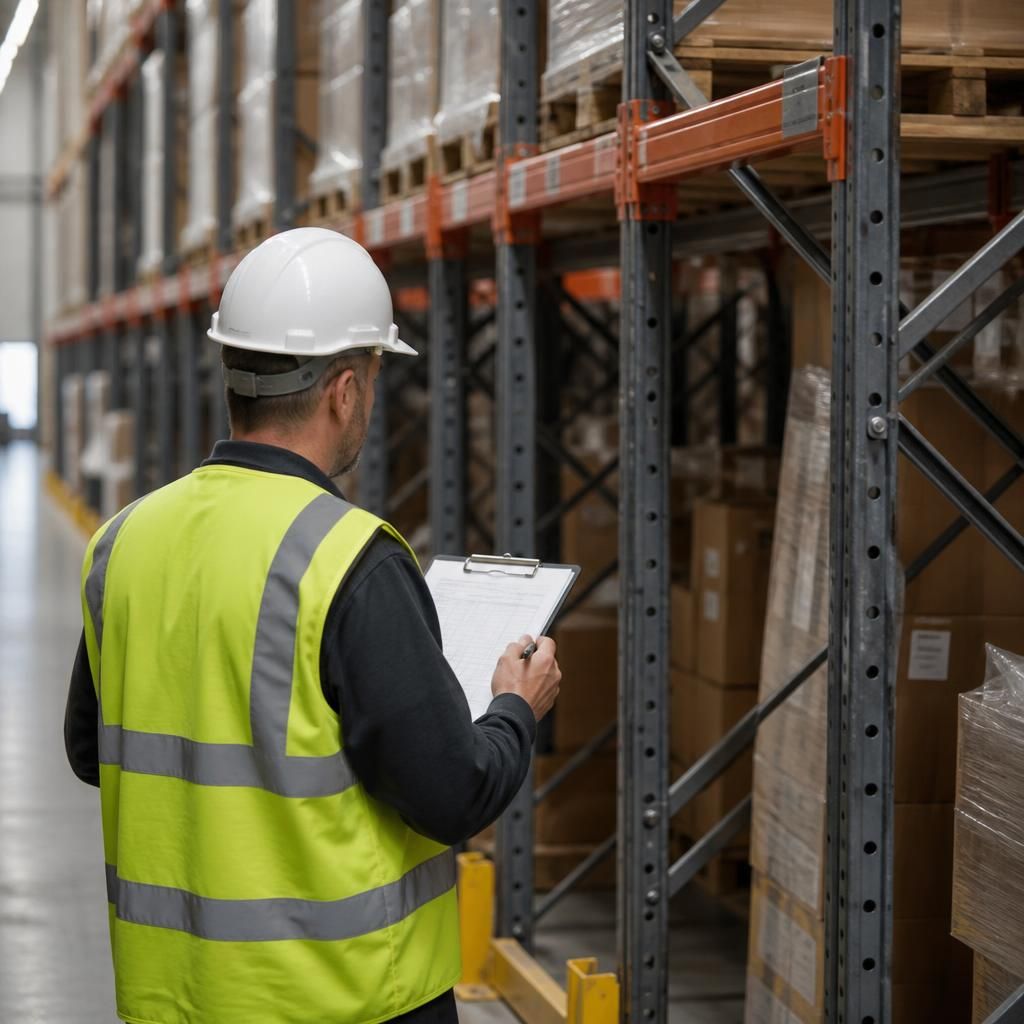
Keeping clear inspection and repair records helps demonstrate that warehouse racking risks were identified, assessed and controlled. If an incident occurs, reports, photographs, repair records, training evidence and follow-up checks can show how the business responded to defects and whether affected areas were taken out of use when necessary.
A report alone is not proof of compliance. The responsible person must ensure that findings are prioritised, unsafe bays are unloaded or isolated where required, repairs are completed appropriately and actions are formally closed. Continuing to use damaged warehouse racking after a serious defect has been identified can increase both the risk of harm and the potential for enforcement action, prosecution or civil claims.
Arrange your warehouse racking inspection
Arrange your warehouse racking inspection with Able Racking to identify defects, assess risks and maintain a safe, compliant storage system. Contact our experienced team to schedule a professional inspection.