
How often should warehouse racking inspections be conducted?
Warehouse racking should receive a documented expert inspection at intervals of no more than 12 months, with the exact frequency determined by a risk assessment. Regular visual checks should also be carried out—typically weekly or at another risk-based interval—and immediately after any event that could cause damage, such as an impact or system alteration.
Warehouse racking should receive a documented expert inspection at intervals of no more than 12 months. The exact frequency should be set by a risk assessment, taking account of the type of storage system, the working environment, traffic levels, loading practices, previous damage and the competence of the people carrying out routine checks. Regular visual checks should also be completed, typically weekly or at another risk-based interval, and immediately after any event that could have affected the system.
These inspection intervals work together rather than replacing one another. Routine checks help identify damage promptly, while the formal expert inspection provides a more detailed assessment of the warehouse racking, its condition and its continued suitability for use.
The usual inspection programme includes:
- Routine visual checks: A trained, nominated person should look for visible damage, displaced loads, missing components, overloading, unsafe storage practices and other hazards. The frequency should reflect the risks in the workplace and should be increased where there is heavy vehicle movement, frequent stock changes or a history of damage.
- Documented expert inspections: A technically competent warehouse racking inspector should complete a systematic inspection at least every 12 months. The inspection should cover the full installation, including frames, beams, bracing, protection, connections, floors and any other relevant components.
- Additional inspections after an event: An inspection should be arranged after an impact, structural alteration, relocation, change of load configuration, unusual overloading, fire, flooding or any other event that could have affected stability or capacity.
A routine visual check is not the same as an expert inspection. It is intended to identify obvious problems quickly so that action can be taken before the damage worsens. It does not normally provide the detailed technical assessment needed to determine whether a damaged component remains suitable for service or whether repairs and replacement are required.
The person carrying out routine checks should know what normal warehouse racking condition looks like, understand the relevant safe working procedures and know how to report concerns. They should be able to recognise issues such as bent uprights, damaged beams, displaced or missing safety pins, impact damage, loose components, leaning frames, damaged floor fixings and loads that are unstable or incorrectly positioned. Findings should be recorded consistently, with clear details of the location, issue and action taken.
The frequency should be reviewed whenever the risks change. For example, more frequent checks may be appropriate where forklift activity is intensive, aisles are restricted, the warehouse has high stock turnover, operators are inexperienced or the installation has previously suffered repeated impacts. A change in the stored goods, pallet type, beam levels or maximum load may also require the inspection and risk assessment programme to be reconsidered.
Any damage that could affect the stability or load-bearing capacity of warehouse racking should be dealt with promptly. The affected area may need to be unloaded, isolated or clearly marked until it has been assessed by a competent person. Components should not be straightened, welded, drilled or otherwise altered as an improvised repair. Remedial work should follow the manufacturer’s requirements or an appropriate technical specification, and the area should be checked again before being returned to service.
A formal inspection report should record the date, areas inspected, defects identified, risk category or priority, recommended corrective action and any follow-up required. It should also make clear whether the installation is suitable for continued use, subject to restrictions, or in need of immediate action. Keeping reports alongside routine check records helps demonstrate that the inspection system is active and allows recurring damage or problem locations to be identified.
There is no single interval that is suitable for every warehouse. The 12-month maximum for a documented expert inspection is an important baseline, but a lower interval may be justified by the risk assessment. Similarly, weekly checks are a common starting point rather than a universal rule. The responsible person should consider the actual conditions in the warehouse and revise the programme when those conditions change.
Where there is uncertainty about the appropriate frequency, the inspection scope or the significance of a defect, obtain advice from a suitably qualified and experienced warehouse racking inspector. A properly planned programme of routine checks, annual expert inspections and event-driven assessments helps protect people, stock and operations while supporting continued compliance with the manufacturer’s instructions and applicable workplace safety guidance.
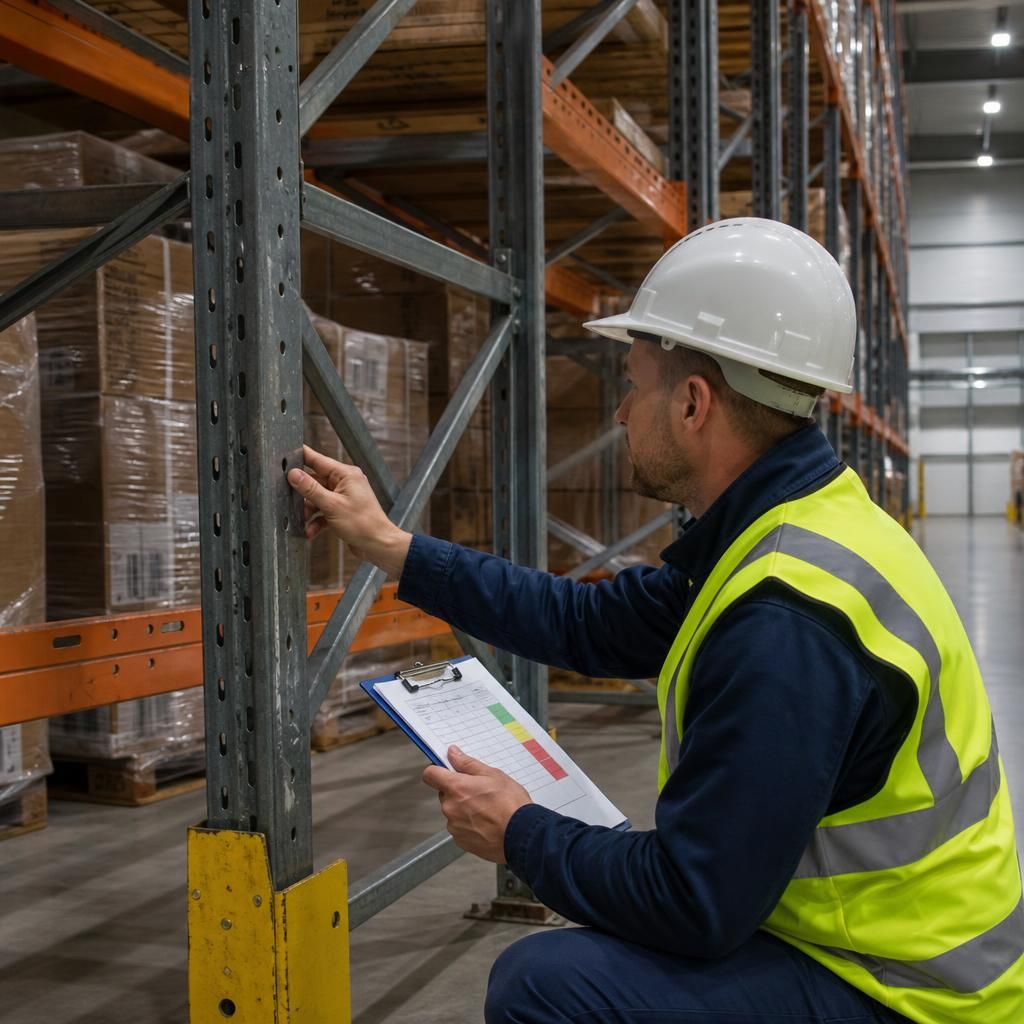
A routine visual check and a formal expert inspection serve different purposes. Routine checks help identify visible damage, displaced loads and unsafe conditions early, while a technically competent inspector assesses the warehouse racking in detail and determines whether it remains safe and suitable for use.
Routine checks should take place at a risk-based frequency, often weekly, and after any impact or significant change. A documented expert inspection should be completed at least every 12 months, or more frequently where vehicle movements, loading practices, previous damage or other workplace risks justify a shorter interval.
Book your warehouse racking inspection
If your warehouse racking inspection is due, or your inspection frequency needs reviewing, book an assessment with Able Racking. Our experienced inspectors can identify defects, recommend appropriate action and help keep your storage system safe and compliant.