
What are the most common deficiencies found during warehouse racking inspections?
The most common deficiencies found during warehouse racking inspections include damaged frames, beams, bracing and guards, missing or unsecured components, overloaded or poorly positioned loads, inadequate aisle clearances, and signs of unauthorised modifications. Inspectors also check for inadequate protection from vehicle impact, corrosion, loose fixings and missing safety signage, then recommend appropriate repairs or controls to restore safe, compliant operation.
The most common deficiencies found during warehouse racking inspections are damage to frames, beams and bracing; missing or unsecured components; overloaded or incorrectly positioned loads; inadequate protection from vehicle impact; and unauthorised alterations. Inspectors also identify corrosion, loose fixings, poor aisle clearances, defective safety accessories and missing documentation or signage. Each issue should be assessed according to its severity, recorded clearly and dealt with through immediate controls, planned repair or continued monitoring.
A warehouse racking inspection is not limited to looking for obvious dents. A competent inspector examines the condition, configuration and use of the complete storage system, comparing what is installed with the available design information and the way the warehouse operates. The following deficiencies are regularly found.
- Damaged upright frames: Forklift impacts and other vehicle contact can bend, buckle or permanently deform upright sections. Damage may occur at the base of a frame, around beam connection points or higher up where it is less visible from floor level. Even apparently minor distortion can reduce the intended load-carrying capacity.
- Damaged beams and connectors: Beams may be dented, twisted, split, deflected or displaced after impact or overloading. Inspectors check beam connectors, locking pins and seating points because a beam that is not properly engaged can become unstable during loading or unloading.
- Missing, loose or damaged bracing: Horizontal and diagonal bracing helps maintain the stability and geometry of a frame. Missing bolts, loose connections, bent braces or incorrectly fitted replacement parts can weaken the structure and require prompt attention.
- Missing safety pins and retaining devices: Beam locking pins, clips and other retention components prevent accidental dislodgement. Where these are absent, damaged or not fully engaged, the affected location may need to be taken out of use until it is made safe.
- Inadequate column protection: End-of-aisle guards, upright protectors and other impact protection may be missing, incorrectly positioned or damaged. Protection that is too small for the risk, poorly fixed or not maintained may fail to prevent a further vehicle strike.
- Overloaded storage positions: Loads may exceed the capacity shown on the load notices or design information. Overloading can also result from placing heavy goods at unsuitable levels, concentrating weight in one area or changing the arrangement without confirming the revised capacity.
- Incorrectly positioned or unstable loads: Pallets that overhang, are damaged, lean, project into aisles or are not properly supported can fall or transfer unexpected forces to the structure. Inspectors also look for gaps between pallets, unsuitable pallet types and loads that are not centred or evenly distributed.
- Inadequate aisle and access clearances: Stored goods, temporary stock, packaging and equipment can reduce the clearance needed for safe vehicle movement, picking and emergency access. Restricted visibility and narrow operating routes increase the likelihood of further impact damage.
- Unauthorised modifications: Removing braces, changing beam levels, relocating components, adding attachments or combining parts from different systems can alter the original design assumptions. Any modification should be assessed and approved by a suitably competent person before it is put into service.
- Corrosion and deterioration: Rust, chemical exposure, moisture and damage to protective coatings can reduce the condition of steel components. Corrosion is particularly important where it affects joints, base plates, fixings or sections that carry significant loads.
- Defective base plates and fixings: Inspectors check whether base plates are secure, correctly supported and properly fixed to the floor. Missing or loose anchors, cracked flooring, settlement and uneven surfaces can affect the stability and alignment of the system.
- Insufficient or damaged safety signage: Load notices should be legible, positioned where operators can see them and consistent with the installed arrangement. Missing capacity information makes it harder for warehouse staff to identify safe loading limits.
Inspectors also consider less visible conditions that can contribute to unsafe use. These include frames that are out of plumb, beams that show excessive deflection, poor alignment between adjoining sections and evidence that components have been repeatedly struck or repaired. The surrounding floor, traffic routes, lighting and housekeeping are relevant because they influence how safely the warehouse racking is accessed and operated.
Findings are normally prioritised by risk rather than treated as a simple pass or fail. A defect presenting an immediate danger may require the affected bay or area to be unloaded, isolated and clearly identified until corrective work is completed. Less urgent damage may be recorded for planned repair, while minor issues that do not currently affect safe operation can be monitored through the site’s inspection and maintenance arrangements. The inspection report should explain the location, condition, likely risk and recommended action for each finding.
When a deficiency is identified, warehouse staff should follow the control specified by the competent inspector. This may include removing stock, preventing access, fitting a correct replacement component, repairing approved damage or arranging a technical assessment. Damaged components should not be straightened, welded or altered on site unless the repair method has been authorised by a suitably qualified person. Replacement parts must be compatible with the system and installed according to the manufacturer’s or designer’s requirements.
Many deficiencies are preventable through good daily management. Operators should report impacts and visible damage immediately, keep aisles and access points clear, load pallets within the stated limits and avoid making changes without approval. Regular visual checks between formal inspections help identify new problems early, but they do not replace a detailed inspection by a competent person. Inspection records, repair evidence, updated load information and any revised drawings should be retained so that the condition and configuration of the warehouse racking can be tracked over time.
For UK workplaces, inspection arrangements should support the duties under applicable health and safety legislation and follow recognised guidance for the safe use and maintenance of warehouse racking, including relevant provisions of BS EN 15635 where applicable. The correct response depends on the system design, the defect, the operating environment and the information available to the inspector. A detailed inspection therefore provides more useful assurance than relying on a visual check alone or assuming that an apparently small defect is harmless.
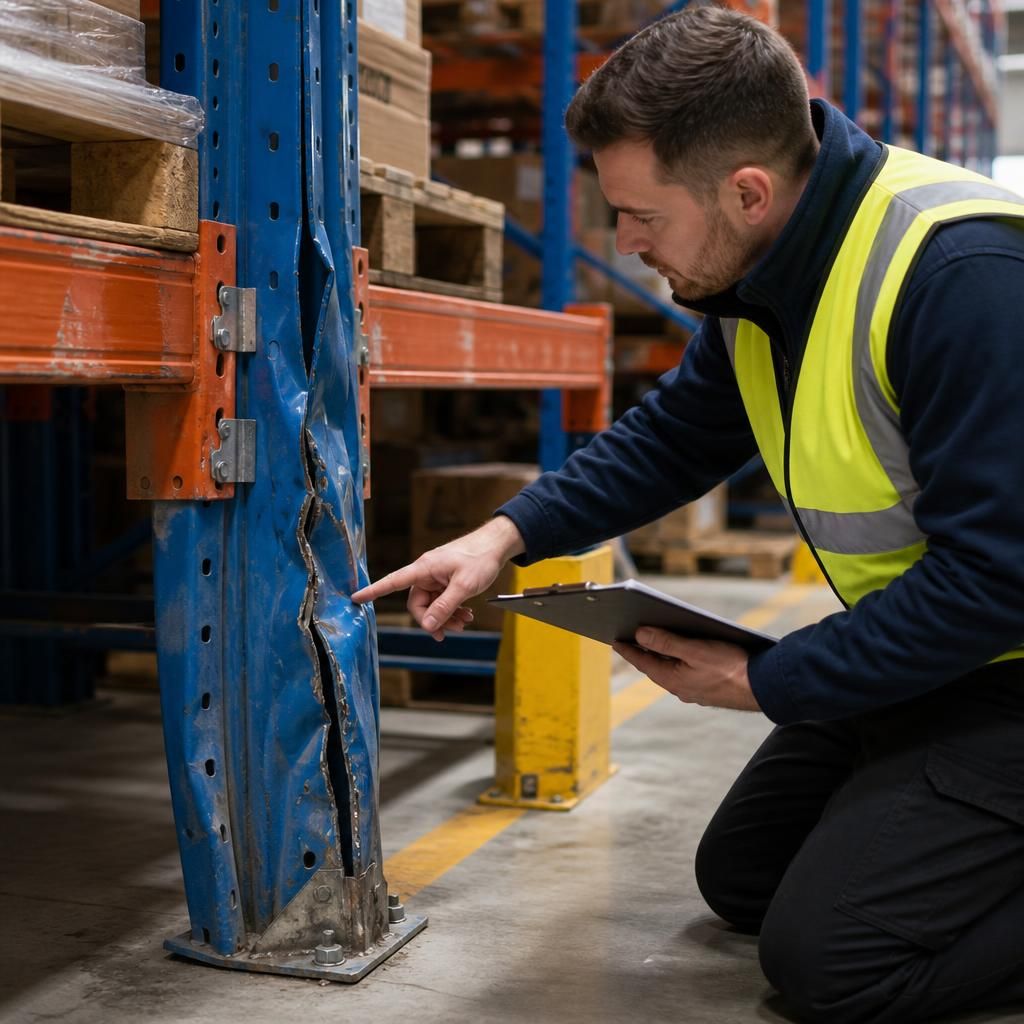
Damage to warehouse racking uprights, beams or bracing is a significant inspection finding because even minor distortion can affect the system’s designed load capacity and stability. Impact damage is often caused by forklift contact, but overloading, poor handling and unauthorised alterations can also contribute.
A competent inspector will assess the location and severity of the damage, check connected components and consider the loads and operating conditions. Where there is an immediate risk, the affected bay should be unloaded, isolated and clearly marked until an approved repair or technical assessment has been completed. Components should not be straightened, welded or altered without suitable authorisation.
Book a Warehouse Racking Inspection
Arrange a warehouse racking inspection with Able Racking to identify deficiencies, prioritise corrective action and support safe, compliant storage operations.