
What qualifications or training should personnel have to perform warehouse racking inspections effectively?
Personnel carrying out warehouse racking inspections should be demonstrably competent through recognised training, relevant practical experience and a sound understanding of applicable safety standards and inspection procedures. They should be able to identify damage, overloading, instability and other defects accurately, assess their significance and produce clear inspection reports with appropriate remedial recommendations.
Personnel performing warehouse racking inspections effectively should be demonstrably competent through suitable training, practical experience and a thorough understanding of warehouse racking systems, inspection methods and workplace safety requirements. There is not one universally prescribed qualification that applies to every inspection, but the person must have enough knowledge and experience to identify defects, judge their seriousness, recommend proportionate action and record findings accurately.
Competence should reflect the type, configuration and use of the warehouse racking being inspected. A person who has only completed a general safety course may not have sufficient expertise to assess structural damage, load-related risks or installation defects. Equally, practical experience alone is not a substitute for formal instruction in recognised inspection procedures.
Suitable personnel will usually have the following knowledge and abilities:
- Warehouse racking construction: an understanding of frames, beams, bracing, protection, decking, locking devices, connections, load notices and other components used in storage systems.
- Inspection techniques: the ability to carry out systematic visual checks from appropriate distances and identify damage, deformation, missing components, loose connections, corrosion, impact evidence and other defects.
- Risk assessment: the ability to assess whether a defect is minor, requires monitoring, needs prompt remedial work or presents an immediate danger requiring the affected area to be taken out of use.
- Load and configuration awareness: an understanding that the safe capacity of warehouse racking depends on its design, bay configuration, beam levels, component condition, floor conditions and the loads being stored.
- Safety awareness: knowledge of safe working practices around vehicles, lifting equipment, stored goods, pedestrian routes and operational warehouse environments.
- Reporting skills: the ability to produce clear records that identify the location, nature and severity of each finding, together with photographs or other supporting evidence where useful.
Training should cover the principles of warehouse racking safety and the relevant guidance used in the UK. This commonly includes familiarisation with BS EN 15635, which sets out principles for the use and maintenance of steel static storage systems, including inspection responsibilities and reporting arrangements. Personnel should also understand the duties placed on employers and equipment users by applicable workplace health and safety requirements. Training should be kept current because inspection methods, warehouse activities, equipment and storage arrangements can change.
A competent inspector should understand the difference between routine checks carried out by warehouse staff and a more detailed expert inspection. Employees may be trained to report obvious damage, displaced loads, missing safety components or other visible concerns during routine operations. A formal warehouse racking inspection requires a broader assessment by someone with the knowledge and experience to examine the system consistently, evaluate defects and provide suitable recommendations.
Practical experience is particularly important. Inspectors should have encountered different warehouse racking layouts, component types, damage patterns and operating conditions. They should be able to distinguish, for example, between superficial marks and deformation that could affect structural performance, or between a correctly installed component and one that is missing, incorrectly positioned or no longer secure. Experience should be supported by documented training and, where appropriate, supervised inspections before the person works independently.
Effective training should also teach inspectors how to work safely while an operation continues around them. This includes planning access, communicating with site personnel, maintaining safe distances from moving vehicles and lifting equipment, avoiding unsafe climbing or reaching, and escalating hazards that cannot be assessed safely from the available position. Inspectors should never create an additional risk in order to examine a defect.
Personnel should be able to classify and communicate findings in a consistent way. Reports should normally include:
- the date and scope of the warehouse racking inspection;
- the areas, aisles, bays or components examined;
- a description and location of each defect;
- the apparent severity and any immediate control required;
- photographs, reference points or markings to support identification;
- recommended repairs, monitoring or further technical assessment; and
- details of restrictions, isolation or follow-up actions agreed with the responsible person.
Inspectors should also know the limits of their competence. A visual inspection does not normally replace a structural calculation, manufacturer’s assessment or specialist engineering evaluation where damage is complex, the original design information is unavailable or the system has been modified. In these circumstances, the inspector should record the concern clearly and recommend assessment by an appropriately qualified specialist rather than make an unsupported judgement.
Refresher training and ongoing assessment help maintain competence. This can include reviewing previous inspection findings, discussing recurring damage with site teams, updating knowledge of relevant guidance, observing inspection quality and checking that reports lead to appropriate corrective action. Training should be refreshed when there are significant changes to the warehouse racking, storage loads, working methods or applicable requirements.
When selecting or using an inspector, ask for evidence of relevant training, practical experience and a defined inspection process. It is also reasonable to check that the individual is insured, works to documented procedures and can provide examples of suitably detailed reports with confidential information removed. The key test is not simply whether the person holds a certificate; it is whether they can demonstrate reliable, independent and technically sound inspection competence.
At Able Racking, inspections are carried out by experienced operatives who understand the practical conditions that affect warehouse racking in daily use. Findings are assessed carefully, recorded clearly and explained in terms of the action needed, helping site teams maintain safe, compliant and operational storage systems.
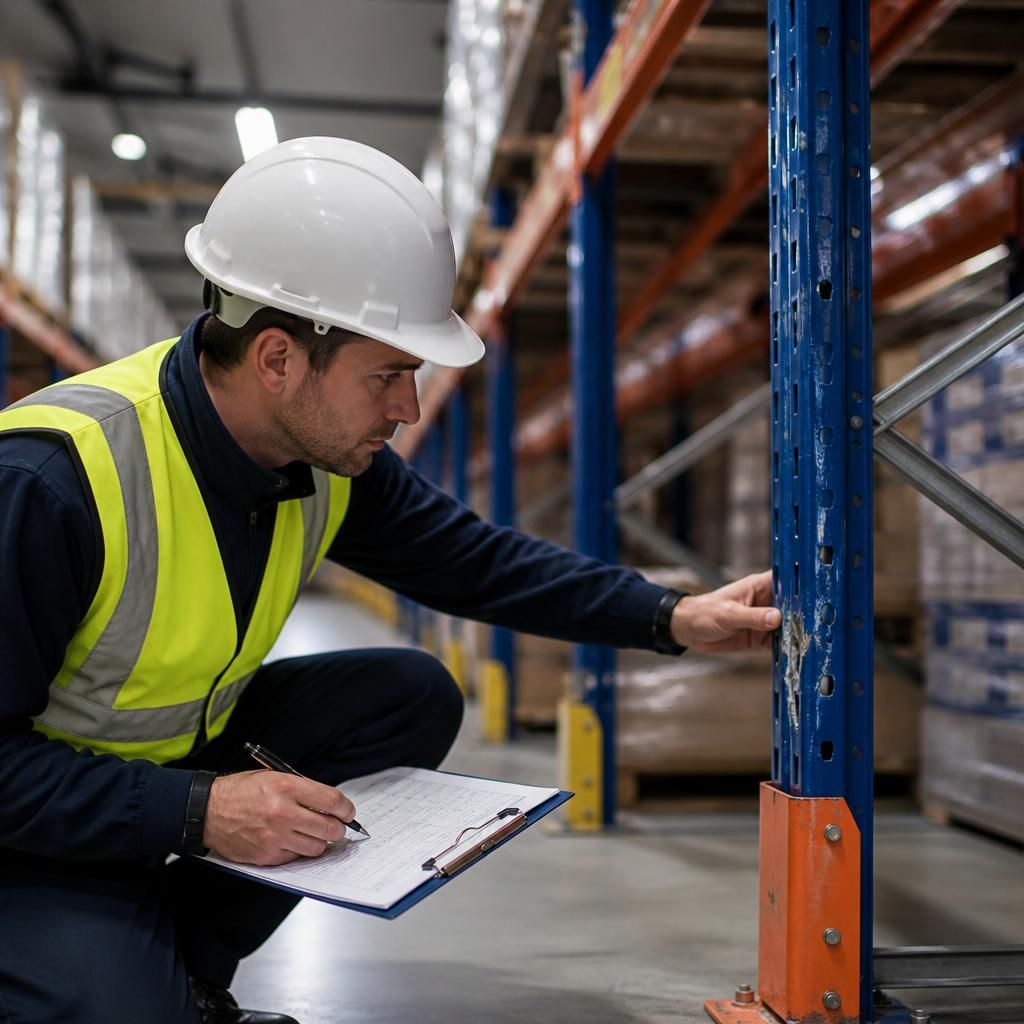
Effective warehouse racking inspections require demonstrated competence, not simply attendance on a general safety course. Personnel should have relevant training in inspection methods, practical experience with warehouse racking systems and the ability to assess damage against recognised guidance, including BS EN 15635.
Competent inspectors should identify defects such as impact damage, deformation, missing components, loose connections and overloading, then judge the appropriate response. They must also record findings clearly, recommend proportionate action and recognise when a complex issue requires further assessment by a suitably qualified specialist.
Arrange a warehouse racking inspection
If you need qualified personnel to assess your warehouse racking, arrange an inspection with Able Racking. Our experienced operatives will record findings clearly and recommend appropriate corrective action.