
How do I properly document the findings of a warehouse racking inspection?
Document a warehouse racking inspection by recording the inspection date, areas and components checked, identified defects, risk level, photographs, recommended actions, responsible person and target completion date. Keep the completed report with evidence of repairs or isolation measures, then record the close-out date and verify that outstanding hazards have been resolved.
Properly documenting a warehouse racking inspection means creating a clear, traceable record of what was inspected, what was found, how serious each issue was, and what action was taken. A useful report should allow someone who was not present during the inspection to identify the affected location, understand the risk, confirm the control measure and verify that the issue has been closed.
The inspection record should be completed promptly while the findings are still accurate and supported by photographs, measurements or other relevant evidence. It should be retained with previous reports, repair records and close-out evidence so that the condition of the warehouse racking can be monitored over time.
Record the inspection details
- Date and time of the inspection.
- Name of the inspector and, where relevant, their employer or organisation.
- Details of the responsible warehouse contact or site representative.
- Warehouse address, building or zone, and the areas included in the inspection.
- The reason for the inspection, such as a scheduled expert inspection, follow-up visit, incident review or post-repair check.
- Any areas, bays or components that could not be accessed, together with the reason and the proposed follow-up action.
It is important to identify the scope accurately. A report that simply states that the warehouse racking was inspected may not show whether every aisle, bay, frame, beam, protection device and relevant accessory was included. Use the site layout, bay references, rack identification labels or another consistent location system to show exactly where the inspection took place.
Describe the warehouse racking and its location
Each finding should be linked to a precise location. Record the aisle, row, bay, frame, beam level or component reference where possible. If the site uses asset labels, include the label or reference number in the report. Consistent location descriptions make it easier for warehouse staff, repair teams and managers to find the affected area without relying on guesswork.
Identify the component involved, for example:
- Upright or frame.
- Beam, connector or locking device.
- Baseplate, anchor or floor fixing.
- Frame, aisle or end protection.
- Bracing, mesh decking, support bars or other accessories.
- Load notice, identification label or safety signage.
Where relevant, also record the apparent cause, such as impact damage, overloading, missing components, unauthorised alteration, corrosion, poor housekeeping or evidence that the warehouse racking is not being used in accordance with its intended configuration.
Describe each defect objectively
Findings should be factual, specific and understandable. Avoid vague comments such as “damaged rack” or “needs attention”. Instead, describe what was observed, where it was observed and why it may affect safe use. For example, a useful entry could state that an upright in a named bay is visibly bent at a particular height, with damage extending over a defined section, and that the affected bay requires assessment and control before continued use.
Where a measurement is relevant, record it using the correct unit and explain what was measured. Do not estimate a measurement if an accurate reading is needed to determine the risk. If the condition cannot be assessed reliably because stock, packaging or another obstruction prevented access, record that limitation rather than assuming the component is satisfactory.
Photographs should support the written description rather than replace it. Take a wider image to show the location and a closer image to show the defect. Ensure that photographs are dated or linked to the relevant report and file name. Include an indicator of scale where this helps demonstrate the size or extent of damage.
Assign a clear risk classification
Every significant finding should have a stated risk level or priority, together with the reason for that classification. The system used should be explained in the report and applied consistently. Many warehouse racking inspections use categories based on the severity of the damage and the urgency of the required action, such as:
- Immediate danger: the affected area should be taken out of use or otherwise controlled without delay, with loads safely removed where this can be done safely.
- Hazard requiring prompt action: the defect requires timely repair, restriction or other corrective action, with interim controls applied where necessary.
- Monitoring or maintenance issue: the condition should be recorded, managed and reviewed within the site’s planned control process.
The classification should reflect the actual condition, the potential consequence of failure, the location of the defect, the loads involved and any existing controls. It should not be based only on how inconvenient the repair may be. If there is uncertainty, seek a competent technical opinion and apply a suitably cautious control until the risk has been assessed.
Record the required action
A finding is not complete until the report states what must happen next. Record the recommended action in practical terms, such as isolating a bay, removing a load, replacing a damaged component, reinstating a missing locking device, correcting an unsafe configuration or arranging a further technical assessment.
Each action should have:
- A named person or department responsible for arranging it.
- A target completion date that reflects the risk level.
- Any interim control, such as an exclusion area, reduced use or load restriction.
- The repair method or technical information required, where known.
- A record of whether the action is open, in progress, awaiting parts, completed or rejected following verification.
Do not record a repair as complete merely because an order has been raised. The report should distinguish between an action being planned and the physical defect being corrected. If a temporary measure is used, state who authorised it, what it controls and when it must be reviewed.
Link the report to repair and close-out evidence
Keep supporting documents with the inspection record. These may include repair quotations, work orders, delivery notes, photographs taken after repair, component details, revised layout information and written confirmation that the affected area has been checked.
Once the action has been completed, a suitably competent person should verify that the defect has been resolved and that the warehouse racking is suitable to return to service. Record the verification date, the name of the person completing it and any remaining restrictions. If the issue remains unresolved, keep it open and document the revised control rather than closing the finding prematurely.
Maintain an inspection and action history
Use a consistent report format for every inspection. This makes changes easier to identify and helps demonstrate that reported damage has been managed. A central action log can be useful where several findings arise from one visit or where repairs are completed at different times.
Review recurring findings for patterns. Repeated impact damage in the same aisle may indicate vehicle movements, visibility, protection or training controls that need attention. Repeated missing locking devices or altered beams may indicate a problem with site checks, stock changes or unauthorised modifications. Documentation should therefore support preventative action, not simply record defects after they occur.
Inspection reports should be retained in line with the organisation’s document-control arrangements and be available to relevant managers, operators, maintenance personnel and inspectors. Protect records from unauthorised alteration, keep superseded reports identifiable and ensure that any revised warehouse racking configuration is reflected in the current documentation.
A well-documented inspection gives the site a reliable audit trail from observation through to verified corrective action. It should show the condition found, the risk decision made, the control applied, the person responsible and the evidence that the warehouse racking was either repaired or deliberately kept out of use until safe.
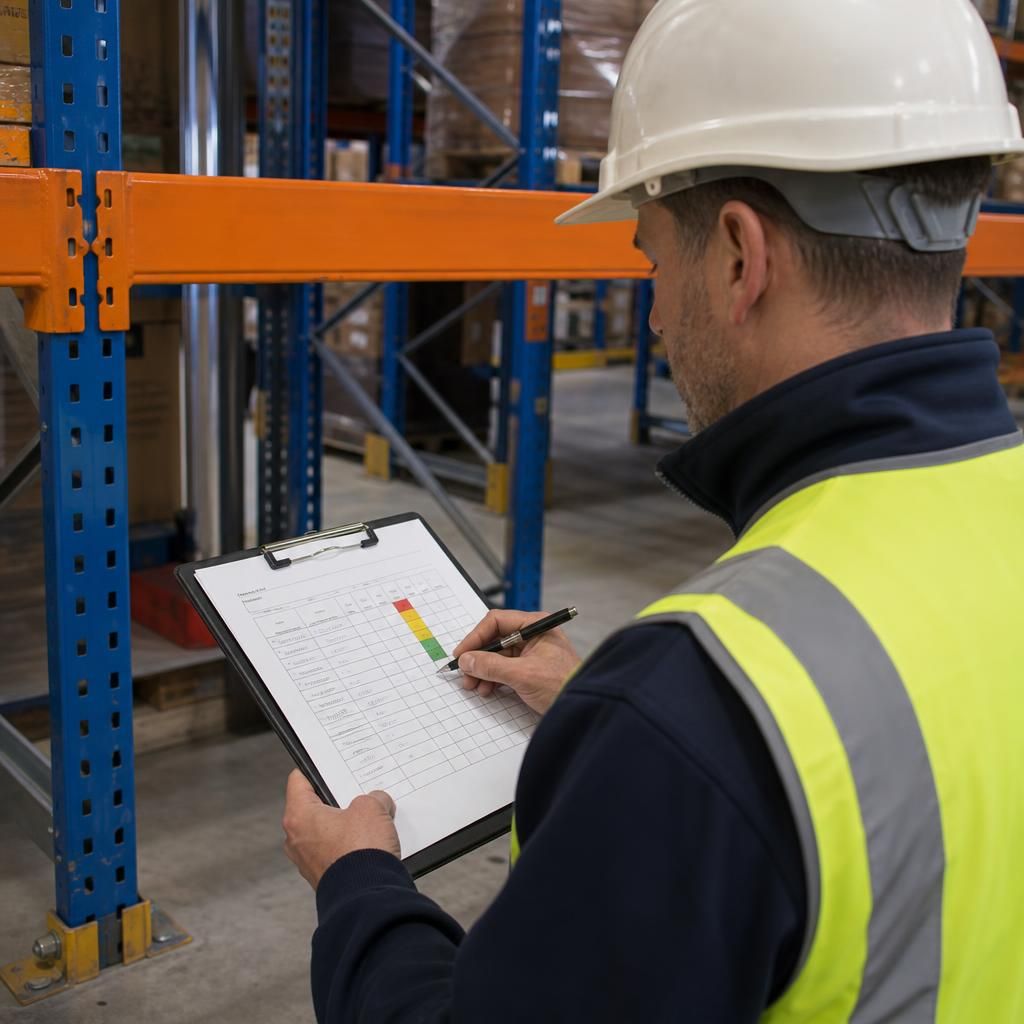
Photographs make an inspection record more useful when they clearly support the written finding. Take a wider photograph showing the aisle, bay or asset reference, followed by a closer image showing the defect. Link each image to the relevant report entry using a consistent file name or reference, and record the inspection date.
Where the extent of damage or distortion is relevant, include a suitable scale indicator and record any measurement separately. Photographs should support, not replace, an objective description of the component, its location, the observed condition and the action required. This creates a reliable record for repair teams and makes later close-out checks easier to verify.
Need help documenting your warehouse racking inspection findings?
Need help documenting your warehouse racking inspection findings? Able Racking can provide expert guidance to ensure defects, risk classifications, corrective actions and close-out evidence are recorded clearly and accurately.