
How can racking inspection training courses benefit my warehouse operations?
Racking inspection training courses equip your warehouse team to identify damage, unsafe conditions and compliance risks before they lead to accidents, product loss or operational disruption. They also support consistent inspections, prompt reporting and preventative maintenance, helping keep storage systems safe, compliant and efficient.
Racking inspection training courses benefit warehouse operations by giving employees the knowledge and practical skills to identify damage, unsafe conditions and developing compliance risks before they result in injury, stock loss or avoidable disruption. A trained inspection team can carry out consistent checks, report defects clearly and support timely repairs and preventative maintenance.
The benefits extend beyond completing a routine checklist. Effective training helps your team understand how storage systems are intended to operate, what common damage looks like and when a defect requires immediate action from a competent person or specialist. This creates a more controlled approach to warehouse safety and helps protect both people and the performance of the storage system.
Earlier identification of damage
Forklift impacts, overloaded beams, displaced components and missing safety devices can compromise a storage system. Training helps inspectors recognise visible signs such as bent uprights, damaged bracing, distorted beams, loose connections, missing locking pins and changes in the position of stored loads. It also explains why apparently minor damage should not be ignored, particularly where repeated impacts or progressive movement may weaken the system.
Identifying these issues at an early stage allows the responsible person to isolate an unsafe area, prevent further use and arrange an appropriate technical assessment or repair. This can reduce the likelihood that a small defect develops into a more serious failure or causes wider operational disruption.
More consistent inspections and reporting
Unstructured checks can produce inconsistent results, especially when different employees use different interpretations of what constitutes a defect. Training establishes a repeatable inspection process covering the condition of structural components, protection, load information, access routes, housekeeping and signs of overloading or misuse.
Inspectors also learn how to record findings in a useful format. Clear reports should identify the location of the issue, describe the observed condition, indicate its severity and state the action required. Accurate records make it easier to track outstanding defects, demonstrate that concerns have been addressed and identify recurring damage patterns.
Improved compliance management
Training supports the responsibilities of employers, warehouse managers and other duty holders under relevant health and safety requirements. It helps employees understand the importance of maintaining safe equipment, following manufacturer information, observing load limits and retaining suitable inspection records.
Courses commonly introduce the principles of recognised guidance, including BS EN 15635 where applicable, and explain how internal checks, documented inspections and specialist assessments fit together. The precise legal and technical requirements depend on the storage system, workplace activities and risk assessment, so training should be applied alongside the organisation’s own procedures and competent technical advice.
A trained employee does not automatically become qualified to design, alter or certify every aspect of a storage system. Where damage is complex, the cause is uncertain or structural integrity may be affected, the issue should be escalated to a suitably competent specialist. Knowing when to escalate is an important part of safe inspection practice.
Reduced risk of accidents and disruption
Well-trained inspectors help identify conditions that could contribute to falling goods, collisions, blocked access or instability. Prompt action can protect warehouse employees, visiting drivers and other people working near the storage system. It can also reduce the risk of emergency closures, damaged stock and interruptions to picking, replenishment and dispatch activities.
Inspection training therefore supports operational continuity as well as safety. It does not remove the need for safe working methods, suitable vehicle operation or effective supervision, but it provides an important control for detecting problems that routine activity may otherwise overlook.
Better preventative maintenance
Inspection findings can reveal patterns that are useful for preventing future damage. For example, repeated impact in one aisle may indicate poor traffic management, inadequate protection, restricted visibility or a layout that does not suit the equipment in use. A trained team can provide more useful information to managers, enabling them to address underlying causes rather than repeatedly repairing the same component.
Regular, well-documented observations also help inform maintenance planning. Components can be assessed and repaired according to their condition and risk, rather than relying solely on reactive work after a failure or serious incident.
Clearer responsibilities across the warehouse
Training gives employees a shared understanding of what they should look for, what they can report and what action is expected after a defect is found. This supports a stronger reporting culture and reduces uncertainty when damage is discovered during a shift.
It is good practice to define who carries out routine visual checks, who reviews inspection reports, who decides whether an area must be taken out of use and who authorises repairs or return to service. Training can support these arrangements, but the responsibilities should also be documented within the warehouse’s inspection and maintenance procedures.
Practical value for managers and trained employees
- Managers receive more reliable information about the condition of the storage system.
- Employees gain practical skills that support safer day-to-day work.
- Defects can be prioritised according to their potential risk and required response.
- Inspection records provide evidence of monitoring and follow-up.
- Recurring damage and unsuitable working practices are easier to identify.
- Communication between warehouse staff, maintenance teams and specialist contractors becomes clearer.
For the training to deliver these benefits, it should be followed by a defined inspection schedule, accessible reporting forms, suitable escalation arrangements and prompt action on reported defects. Supervisors should also check that trained employees remain familiar with the systems they inspect, particularly after layout changes, alterations, new vehicle movements or changes to loading practices.
In practical terms, racking inspection training turns condition checks into a controlled safety process. It helps your warehouse team recognise risk earlier, make better-informed decisions and support compliance through reliable records and appropriate follow-up. Used alongside competent repairs, planned maintenance and effective warehouse procedures, it contributes to safer operations, fewer avoidable interruptions and longer-lasting storage equipment.
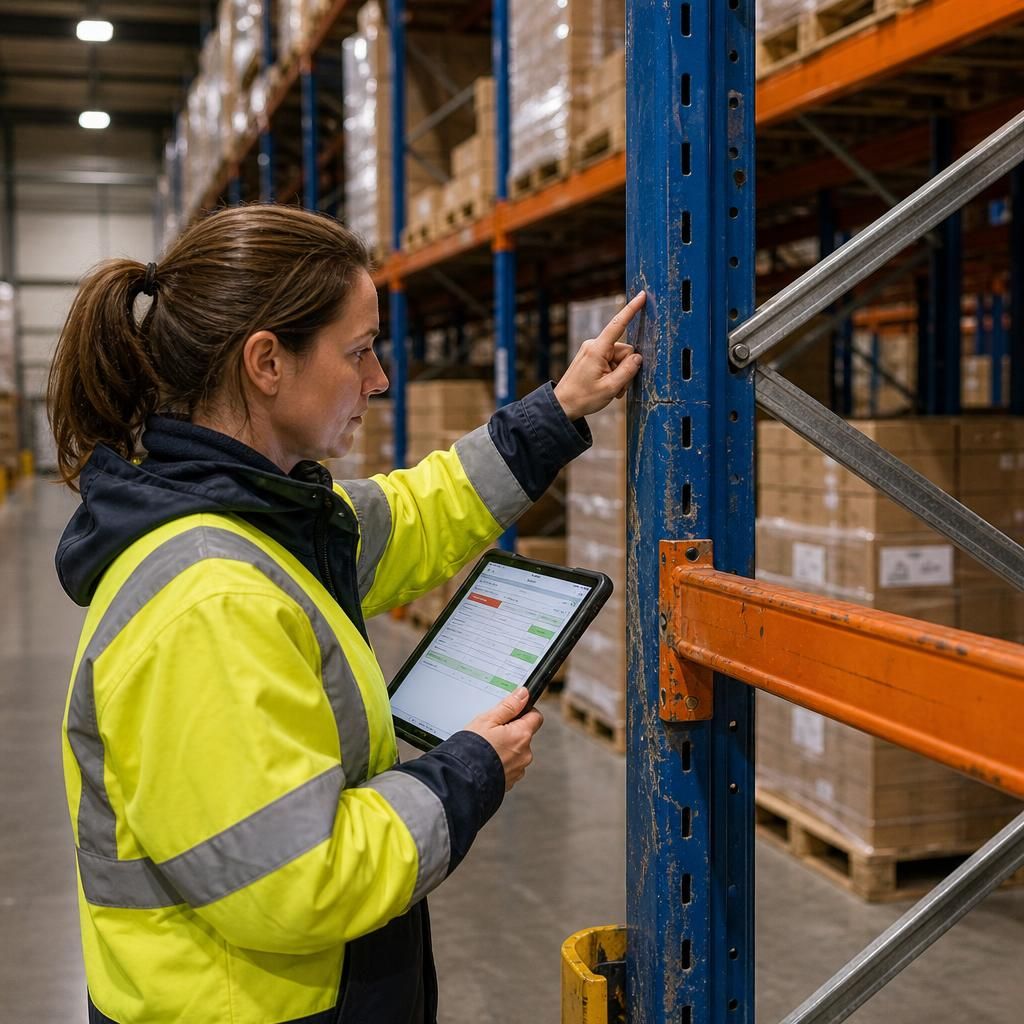
Racking inspection training helps warehouse employees identify damage and unsafe conditions early, then record and escalate them correctly. This supports prompt action before a defect contributes to falling goods, further structural damage or disruption to warehouse operations.
Training gives inspectors a consistent method for checking uprights, bracing, beams, connections, locking devices, protection and load information. It also helps them distinguish between conditions that require immediate isolation and issues that can be referred for planned repair or further assessment.
- Record the precise location and condition of the defect.
- Describe the likely risk clearly rather than using vague terms.
- Follow the site procedure for isolating affected areas.
- Escalate uncertain or significant damage to a suitably competent specialist.
- Track remedial work through to completion and authorised return to use.
Consistent reporting gives managers reliable information for prioritising repairs, identifying repeated impact damage and improving warehouse procedures. Training does not replace specialist assessment or repair, but it ensures that potential problems are recognised and managed without unnecessary delay.
Explore racking inspection training for your warehouse
Speak to Able Racking about the inspection training course that best suits your warehouse team, procedures and storage systems. Our experienced specialists can explain the available options and help you plan the next step.