
What safety standards should a pallet rack risk assessment cover?
A pallet rack risk assessment should cover the condition and configuration of the warehouse racking, load capacities, stability, impact damage, clearances, protection measures, access arrangements, and risks from forklifts and other workplace activities. It should also assess compliance with relevant UK health and safety duties, manufacturer guidance, and recognised warehouse racking standards, with defects prioritised, recorded and corrected.
A pallet rack risk assessment should examine the safety of the warehouse racking system, the loads it carries, how it is used and the surrounding workplace risks. It should identify foreseeable hazards, assess the level of risk, specify suitable controls and record actions for defects that require monitoring, repair or immediate isolation. The assessment should be based on current site conditions, not solely on the original design or installation information.
Legal duties and recognised guidance
The assessment should consider the duties that apply to work equipment and warehouse operations, including the Health and Safety at Work etc. Act, the Management of Health and Safety at Work Regulations and the Provision and Use of Work Equipment Regulations (PUWER). Relevant guidance includes the HSE publication HSG76, Warehousing and storage: A guide to health and safety, together with applicable European standards for steel static storage systems.
EN 15635 provides operational guidance for the use and maintenance of warehouse racking. Depending on the system and the information available, the assessment may also need to take account of standards covering design, specification, tolerances, clearances and protection. Manufacturer instructions, design calculations, handover documents and any site-specific engineering advice should be treated as important evidence.
System condition and structural integrity
The inspection should assess the condition of frames, uprights, braces, beams, connectors, locking devices, baseplates, anchors, protectors and other structural components. It should look for:
- Impact damage from forklift trucks, pallet trucks or other vehicles;
- Bent, twisted, cracked, distorted or missing components;
- Loose, missing or incorrectly fitted fixings and beam locks;
- Damaged or inadequate floor anchors and baseplates;
- Corrosion, deterioration, unauthorised alterations or incompatible replacement parts; and
- Signs that the system has moved, settled or become unstable.
Damage should be categorised according to its seriousness and dealt with promptly. Where a defect could cause collapse or create an immediate danger, the affected bay or area should be taken out of use until it has been made safe by a competent person.
Load capacity and configuration
The assessment should compare the installed configuration and stored loads with the available design information and load notices. It should check that:
- Load notices are present, legible and consistent with the actual layout;
- Beam levels, bay widths, frame heights and component types match the approved design;
- Loads do not exceed the stated capacity of beams, frames, floors or accessories;
- Pallets are suitable, stable and in good condition;
- Loads are evenly distributed and properly supported;
- Overhanging, unstable or poorly wrapped loads are controlled; and
- Any changes to the arrangement have been reviewed and authorised.
Capacity must not be estimated from appearance. If design information is missing, the system has been altered or the proposed loads differ from the original specification, a suitable technical review may be needed before use.
Clearances, access and workplace layout
A pallet rack risk assessment should consider the clearances needed for safe operation, including the space between loads, frames, beams, vehicles, walkways, doors, fire equipment, sprinklers and other structures. It should assess whether aisles allow vehicles and pedestrians to move safely and whether visibility is adequate at crossings, corners and junctions.
The layout should also be checked for obstructions, uneven floors, poor housekeeping, inadequate lighting, spillages and areas where people could be trapped or struck. Emergency routes and access to fire-fighting equipment must remain available. Where pedestrians and vehicles share space, the assessment should address segregation, barriers, marked routes, speed controls, crossing points and site traffic procedures.
Protection against impact and falling objects
Controls should be considered for foreseeable vehicle impacts, including end-of-aisle protection, upright guards, barriers and other suitable protective measures. Their position and condition should be reviewed against the traffic routes and the likely direction of impact.
The assessment should also cover falling pallets, products or components. This includes the suitability of decking, pallet supports, mesh, backstops and other accessories, as well as the risk of items being pushed through the rear of a bay or falling into an occupied walkway. Damaged pallets and unsuitable storage methods should be removed from service.
Use, inspection and maintenance arrangements
A safe system should define who may load and unload the system, how loads are positioned, how damage is reported and who is authorised to make adjustments or repairs. It should cover operator training, forklift controls, inspection of pallets and housekeeping expectations.
The risk assessment should link to a documented inspection programme. Routine visual checks by trained staff can identify new damage quickly, while a more detailed expert inspection should be completed at suitable intervals and after events such as significant impact, changes to the layout, relocation, overloading, fire, flooding or other circumstances that could affect stability. A risk assessment is not a substitute for a formal warehouse racking inspection, and an inspection report should not be treated as a complete assessment of every workplace activity.
Records should identify the location and nature of each defect, its risk classification, the action required, the person responsible and the target completion date. Repairs should use compatible components and be completed in accordance with the manufacturer’s or a suitably qualified engineer’s instructions. Straightening or welding damaged structural members without approval can create additional risks.
People, procedures and foreseeable changes
The assessment should consider everyone who may be affected, including forklift operators, warehouse staff, maintenance workers, contractors, visitors and emergency responders. It should account for inexperienced or vulnerable workers where relevant and confirm that instructions, supervision and training are suitable.
It should also be reviewed when the business changes its stock, vehicles, shift patterns, traffic routes, storage density or warehouse racking configuration. New equipment, different pallet types, increased load weights or changes to the building can introduce risks that were not present when the original assessment was completed.
What a complete assessment should produce
A thorough assessment should leave the business with a clear record of the systems and areas examined, the hazards identified, existing controls, additional measures required and the priority for each action. It should be supported by relevant drawings, load information, inspection records, photographs and repair evidence where appropriate.
The aim is not simply to confirm that warehouse racking appears serviceable. It is to demonstrate that the system is suitable for its intended use, operated within its design limits, protected from foreseeable damage and managed through effective inspection, maintenance and corrective-action procedures.
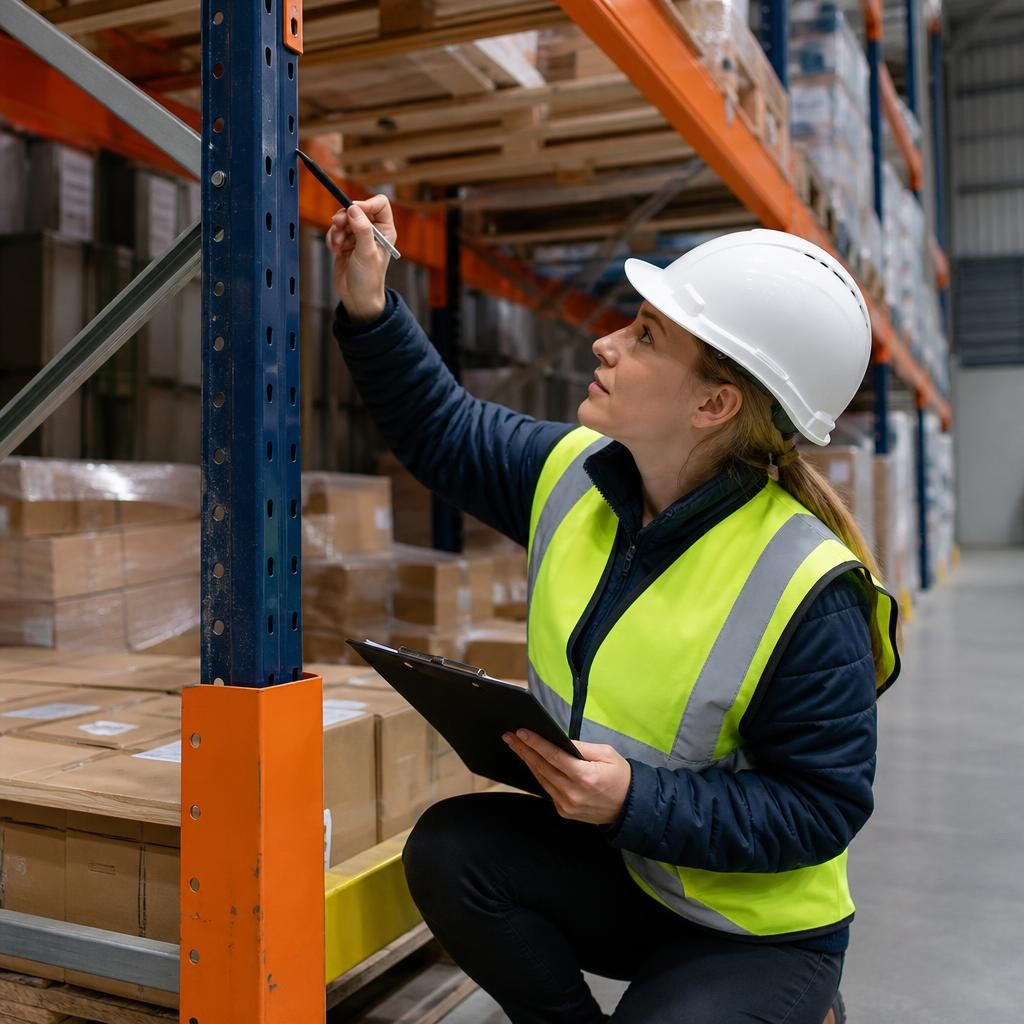
A key safety standard for a pallet rack risk assessment is the prompt control of damage. The assessment should identify impact damage, distorted uprights or beams, missing components, loose fixings, damaged anchors and other defects that could affect the stability or safe use of the warehouse racking.
Each defect should be recorded with its location, severity and required action. Where damage presents an immediate danger, the affected bay or area should be isolated and unloaded until a competent person confirms the appropriate repair. Repairs should use compatible components and follow the manufacturer’s or engineer’s instructions; damaged structural members should not be straightened or welded without suitable technical approval.
Book your pallet rack risk assessment
Contact Able Racking to book a pallet rack risk assessment and receive clear, prioritised guidance on any corrective actions required.