
What measures can be taken to ensure damaged or misconfigured warehouse racking is promptly identified and corrected?
Damaged or misconfigured warehouse racking should be identified through routine visual checks, documented inspections and immediate reporting of defects, with affected areas isolated until assessed. A competent inspector can then determine the required repair, replacement or reconfiguration and verify that the warehouse racking is safe before it returns to service.
Damaged or misconfigured warehouse racking is best controlled through routine visual checks, documented inspections, immediate defect reporting and a clear process for isolating, repairing and verifying affected areas. Any warehouse racking that may be unsafe should be taken out of use until a competent person has assessed it and confirmed that the required corrective action has been completed.
Use a planned inspection process
Warehouse racking should be monitored at several levels, rather than relying only on an occasional formal assessment. Warehouse operatives should carry out frequent visual checks for obvious damage, missing components, displaced loads and signs that the system no longer matches its intended configuration. Supervisors should review reported issues and ensure they are recorded and dealt with promptly.
A formal warehouse racking inspection should be completed by a suitably competent inspector at an interval based on the condition, use and risk profile of the installation. The inspection should examine the structure, protection, loads, floor conditions, configuration, safety notices and any previous repairs. Inspection findings should be documented clearly, with defects prioritised according to their potential effect on stability and safety.
Make defect reporting immediate and unambiguous
Everyone working around warehouse racking should know how to report damage. Reports should identify the location, affected components, apparent severity and any relevant circumstances, such as an impact from handling equipment or an unstable load. Photographs can help the responsible person assess the issue, but they should not replace a physical inspection where structural damage is suspected.
Reporting arrangements should be simple enough to use during a busy shift. Supervisors should check that reports are being closed properly rather than merely recorded. Repeated damage in the same aisle or at the same position may indicate a wider issue with traffic routes, protection, loading practices or operator training.
Isolate unsafe warehouse racking
Suspected unsafe warehouse racking should be clearly identified and prevented from further use. This may require unloading affected locations, restricting access to an aisle or placing suitable warning notices and physical barriers around the danger area. Loads should not be removed or adjusted if doing so could increase the risk of collapse; the response should be planned by a competent person.
Isolation should remain in place until the defect has been assessed and the required repair, replacement or reconfiguration has been completed. Removing a warning label without resolving the underlying problem creates a risk that damaged warehouse racking will return to service unnoticed.
Assess the cause and extent of the defect
An inspection should determine whether the issue is limited to one component or has affected the wider warehouse racking system. Important checks include:
- uprights, frames, beams, braces, connectors and baseplates for bending, cracking, distortion or separation;
- protective guards and anchors for damage, displacement or inadequate fixing;
- beam levels, bay dimensions and component compatibility against the approved configuration;
- floor condition, plumbness, stability and any signs of movement;
- load positions, pallet condition, overhangs and evidence of overloading;
- locking devices, clips, safety pins and other retaining components;
- load notices and layout information to confirm that the installation is being used as designed; and
- nearby warehouse racking for related damage caused by the same impact or installation problem.
Paint damage alone may be cosmetic, but a visible dent, twist or deformation in a load-bearing component should never be dismissed without assessment. The inspector should consider the component, its location, the nature of the damage and the loads supported above it.
Correct damage using an approved method
Repairs should be based on the manufacturer’s requirements or a technically justified repair specification. Damaged load-bearing components should not be straightened, welded, drilled or modified on site unless the method has been specifically approved by a suitably qualified person. In many cases, replacement is safer and more appropriate than attempting to restore a damaged component.
Replacement parts should be compatible with the existing warehouse racking system and installed by trained personnel. The repair should include all associated fixings, locking devices, anchors and protection required for the installation. Temporary measures should be clearly controlled and should not be treated as a permanent solution.
Control misconfiguration as well as physical damage
Warehouse racking can become unsafe even when no component is visibly bent or broken. Common configuration problems include unauthorised changes to beam levels, removal of braces or safety components, incompatible replacement parts, incorrect bay loading, missing load notices and changes to the aisle layout that affect access or stability.
Any proposed alteration should be reviewed before work begins. The responsible person should confirm that the revised arrangement is suitable for the building, equipment, pallets, loads and operating methods. Updated layout drawings, load information and notices should be provided where the configuration changes, and affected staff should be briefed before the area is used.
Verify the completed work
Corrective action is not complete until the warehouse racking has been checked after repair or reconfiguration. The verification should confirm that:
- the correct components and fixings have been installed;
- the structure is aligned, stable and adequately anchored;
- protection and safety devices are in place;
- load levels and capacities match the approved arrangement;
- notices and records have been updated; and
- the area is suitable to return to service.
The person authorising the return to service should be competent to make that decision and should retain the inspection and repair evidence. Where the cause involved an impact, poor loading or an unauthorised alteration, the underlying cause should also be addressed rather than simply repairing the visible defect.
Prevent recurrence through management controls
Effective prevention combines physical protection with safe working practices. Suitable controls may include impact protection at vulnerable positions, clearly defined vehicle routes, separation of pedestrians and handling equipment, controlled access to warehouse racking, correct pallet selection and regular operator training.
Staff should understand load limits, approved storage positions, the importance of keeping aisles clear and the requirement to report damage immediately. Supervisors should monitor whether warehouse racking is being used in accordance with the approved design and whether repeated defects suggest that additional protection or revised procedures are needed.
Inspection records should identify the defect, location, risk classification, action owner, completion date and evidence of closure. Reviewing these records helps identify recurring damage and supports a preventative maintenance programme. A competent warehouse racking inspector can also advise on inspection frequency, repair requirements and whether a system remains suitable after changes to loads, equipment or operating conditions.
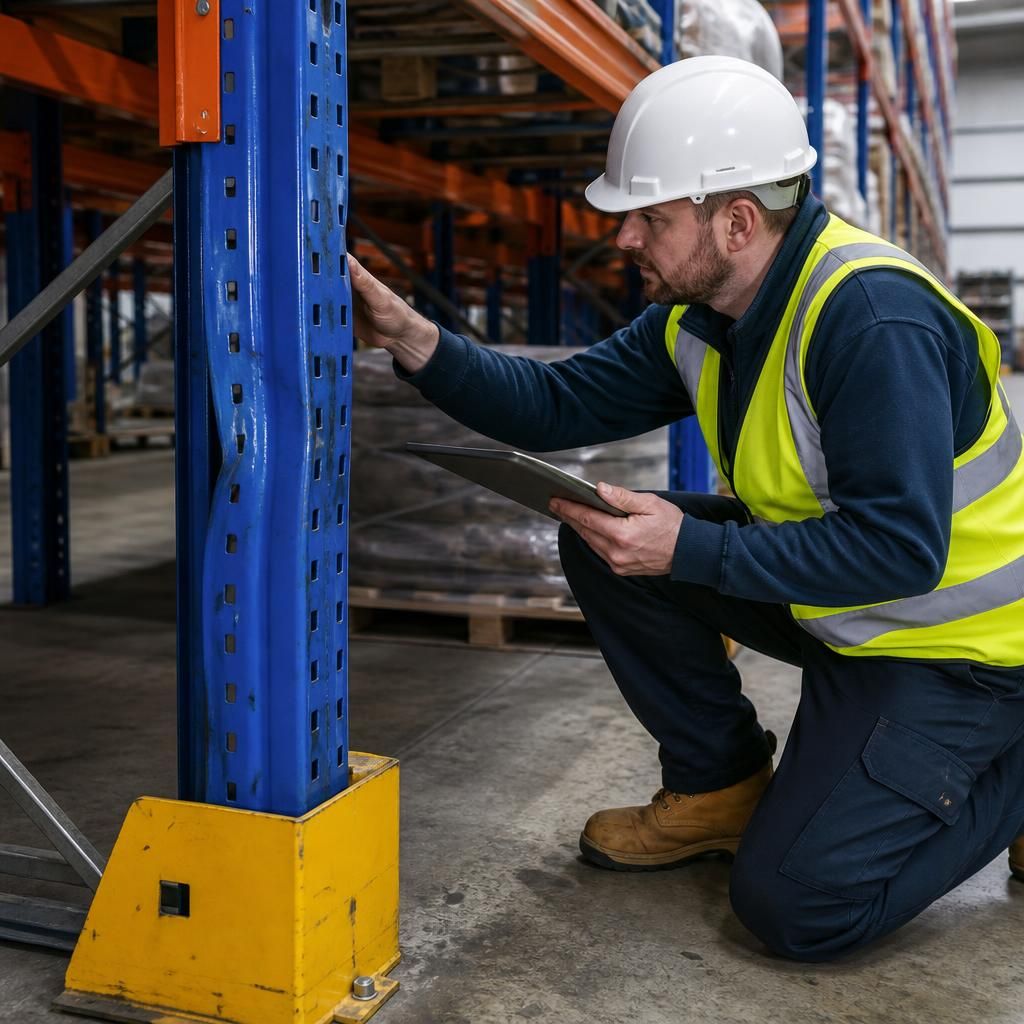
Suspected damage to warehouse racking should be reported immediately and the affected area isolated until it has been assessed by a competent person. This may involve unloading the location, restricting access and displaying clear warning notices. Staff should not remove loads or attempt to straighten damaged components if doing so could increase the risk of instability.
Warehouse racking should only return to service after the required repair, replacement or reconfiguration has been completed and independently checked. Verification should confirm that the correct components, fixings, protection, load information and safety notices are in place, with the inspection and corrective action recorded for future reference.
Arrange an Expert Warehouse Racking Inspection
If damaged or misconfigured warehouse racking has been identified, arrange an expert warehouse racking inspection to assess the risk and specify the correct corrective action. Able Racking can help verify repairs, reconfiguration and safe return to service.