
What qualifications should the personnel conducting the warehouse racking inspections have to ensure compliance?
Personnel conducting warehouse racking inspections should be demonstrably competent, with relevant practical experience, formal inspection training and a sound understanding of applicable UK legislation, HSE guidance and BS EN 15635. Using an independent, suitably qualified specialist—such as a SEMA-approved racking inspector—provides clear evidence that the inspection has been completed to an appropriate professional standard.
Personnel conducting warehouse racking inspections should be demonstrably competent through a combination of formal inspection training, relevant practical experience and a thorough understanding of UK safety requirements. They should be able to identify structural damage, assess whether defects affect safe use, recommend proportionate action and produce inspection records that support compliance. For many businesses, appointing an independent specialist, such as a SEMA-approved racking inspector, provides clear evidence that the inspection has been completed by a suitably qualified person.
There is no single statutory licence that applies to every warehouse racking inspector. Instead, the responsible person must select an inspector whose knowledge, training and experience are appropriate to the complexity and condition of the storage system being assessed. The inspector’s competence should be demonstrable, current and relevant to the type of warehouse racking installed at the site.
Core qualifications and knowledge should include:
- Formal warehouse racking inspection training: The inspector should have completed recognised training covering inspection methods, common damage patterns, component identification, load capacity information, risk classification and reporting requirements.
- Knowledge of BS EN 15635: This standard sets out important principles for the use and maintenance of steel static storage systems. A competent inspector should understand its approach to regular inspections, damage assessment, risk levels, corrective action and record keeping.
- Understanding of UK health and safety duties: Inspectors should be familiar with the relevant duties under the Health and Safety at Work etc. Act, the Provision and Use of Work Equipment Regulations and the Management of Health and Safety at Work Regulations, where applicable to the site and its operations.
- Practical experience: Classroom learning should be supported by experience inspecting warehouse racking in operational environments. This helps the inspector recognise issues such as impact damage, missing components, unauthorised alterations, overloading, poor housekeeping and signs of instability.
- Ability to assess risk: The inspector must be able to distinguish between cosmetic issues and defects that could affect structural integrity or safe use. They should assign appropriate priorities and explain when an area must be unloaded, isolated or repaired without delay.
- Knowledge of manufacturers’ information: Inspection decisions may depend on the original design, stated load limits, component specifications and installation details. The inspector should know how to review available documentation and identify when further technical assessment is required.
- Competence in written reporting: A professional inspection report should identify the warehouse racking inspected, record defects clearly, include suitable photographs or location references where useful, classify the risks and state the recommended corrective action.
SEMA approval is widely recognised in the UK as a useful indicator of specialist competence. A SEMA-approved racking inspector has undergone relevant assessment and training for inspecting storage equipment. This does not remove the need to consider the individual’s practical experience, the scope of the inspection and the specific conditions at the site, but it can provide an additional assurance that the inspector understands recognised warehouse racking safety principles.
The inspector should also understand the limits of a visual inspection. An annual warehouse racking inspection normally assesses visible condition, installation, damage, configuration and use. It does not automatically confirm that every design calculation, load rating or hidden connection is correct. Where there is uncertainty about structural capacity, an unauthorised alteration or damage that cannot be assessed visually, the inspector should recommend a further examination by an appropriately qualified structural or storage-system specialist.
When selecting an inspector, check the following:
- Evidence of relevant inspection training and any current professional approval.
- Experience with the type, configuration and operating environment of the warehouse racking on site.
- Familiarity with BS EN 15635, applicable UK legislation and relevant HSE guidance.
- A clear inspection method covering visible damage, stability, protection, load notices, configuration and use.
- Appropriate professional indemnity and public liability arrangements where required by the contract or site rules.
- A reporting process that records findings, risk priorities, photographs or location references and agreed corrective actions.
- Evidence that inspectors receive ongoing training and keep their knowledge of standards, products and safe working practices current.
Independence is also important. The person carrying out the inspection should be sufficiently impartial to report defects accurately, even where repair or replacement work may follow. An inspector should not overlook damage because it is inconvenient to operations, and any recommended repair should be based on the condition and risk presented by the warehouse racking.
The site operator remains responsible for acting on the inspection findings. A qualified inspector identifies and reports issues, but the duty holder must ensure that unsafe areas are controlled, repairs are completed by competent personnel and inspection records are retained. Reports should be reviewed with the warehouse manager or person responsible for warehouse racking safety so that actions, owners and completion dates are clear.
In practical terms, the strongest evidence of compliance is not a certificate alone. It is a combination of suitable qualifications, relevant experience, knowledge of recognised standards, a consistent inspection process and a detailed report that leads to effective corrective action. These checks help ensure that warehouse racking remains safe, serviceable and suitable for continued use.
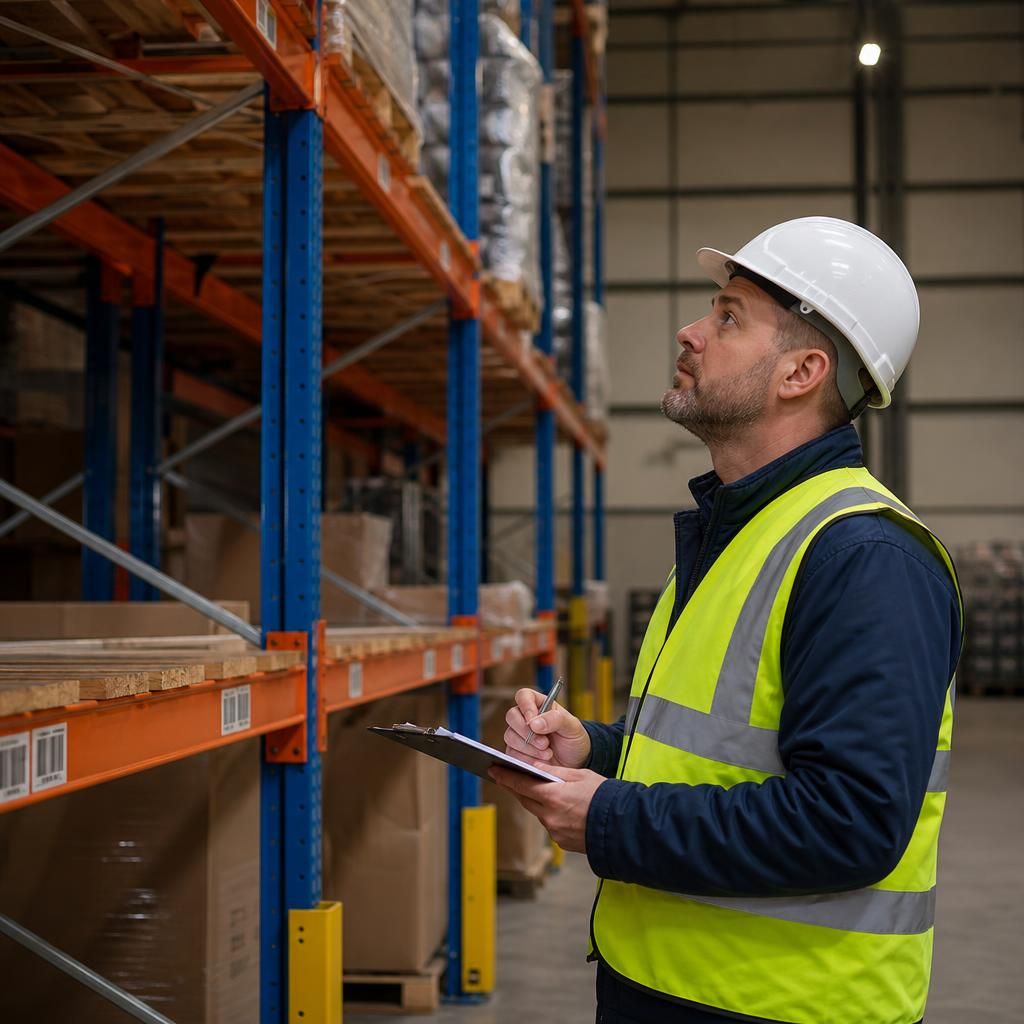
A competent warehouse racking inspector combines recognised inspection training with practical experience, knowledge of BS EN 15635 and an understanding of relevant UK health and safety duties. Qualifications or professional approval, including SEMA approval where applicable, should be supported by evidence that the inspector has assessed warehouse racking in environments similar to yours.
When appointing an inspector, confirm that they can identify damage, assess its risk, review load and configuration information, and produce a clear report with corrective actions. A certificate alone does not demonstrate competence; current knowledge, suitable experience, impartial judgement and a consistent inspection method are equally important.
Speak to a Qualified Warehouse Racking Inspector
Speak to a qualified warehouse racking inspector to confirm that your inspection is carried out by a competent, suitably experienced professional. Able Racking can advise on inspection requirements and provide a clear report with prioritised corrective actions.