
When does warehouse racking need professional repairs?
Warehouse racking needs professional repairs when an inspection identifies damaged, bent or displaced components, loose connections, corrosion, instability or any other defect that could reduce its safe load-bearing capacity. Racking affected by forklift impact or suspected to be unsafe should be taken out of service and assessed by a competent professional before being used again.
Warehouse racking needs professional repairs when any component is bent, cracked, loose, displaced, corroded or otherwise damaged in a way that could affect stability or safe load-bearing capacity. Damage caused by forklift impact, overloading, poor installation or repeated use should be assessed by a competent warehouse racking specialist before the affected bay is used again.
Do not rely on appearance alone. Some defects are immediately obvious, while others affect connections, frames or load paths that may not be visible from normal working positions. A professional assessment determines whether the warehouse racking can remain in service, requires temporary controls, needs a component replacement or should be taken out of use until repairs are completed.
Common signs that professional repairs are required include:
- Uprights, bracing members or beams that are bent, twisted, dented or visibly distorted.
- Cracked welds, damaged connectors, missing locking pins or loose fixings.
- Beams that have become displaced, are no longer seated correctly or show signs of connector damage.
- Frames that are out of alignment, leaning or no longer securely anchored to the floor.
- Corrosion, perforation or deterioration that has reduced the condition of a structural component.
- Damaged or missing guards, end barriers, safety pins, spacers or other protective components.
- Evidence that pallets are not being properly supported, are overhanging or are contacting structural members.
- Repeated impact damage in the same location, even where earlier repairs appear to have restored the structure.
- Unexpected movement, unusual noise or visible changes in the warehouse racking during loading or unloading.
Any suspected impact damage should be reported promptly rather than left until the next planned inspection. A minor-looking dent can weaken an upright or affect the alignment of connected components. Continued loading may increase the damage and make the eventual repair more extensive.
Take immediate precautions when damage is identified. Stop using the affected bay or section where there is a credible risk of collapse, instability or falling stock. Prevent access to the area, do not add or move loads within it, and inform the person responsible for warehouse racking safety. Loads should only be removed if this can be done without exposing people to additional risk. Where the condition is uncertain, the safer approach is to isolate the area and obtain competent advice.
Professional repairs are also appropriate when a defect has been identified during a formal warehouse racking inspection, after an accident or near miss, following a change in loading arrangements, or when the system no longer matches its original design. Changes to pallet dimensions, load weights, handling equipment, aisle arrangements or building conditions can place demands on the structure that were not present when it was installed.
A proper repair assessment normally considers:
- The location, type and extent of the damage.
- Whether the affected component is structural, protective or ancillary.
- The loads stored in the area and the rated capacity of the system.
- The condition of connected frames, beams, bracing, anchors and floor fixings.
- Whether the damage is isolated or indicates a wider problem with layout, operation or impact control.
- Whether the component can be repaired in accordance with the manufacturer’s design or must be replaced.
Repairs should be completed using suitable components and methods that preserve the original design capacity. Straightening, welding, drilling or adapting damaged structural members on site may not restore their strength and can create further risks. A competent repair specialist should confirm the required solution, use compatible replacement parts where necessary, and check the completed work before the area returns to service.
Temporary measures should not be treated as a permanent repair. Unloading a bay, fitting a temporary barrier or adding an improvised support may help control immediate risk, but these actions do not establish that the warehouse racking is safe for normal use. The repair decision should be recorded, including the defect found, the area affected, the action taken and any restrictions that remain in place.
After repairs, the responsible person should ensure that the warehouse racking is re-examined before normal operations resume. Updated capacity information, load notices or site instructions may be needed if the repair, replacement component or layout has changed the way the system is used. Staff and forklift operators should also be made aware of any revised restrictions.
Professional repairs form part of a wider preventative approach. Regular inspections can identify early damage, while operator training, suitable impact protection, clear load limits and well-managed traffic routes can reduce the likelihood of recurrence. If the same bay is repeatedly struck, repairing the component alone may not address the underlying cause; the layout, protection and working practices should also be reviewed.
If you are unsure whether damage requires repair, treat it as requiring assessment rather than making an assumption based on its size or age. Prompt isolation and expert advice help protect people, stock and the wider warehouse operation while providing a clear, documented route back to safe use.
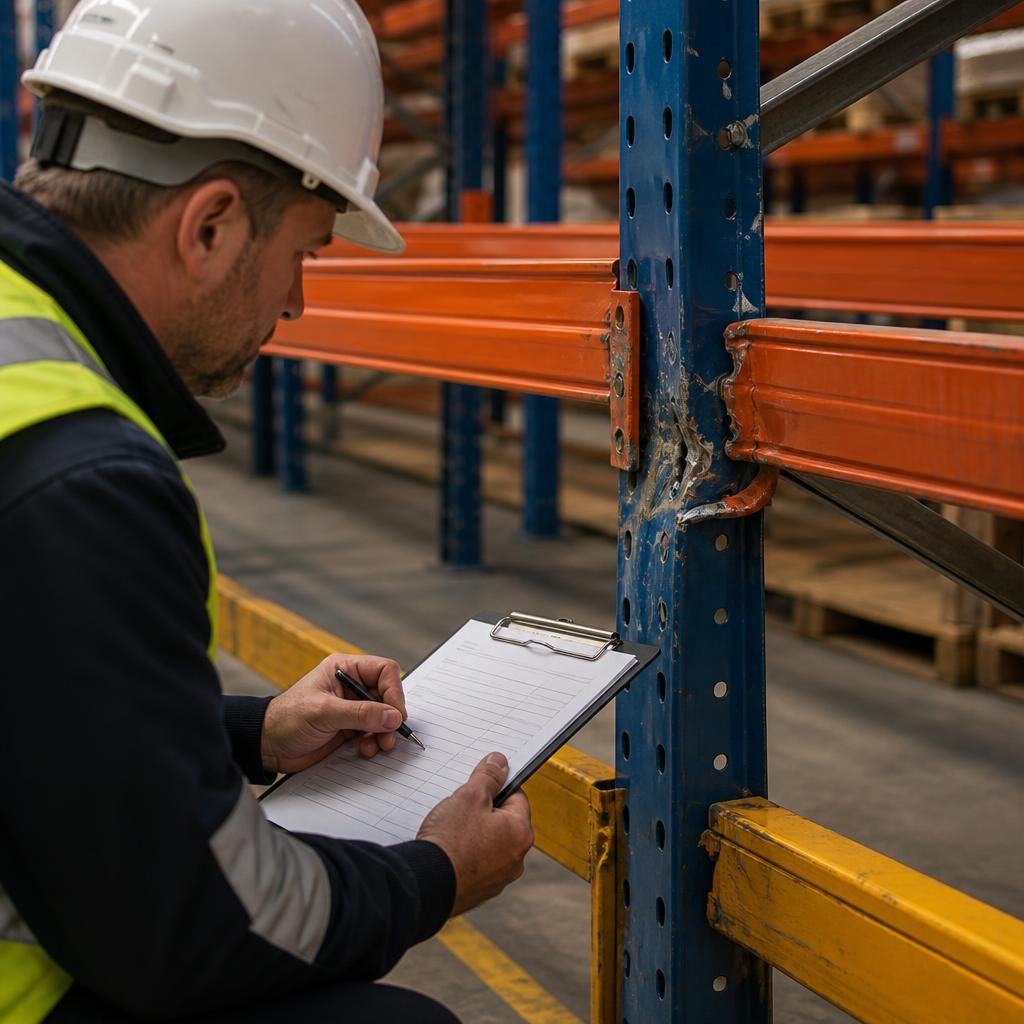
Warehouse racking with suspected impact or structural damage should be isolated and professionally assessed before it is used again. A bent upright, displaced beam, damaged connector or missing safety component can affect the system’s stability and load-bearing capacity, even when the defect appears minor.
Stop loading the affected bay, prevent access where there is a credible risk, and report the damage to the person responsible for warehouse racking safety. Do not straighten, weld or adapt damaged components as an improvised repair. Loads should only be removed if this can be done without exposing people to additional risk.
A competent repair specialist can assess the damage, inspect connected components and confirm whether replacement parts or another suitable repair method is required. The area should be re-examined before normal use resumes, with any revised load information or operating restrictions communicated to warehouse staff.
Arrange a professional warehouse racking repair assessment
Arrange a professional warehouse racking repair assessment if you have identified impact damage, distortion, loose connections or any other defect that could affect safe use. Able Racking can assess the affected area and advise whether it requires isolation, component replacement or a suitable repair before it returns to service.