
How often should warehouse racking be inspected?
Warehouse racking should receive a documented expert inspection at intervals of no more than 12 months, with more frequent inspections where risk, use or site conditions require them. Trained staff should also carry out regular visual checks, reporting any damage or safety concerns immediately so they can be assessed and addressed.
Warehouse racking should receive a documented inspection by a technically competent person at intervals of no more than 12 months. Trained staff should also complete regular visual checks, with the frequency determined by the level of risk, the intensity of use and the conditions in the workplace. Any damage, instability or other safety concern should be reported immediately and assessed before the affected area is used again.
The annual inspection is the minimum recommended interval for a formal expert assessment. It is not a substitute for routine checks by people who work with the warehouse racking every day. Forklift movements, loading activity and changing workplace conditions can cause damage between formal inspections, so defects need to be identified as soon as possible.
What the inspection frequency should be based on
- Impact risk: Areas exposed to forklift or other vehicle movements may need more frequent checks, particularly where access is restricted or traffic is busy.
- Use and loading activity: Warehouse racking that is loaded and unloaded frequently is exposed to more handling activity and should be monitored accordingly.
- Workplace conditions: Uneven floors, poor visibility, restricted access, temperature changes and other site conditions can affect the risk profile.
- History of damage: Recurring impacts or repeated defects indicate that visual checks, operator controls or protective measures may need to be strengthened.
- Changes to the installation: A further assessment is appropriate after changes to the warehouse racking, load requirements, vehicle arrangements or warehouse layout.
- Staff and operating changes: New operators, altered working practices or changes in supervision can affect how safely the storage equipment is used.
Routine visual checks
Employees who use or work near warehouse racking should be trained to recognise visible problems and know how to report them. Checks should be carried out at a frequency suitable for the operation, which may be more often than a formal expert inspection where the risk is higher. The check should cover visible damage to uprights, beams, bracing, connectors, protection and floors, as well as signs of displacement, overloading or unsafe loading.
These checks should be recorded in a way that allows the business to identify repeated problems and confirm that reported defects have been dealt with. A visual check is not intended to replace a competent inspection. Its purpose is to provide an early warning when something has changed or been damaged.
When an additional inspection is needed
Do not wait for the next planned inspection if the warehouse racking has been struck, overloaded, altered or exposed to an unusual event. An additional assessment may be needed after:
- a collision involving a forklift or other vehicle;
- the discovery of bent, cracked, loose or displaced components;
- changes to beam levels, bays, load ratings or the arrangement of stored goods;
- the introduction of different pallets, handling equipment or operating methods;
- building movement, flooding, fire or another event that could affect stability; or
- an unexplained change in the appearance, alignment or behaviour of the installation.
Where there is a concern about immediate safety, the affected section should be isolated and unloaded where necessary until it has been assessed. Damaged warehouse racking should not be put back into service simply because it appears to be holding its load. A competent person should determine whether it is safe to use, requires repair or needs replacement.
What a formal inspection should provide
A formal inspection should be completed by someone with the necessary knowledge, training and experience to assess warehouse racking. The inspection should be systematic and should consider the condition of the installation, its use, visible damage, load information, protection and any relevant changes since the previous assessment.
The findings should be documented and reported to the person responsible for warehouse racking safety. The report should make clear what was inspected, which defects were identified, how serious they are and what action is required. Repairs and follow-up checks should also be recorded so there is a clear audit trail.
A practical inspection arrangement
- Assign responsibility for coordinating warehouse racking safety and maintaining inspection records.
- Set a routine visual-check schedule based on the risks and working conditions at the site.
- Arrange a documented competent inspection at least every 12 months.
- Review the inspection frequency after damage, operational changes or changes in risk.
- Report and assess defects immediately, isolating unsafe areas until suitable action is taken.
- Confirm that repairs have been completed correctly before the affected warehouse racking is returned to use.
The correct frequency is therefore not simply an annual appointment. The formal inspection should take place no more than 12 months apart, while routine checks and additional assessments should reflect the way the warehouse operates. A risk-based programme gives the person responsible for safety a more reliable way to protect people, stock and the storage installation.
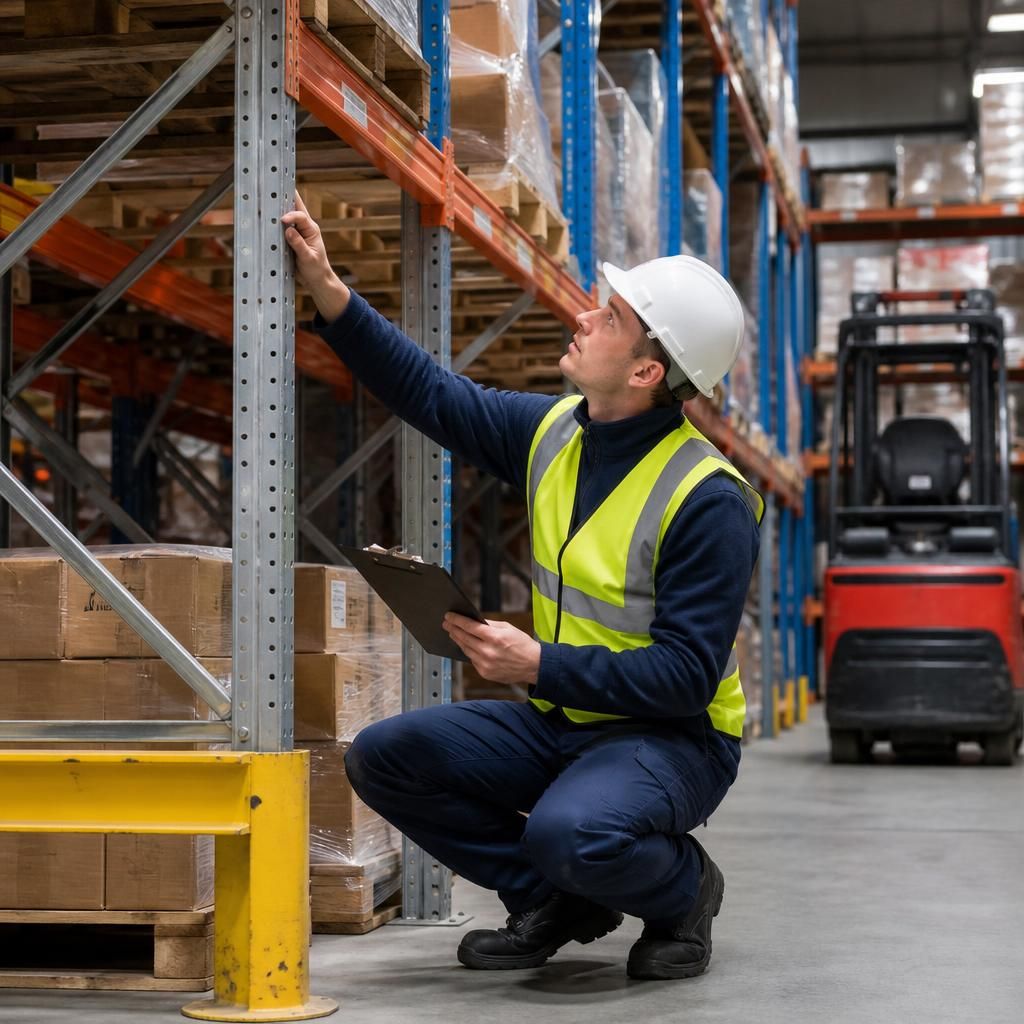
A formal warehouse racking inspection should be completed by a technically competent person at intervals of no more than 12 months. This annual assessment is the minimum interval, not a substitute for routine visual checks by trained employees. More frequent checks or an additional professional inspection may be necessary where forklift traffic is heavy, loading activity is intensive, damage has occurred or the warehouse layout and operating methods have changed.
Arrange your warehouse racking inspection
Arrange a documented warehouse racking inspection with Able Racking to confirm that your installation remains safe, compliant and suitable for current operating conditions. Contact our experienced team to discuss your inspection requirements and any areas of concern.