
What safety considerations are crucial for Automated Racking and ASRS Systems?
Automated Racking and ASRS Systems require documented risk assessments, effective guarding and access controls, clearly defined pedestrian and maintenance zones, and reliable emergency-stop procedures to protect people from moving equipment and stored loads. Regular inspections, planned maintenance, competent operation and task-specific training are also essential for maintaining safe, compliant and dependable warehouse operations.
Automated Racking and ASRS Systems must be designed, installed, operated and maintained around the prevention of access to moving machinery, stored loads and automated work zones. The essential controls are a documented risk assessment, suitable guarding, controlled access, safe pedestrian routes, dependable emergency stops, competent maintenance and task-specific training. These controls must work together rather than being treated as separate checks.
Start with a system-specific risk assessment
A risk assessment should cover the complete installation, including the warehouse racking, conveyors, lifts, cranes, shuttles, robots, control systems, loading points and interfaces with other equipment. It should consider normal operation, foreseeable misuse, cleaning, fault-finding, recovery of trapped loads, maintenance, fire response and changes to stock or working practices.
The assessment should identify who could be exposed to harm, including operators, maintenance engineers, visiting drivers, contractors and anyone entering the automated area. Particular attention is needed where people and vehicles work near the system, where access doors or gates are opened, and where manual activities take place at goods-in or goods-out stations.
Risk assessments should be reviewed after an incident, equipment modification, software change, change of load type or change to the layout. They should also be revisited when inspection findings show recurring damage or when operators develop workarounds that were not part of the original design.
Prevent access to dangerous moving parts
Automated equipment should normally be enclosed by fixed guarding, fencing or other suitable barriers. The guarding must prevent people from reaching moving machinery, entering storage aisles or stepping into the path of a shuttle, crane or transfer device during automatic operation. Openings should be designed so that loads can pass through without creating an avoidable access point for people.
Access gates and doors should have interlocks that stop or prevent hazardous movement when opened. The arrangement should also prevent automatic restart simply because a gate has been closed. Where there is a risk that someone could enter and remain inside the protected area, the system should include suitable presence detection, trapped-person protection and a means of confirming that the area is clear before restart.
Guarding is not a substitute for safe procedures. Authorised access should be controlled, recorded where appropriate and limited to trained personnel. Bypassing interlocks, removing barriers or using access points as shortcuts should be prohibited and treated as a serious safety issue.
Separate pedestrians, vehicles and automated equipment
Pedestrian walkways, forklift routes, maintenance access and automated travel paths should be clearly defined. Physical segregation is preferable where routes could intersect. Where an interaction cannot be eliminated, suitable barriers, gates, warning signs, traffic controls, visibility measures and agreed right-of-way arrangements should be used.
Loading and unloading stations need particular attention. Operators should be able to place or remove goods without reaching into a moving zone, standing beneath a suspended load or entering an aisle while the system is enabled. The position of controls should give a clear view of the relevant danger area wherever practicable.
Floors, access routes and escape paths must be kept clear. Damaged barriers, poor lighting, obstructed walkways and inadequate visibility can undermine otherwise effective automated safeguards. Site rules should also address visitors, contractors and delivery personnel who may not understand the system’s warning signals or restricted areas.
Control stored-load and structural risks
Every automated storage system has defined limits for load weight, dimensions, stability, packaging, pallet quality and load distribution. These limits should be documented and enforced. Loads that are damaged, unstable, overhanging, incorrectly positioned or unsuitable for the equipment should not be introduced into the system.
Warehouse racking and supporting structures should be checked for impact damage, deformation, loose components, corrosion and other conditions that could affect stability. Automated movement can make a poorly positioned load more hazardous by transferring it at speed or placing it at height. Inspection arrangements should therefore include both the structure and the automated equipment that serves it.
Load carriers, pallets, trays and containers should be compatible with the system and kept in suitable condition. The control software may identify weight or position faults, but electronic monitoring does not replace physical inspection. Any recurring misalignment, dropped load, collision or obstruction should be investigated rather than repeatedly reset.
Provide effective emergency-stop and isolation arrangements
Emergency-stop devices should be readily accessible from relevant operating and access positions, clearly identified and included in routine functional checks. Staff need to understand what an emergency stop does, what hazards may remain after activation and who is authorised to reset the system.
An emergency stop may halt movement but may not isolate every source of energy. Safe maintenance requires a documented isolation and lock-off procedure covering electrical, mechanical, hydraulic, pneumatic, gravity and stored energy. Isolation points should be identifiable, accessible and suitable for the work being carried out. A restart check should confirm that guards are in place, tools and people are clear, and all affected personnel have been informed.
Emergency arrangements should explain how to raise the alarm, stop related equipment, contact responsible personnel, recover an injured or trapped person and preserve the scene for investigation. Procedures should be practised where necessary, particularly for systems that contain restricted or difficult-to-access areas.
Manage maintenance, fault recovery and authorised entry
Maintenance and fault recovery are often higher-risk activities than normal automatic operation. A written method of work should define the isolation process, access controls, competent persons, tools, protective equipment, communications and return-to-service checks.
Faults should not be cleared by entering a hazardous area while equipment remains capable of movement. If a special operating mode is required for diagnosis, it should provide appropriate reduced-speed, hold-to-run or other protective controls, with the risks assessed in advance. Temporary overrides should be controlled, recorded and removed immediately after the task.
Maintenance records should cover safety devices, emergency stops, interlocks, sensors, guarding, brakes, lifting mechanisms, conveyors, control panels and software-related faults. Repeated failures should trigger a root-cause review. Simply resetting an alarm can leave the underlying defect unresolved and increase the likelihood of a more serious event.
Inspect the system at suitable intervals
Inspection arrangements should combine operator checks, planned technical examinations and periodic review by a competent person. The scope and frequency should reflect the equipment type, operating intensity, environment, manufacturer instructions, risk assessment and previous findings.
Daily or pre-use checks may identify damaged guards, unusual noise, leaks, poor load presentation, failed warning devices, obstructions or visible structural damage. More detailed inspections should examine the condition and function of safety systems, the supporting warehouse racking, mechanical components and control interfaces.
Findings should be recorded with enough detail to identify the location, risk, action required and person responsible. Where a defect presents an immediate danger, the affected equipment or area should be taken out of service until it has been made safe. Repairs should be completed by suitably competent personnel and verified before normal operation resumes.
Address fire, smoke and other site emergencies
Automated storage installations can affect fire detection, suppression, evacuation and access for emergency responders. The fire risk assessment should consider stored materials, packaging, charging areas, electrical equipment, restricted access and the height and density of stored loads. Detection and suppression arrangements must be appropriate to the building and system design.
Emergency plans should explain how the automated system interacts with alarms, ventilation, power supplies, fire doors and evacuation routes. Staff should never re-enter a restricted area to retrieve stock or investigate a fault during an emergency. Any shutdown sequence should be defined with the relevant responsible parties and tested where appropriate.
Train people for their actual tasks
Training should be specific to the system and the person’s responsibilities. Operators need to understand normal controls, warning signals, load restrictions, emergency stops, access rules and fault-reporting arrangements. Maintenance personnel need additional instruction in isolation, stored energy, guarded access, recovery procedures and safe testing.
Induction should be provided before someone works near the system, with refresher training after modifications, incidents, procedural changes or a prolonged absence. Contractors and visiting engineers should receive site-specific information rather than relying only on their general experience. Competence should be checked in practice, not assumed from attendance alone.
Keep the controls under review
Safety performance depends on the installation remaining suitable as operations change. New stock profiles, altered software, additional shifts, revised traffic routes, increased throughput or changes to staffing can introduce risks that were not present at commissioning. Management should consult operators and maintenance teams because they often identify access problems, recurring alarms and unsafe informal practices first.
A robust approach combines risk assessment, guarding, segregation, load control, emergency isolation, inspection, maintenance and training. Documented evidence of these activities supports legal compliance and provides a practical basis for keeping Automated Racking and ASRS Systems safe, reliable and suitable for continued warehouse use.
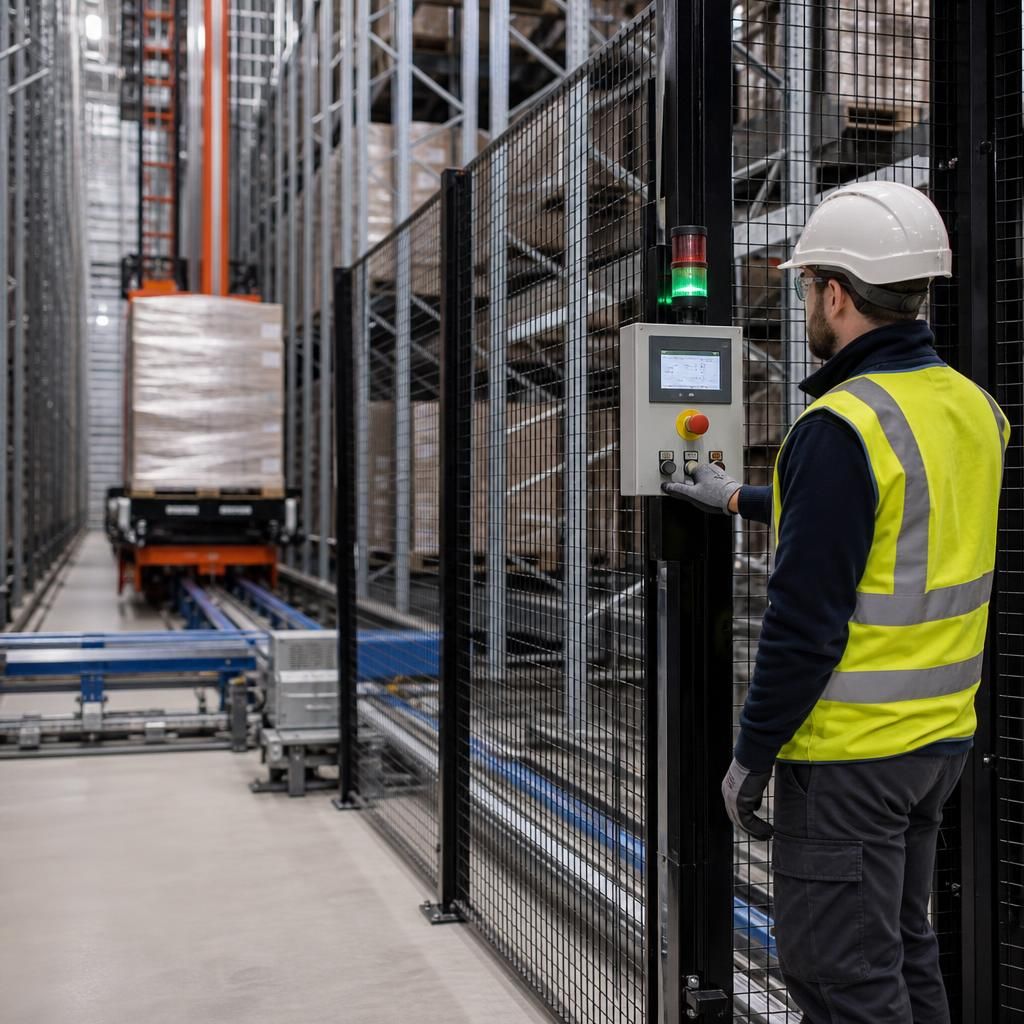
Emergency-stop controls are essential on Automated Racking and ASRS Systems, but stopping movement does not necessarily remove every hazard. A safe response also requires clearly identified isolation points and a documented lock-off procedure covering electrical, mechanical, pneumatic, hydraulic, gravity and stored energy.
Only authorised, competent personnel should enter a protected area to clear a fault or carry out maintenance. Before work begins, the system must be isolated, secured against restart and checked to confirm that hazardous energy has been removed. After the task, guards, tools and personnel must be accounted for before a controlled restart. Regular functional checks of emergency stops, interlocks and warning devices help confirm that these safeguards remain dependable.
Book Your Automated Racking and ASRS Safety Assessment
Book your Automated Racking and ASRS safety assessment with Able Racking to review guarding, access controls, emergency procedures, inspections and maintenance arrangements. Contact our experienced team to arrange a practical assessment suited to your system and warehouse operations.