
What are the different types of mezzanine gates, and how do they cater to various operational environments?
Mezzanine gates include swing gates, sliding gates, lift-out gates and pallet gates, with each design controlling access to the edge while allowing goods and equipment to move safely between floor levels. The most suitable type depends on the operational environment, including available space, load-handling methods, traffic levels, gate opening frequency and the level of protection required.
Different types of mezzanine gates are designed to control access at an open floor edge while allowing people, pallets, materials and equipment to pass safely between levels. Common options include swing gates, sliding gates, lift-out gates, pallet gates, vertical lift gates and folding or collapsible gates. The right choice depends on the available space, the way goods are moved, how often the opening is used, the size and weight of loads, and the level of protection required.
Swing gates
Swing gates are hinged and open inwards or outwards, depending on the design and the available working area. They are suitable where there is sufficient clearance for the gate to move without striking stored goods, vehicles, lifting equipment or people. A self-closing design is generally preferable because it reduces the likelihood of the gate being left open at the floor edge.
- Suitable for pedestrian access and smaller goods-handling activities.
- Simple to operate and straightforward to inspect.
- Can be fitted with latches, locks and self-closing mechanisms.
- Require careful consideration of the gate swing, particularly near walkways and loading areas.
Swing gates may be less suitable in busy areas where the moving leaf could obstruct a route or be struck by handling equipment. Their position, opening direction and closing action should be assessed as part of the site risk assessment.
Sliding gates
Sliding gates move horizontally along a track rather than swinging into the surrounding work area. This makes them useful where floor space is restricted or where a swinging gate could interfere with pedestrian routes, machinery or load-handling equipment.
- Work well beside narrow aisles and confined operating areas.
- Do not require the clear swing area needed by a hinged gate.
- Can be useful where goods are transferred frequently through the opening.
- Need a clean, correctly aligned track and suitable protection from impact.
Sliding mechanisms should be checked for damage, obstruction and smooth operation. A gate that sticks or fails to close fully can create an unsafe condition, especially where the opening is used repeatedly during a shift.
Lift-out gates
Lift-out gates are removed from their posts or sockets to create an opening and then replaced when the transfer is complete. They can be appropriate for occasional access or where the opening must remain completely clear when goods are being moved.
- Have a relatively simple construction with few moving parts.
- Can provide a wide opening for larger items.
- Are suitable only where operators can handle the gate safely and store it securely when removed.
- Must never be left out of position while the edge is exposed.
The weight and dimensions of a lift-out gate should be suitable for the people expected to use it. If the gate is heavy, awkward or frequently removed, a powered, counterbalanced or alternative design may provide better control.
Pallet gates
Pallet gates are specifically designed for transferring pallets and other unit loads between a lower level and a mezzanine platform. A common arrangement uses a two-sided barrier system, often called a pallet safety gate or pallet loading gate. One side opens towards the loading position while the opposite side remains closed, helping to maintain edge protection during the transfer.
- Support regular movement of pallets and bulky loads.
- Help separate the loading operation from the open edge.
- Can be configured for forklift, pallet truck or other handling methods.
- May be manual, counterbalanced, mechanically assisted or powered.
Pallet gates must be selected around the actual load dimensions, handling equipment and transfer procedure. The gate should not be treated as a substitute for safe working practices: loads must be stable, operators must have adequate visibility, and the loading area must be kept clear of unauthorised personnel.
Vertical lift gates
Vertical lift gates rise upwards to create access without projecting into the area in front of the opening. They can be helpful where horizontal space is limited, where traffic passes close to the gate, or where the opening needs to accommodate larger loads.
- Use overhead space rather than valuable floor space.
- Can provide a clear opening for pallets, cages and long items.
- May be operated manually with counterbalance assistance or by a powered mechanism.
- Require adequate headroom and controls to prevent uncontrolled movement.
Vertical lift systems need particular attention to guides, hinges, counterbalances, cables, chains, stops and locking arrangements. Operators should be protected from trapping and crushing points, and the gate should remain stable throughout its movement.
Folding or collapsible gates
Folding gates use linked sections that concertina or fold to one side. They can provide a practical compromise where a full swing is not possible but a larger opening is needed than a conventional pedestrian gate can provide.
- Can be folded away when access is required.
- May suit areas with changing access requirements.
- Can cover wider openings while limiting the space needed for operation.
- Require checks on hinges, links, guides and closing points.
These gates should be assessed for pinch points and for the possibility of sections being left partly open. Their arrangement must provide continuous edge protection when closed and must not create gaps through which a person, load or piece of equipment could pass unintentionally.
How the operating environment affects the choice
The operating environment is often more important than the gate style itself. A gate used occasionally by trained employees may need a different arrangement from one used continuously by forklifts, pallet trucks and delivery teams. Consider the following factors before selecting or replacing a gate:
- Available space: Sliding, vertical lift or folding designs can be preferable where a swing gate would obstruct a route.
- Load type: Pallets, stillages, cages, containers and long materials may require different opening widths and load-transfer arrangements.
- Traffic levels: Frequent movements may justify a durable, assisted or powered system that reduces manual handling and encourages consistent closure.
- Handling equipment: The gate must be compatible with the turning area, reach, fork dimensions and operating method of the equipment in use.
- Pedestrian access: Where people and goods use the same area, the design should help separate traffic and prevent people approaching an exposed edge.
- Headroom and obstructions: Overhead services, lighting, conveyors and building structures can affect whether a vertical or overhead mechanism is practical.
- Environmental conditions: Dust, moisture, temperature, wash-down procedures and corrosive substances may influence the materials, finishes and maintenance requirements.
- Visibility and communication: Operators should be able to see the loading area or use an agreed communication system before opening or moving the gate.
Safety features to specify
Regardless of the gate type, the installation should maintain protection at the edge whenever goods are not actively being transferred. Useful features may include self-closing action, positive latching, interlocking, warning signs, guarded controls, impact protection, anti-drop arrangements and controls that prevent the gate being opened from an unsafe position. The precise combination depends on the design and the assessed risks.
Where a gate is powered or mechanically assisted, guarding and control measures should prevent unexpected movement, trapping and unauthorised operation. Where it is manually operated, the force, reach and posture required should be suitable for the intended users. The gate should also be compatible with the supporting structure and must not compromise the floor, handrails, toe boards or other edge protection.
Choosing the most suitable type
Start by mapping the movement of people and goods around the opening. Identify what is being transferred, how it is handled, where operators stand, what could fall or overturn, and what happens if the gate is left open. Compare the available designs against these conditions rather than choosing solely on purchase price or appearance.
A competent assessment should also consider the gate’s installation, inspection and maintenance requirements. Hinges, tracks, latches, barriers, counterbalance systems and interlocks need to remain in effective working order. Any impact, unusual resistance, incomplete closure or damaged component should be reported and the gate taken out of service where its protective function may be compromised.
For a site with mixed pedestrian and goods movement, a properly configured pallet gate or assisted barrier system will often provide more controlled protection than a basic access gate. For occasional pedestrian use, a self-closing swing gate may be appropriate where space permits. Sliding, lift-out, vertical lift and folding designs can solve particular space or access problems, but each must be installed and operated according to its intended use.
Before implementation, confirm that the proposed gate suits the existing structure, workplace traffic arrangements and safe system of work. A site-specific review by experienced personnel can identify clearance issues, impact risks and practical operating problems that may not be apparent from a product specification alone.
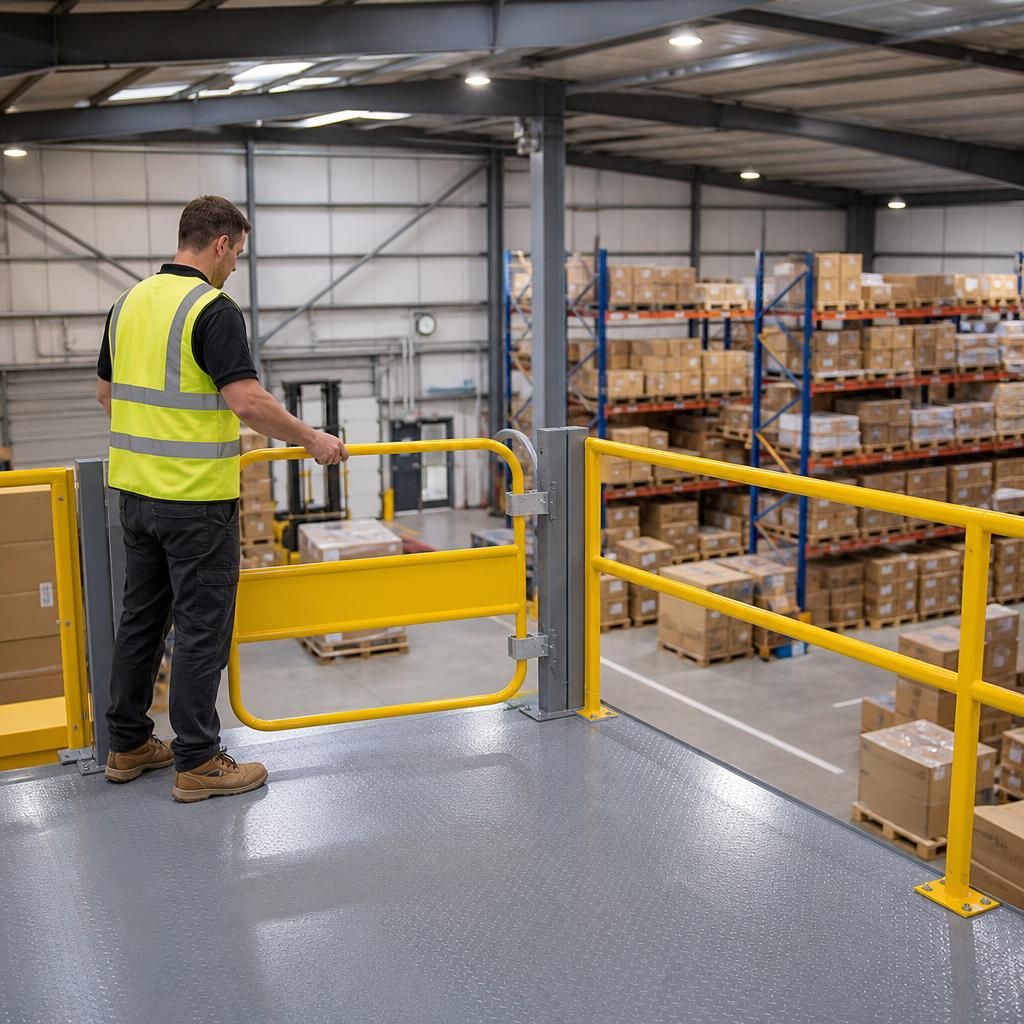
A pallet gate is designed for regular transfer of pallets and other loads between a mezzanine platform and the level below. Its barrier arrangement allows goods to be loaded while maintaining edge protection on the side where people are working.
This type of gate is most suitable for busy warehouse and industrial environments using forklifts or pallet trucks. The opening, load capacity and operating method should match the equipment, pallet dimensions, traffic flow and available working space. Where transfers are occasional or mainly pedestrian, a self-closing swing gate or sliding gate may provide a more practical solution.
Discuss your mezzanine gate requirements
Discuss your mezzanine gate requirements with Able Racking to identify a suitable design for your access arrangements, load-transfer methods and workplace risks. Our experienced team can help assess the existing installation and recommend practical safety measures.