
What safety features should be considered when choosing a mezzanine floor gate to ensure comprehensive protection?
When choosing a mezzanine floor gate, consider interlocked or self-closing operation, secure guardrails and toe boards, a protected loading edge, suitable load capacity, and controls that prevent the gate and access opening being exposed at the same time. The design should also be compatible with the intended handling equipment, workplace layout and applicable safety requirements, with installation and inspection completed by competent professionals.
The essential safety features of a mezzanine floor gate are positive interlocking, secure edge protection, controlled opening and closing, protection against falling goods and people, and compatibility with the way materials are handled. The gate should prevent access to an unprotected edge whenever the loading opening is exposed, while allowing authorised operators to transfer goods efficiently. Its design, installation and use should be based on a site-specific risk assessment and applicable UK workplace safety requirements.
Positive interlocking and controlled access are central to comprehensive protection. A suitable gate should be designed so that the access side and the loading side cannot both be open at the same time. Interlocked gates, linked barriers or equivalent systems help ensure that the exposed edge remains protected during loading and unloading. The mechanism should not be capable of being easily defeated, bypassed or left in an unsafe position during normal work.
Consider the following features when assessing a gate:
- Self-closing or self-restoring operation: The gate should return to its safe position after the load has passed, where the application allows. This reduces reliance on operators remembering to close it manually.
- Mechanical interlocking: The system should control the relationship between the gate, landing barrier and access opening so that a fall hazard is not created during loading.
- Secure guardrails and handrails: The surrounding edge protection should be continuous, robust and properly connected to the floor structure. It should not leave reachable gaps around the gate or its operating area.
- Toe boards or equivalent lower protection: These help prevent feet, pallets, tools and smaller items from passing beneath the barrier. They are particularly important where people work or pass below the loading point.
- Protected loading edge: The gate should provide a clear barrier across the open edge whenever materials are not actively being transferred. The arrangement should not depend on a loose chain, removable rail or unsecured component.
- Controlled movement: Hinged, counterbalanced, vertical or powered gates should move predictably without dropping, swinging unexpectedly or creating crush, shear or trapping points.
- Positive latching: The gate should remain securely closed and should not drift open because of vibration, contact with a load or normal use. The latch should be visible and straightforward to check.
- Suitable load capacity: The gate and its supporting structure must be selected for the loads, pallet sizes, containers and handling equipment used at the site. The safe working load should be clearly defined, communicated and never exceeded.
Protection against falling materials should be considered separately from protection against falls from height. A person may be protected from stepping through the opening while goods can still fall if the gate has excessive gaps, inadequate lower protection or an unsuitable operating method. The design should retain the materials being handled and prevent pallets or packages from being pushed into the barrier. Where loose, unstable or small items are transferred, additional containment may be required.
The gate must also be compatible with the loading method. Check the dimensions and clearance needed for pallets, cages, stillages, containers, lifting equipment and the operator’s line of sight. A design that requires an operator to reach around a barrier, stand close to an exposed edge or manually hold a heavy gate open can introduce avoidable risk. The operating position should provide adequate footing, visibility and room to manoeuvre without obstructing nearby walkways or emergency routes.
Gate selection should account for the type of movement used on the floor. A two-arm or pallet gate may suit regular pallet transfer where the barrier alternates between the loading and protected positions. A vertical or lift-up arrangement may be more appropriate where floor space is restricted, provided its movement and stored position do not create impact or trapping hazards. A swing gate can be suitable in some access situations, but it needs sufficient clearance and reliable control to prevent it opening towards an unsafe edge or obstructing people and equipment.
Other practical safety features include:
- Clearly visible operating instructions and warnings at the point of use.
- Controls positioned away from crush points and the unprotected edge.
- Guarding around springs, counterweights, chains, hinges or powered mechanisms where these could catch clothing or hands.
- Materials and finishes that resist corrosion, impact and the conditions in the working environment.
- Secure fixings designed for the supporting structure, rather than improvised attachments.
- A design that permits inspection of hinges, latches, pivots, welds, fixings and safety devices.
- Emergency arrangements that allow people to leave the area safely without creating an unprotected opening.
Structural suitability is just as important as the visible barrier. The supporting floor, edge protection and gate assembly must be assessed as a complete system. Check the condition of the supporting steelwork, connection points and surrounding guarding before installation. The gate should not be fitted where the structure cannot withstand the imposed forces or where its operation would compromise existing protection. Any alteration to the floor or its guarding should be reviewed by a competent person.
Do not select a gate solely because it fits the opening or appears robust. The assessment should consider the foreseeable risks, including dropped loads, misuse, unauthorised access, impact from handling equipment, awkward manual handling, poor visibility and simultaneous use by more than one person. Where powered equipment is involved, the gate arrangement should be coordinated with the equipment controls and site traffic plan.
Installation and commissioning should confirm that the safety features work in practice. The installer should verify alignment, fixings, clearances, latching, interlocking and the full range of movement. The gate should be tested under realistic operating conditions, including the intended load and handling method where appropriate. Operators should receive instruction on permitted loads, safe positioning, opening and closing procedures, prohibited actions and what to do if the mechanism does not operate correctly.
After installation, include the gate in the workplace inspection and maintenance arrangements. Operators should report damage, unusual movement, failed latches, missing toe protection, loose fixings or any attempt to bypass the interlock immediately. Planned inspections should examine the structure and all moving and protective components, with defects recorded and repaired by suitably competent personnel. A gate that has been struck, altered or exposed to an abnormal load should be taken out of service until its condition has been assessed.
For a reliable choice, compare each gate against the risk assessment, the intended loading process, the floor structure and the applicable legal and technical requirements. The safest solution is one that maintains a protected edge throughout normal operations, prevents foreseeable misuse, contains the materials being transferred and remains straightforward to inspect, operate and maintain.
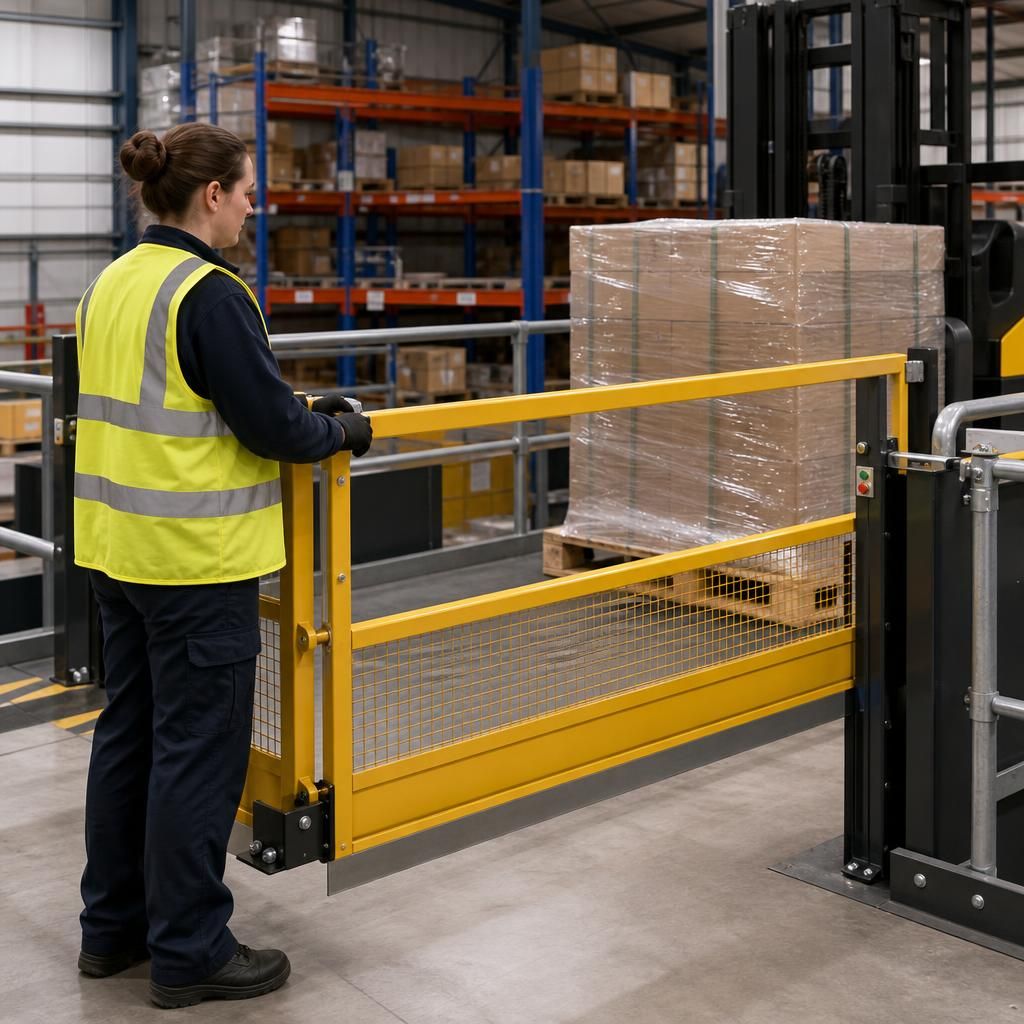
Positive interlocking is one of the most important safety features in a mezzanine floor gate. It ensures that the loading opening is protected on one side before the operator can access the other, preventing the gate and access barrier from being open at the same time.
The mechanism should be robust, clearly visible and difficult to bypass during normal use. During commissioning, a competent installer should check the alignment, latching, clearances and full movement of the gate, then explain its correct operation to all relevant staff. Any failed interlock, damaged component or unusual movement should be reported immediately and the gate taken out of use until it has been assessed.
Discuss your mezzanine floor gate safety requirements
Discuss your mezzanine floor gate safety requirements with our experienced team to confirm the right protection, operating method and inspection arrangements for your site.