
What factors should be considered when selecting materials for warehouse rack repairs?
Materials for warehouse rack repairs should be selected for structural strength, compatibility with the existing system, load capacity, corrosion resistance and suitability for the damage identified. Repairs must also follow the manufacturer’s specifications and relevant safety standards, with an experienced technician confirming that the replacement steel, components and fixings restore the warehouse racking system’s stability and compliance.
Materials for warehouse rack repairs should be chosen according to the required structural strength, compatibility with the existing warehouse racking system, load capacity, environmental conditions and the nature of the damage. Replacement steel, protective coatings, bolts, bracing and other components must restore the intended load path without introducing weaker or incompatible parts. A competent technician should verify the selection against the original manufacturer’s specifications, available design information and relevant safety requirements before work begins.
Structural strength and section design
Replacement material must have suitable strength, stiffness and section dimensions for its position in the warehouse rack system. Uprights, beams, braces, baseplates and guards each perform different structural functions, so a visually similar piece of steel is not necessarily an appropriate substitute. The repair specification should consider the steel grade, thickness, profile, hole pattern, connection details and the way forces are transferred through the repaired area.
Using a heavier or thicker component is not automatically a safe solution. It may alter the way connected parts behave, prevent correct fitting or transfer additional force to an adjacent component. Equally, a thinner section, unsuitable profile or unverified locally fabricated part may reduce the warehouse racking system’s capacity. Where the original component is identifiable, a manufacturer-approved replacement is generally preferable.
Compatibility with the existing system
Materials must match the design and connection method of the existing warehouse racking. This includes the dimensions of the replacement component, the position and size of fixing holes, beam connector geometry, bracing arrangement and the type and grade of fasteners. Compatibility also covers the interface between new and retained steel; a repair should not rely on distorted holes, damaged threads or connections that can no longer develop their intended strength.
Bolts, nuts, washers, anchors and other fixings should be selected as part of the complete repair rather than treated as generic hardware. Their strength class, size, thread condition, corrosion protection and installation requirements must be suitable for the connection. Anchors need particular care because the concrete condition, embedment, edge distances and installation method can affect their performance.
Load capacity and the location of the damage
The material choice depends on whether the damage affects a primary load-bearing member, a bracing element, a connection or a protective accessory. Damage to an upright or beam may require a designed strengthening arrangement or replacement section, while a damaged guard may need a different specification because it is intended to absorb impact rather than support stored loads.
The technician should consider the loads currently carried by the affected bay, the intended storage configuration and any changes made since the warehouse racking was installed. A repair must preserve the system’s assessed capacity and stability. If the original design data or component identification is unavailable, the condition should be assessed before selecting materials rather than relying on appearance alone.
Corrosion resistance and the working environment
Steel and fixings should be suitable for the conditions in which the warehouse rack system operates. Moisture, condensation, cleaning chemicals, outdoor exposure, temperature variation and corrosive products can affect the choice of coating or material. Galvanised, painted or other protected finishes may be appropriate in different environments, but the replacement finish should be compatible with the retained components and the expected service conditions.
Corrosion should not simply be covered over. Where section loss has reduced the material’s thickness or weakened a connection, the affected part may need replacement or a formally designed repair. Cutting, drilling, welding or grinding can also damage protective coatings, so exposed areas and altered surfaces should be treated in accordance with the repair specification.
Repair method and material behaviour
The proposed material must suit the repair technique. A bolted replacement, a designed strengthening plate and a welded repair have different requirements. Welding can affect the properties and protective finish of steel, and it should not be carried out on warehouse racking without suitable engineering justification, competent personnel and appropriate controls. Heat, distortion and access constraints may affect nearby connections or stored loads.
Materials used for strengthening should provide a predictable connection to sound, undamaged steel. They should not conceal cracks, buckling, excessive deformation or other defects that require the original component to be replaced. The repair design should also allow inspection of the completed work and avoid creating areas where debris, water or impact damage can accumulate.
Compliance, traceability and inspection
Material selection should be supported by documentation where appropriate, including component identification, manufacturer information, material specifications and fixing details. This creates a clear record of what was installed and helps future inspections identify the repaired area and any restrictions that apply to it.
After the repair, the warehouse racking should be inspected to confirm that components are correctly positioned, connections are secure, protective measures are effective and the system remains suitable for its intended use. Load notices, operating restrictions or temporary controls may need to remain in place until the repair has been verified and the area is formally returned to service.
In practice, the safest material is not necessarily the strongest material available; it is the correctly specified component that works with the existing warehouse racking system, suits the damage and environment, and can be installed and inspected in accordance with the repair design. Where there is uncertainty about the steel grade, component identity, load capacity or extent of damage, the affected area should be isolated and assessed by an appropriately experienced warehouse racking repair technician before materials are ordered.
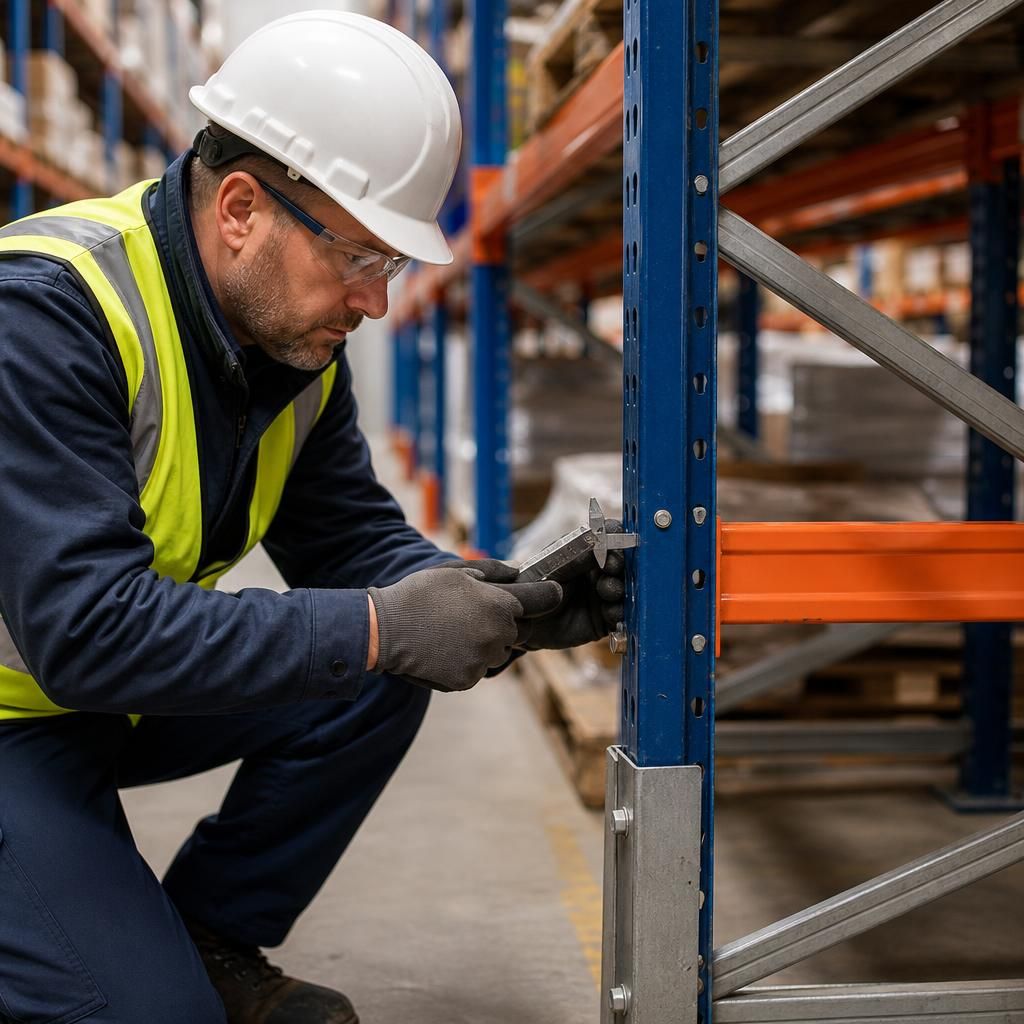
Choosing repair materials for warehouse racking requires more than matching the appearance of the damaged component. The replacement steel, brace, bolt, anchor or protection must suit the existing system’s dimensions, connection method, load requirements and operating environment. A component that looks similar may have a different strength, profile or fixing arrangement and could compromise the repaired structure.
Before materials are ordered, an experienced technician should identify the damage, check the original manufacturer’s information where available and assess the loads carried by the affected area. The selected materials must connect to sound steel, withstand the warehouse conditions and allow the completed repair to be inspected. Where corrosion, distortion or uncertainty about the component is present, the affected section should be isolated until a competent assessment confirms the appropriate repair specification.
Discuss the Right Materials for Your Warehouse Rack Repairs
Contact Able Racking to discuss the materials required for your warehouse rack repairs and arrange an assessment of the affected system. Our experienced technicians can confirm a suitable, compliant repair specification before replacement components are ordered.