
What distinguishes pallet racking from other warehouse storage solutions?
Pallet racking distinguishes itself by combining high-density vertical storage with direct access to individual pallets, making it suitable for warehouses handling varied stock and frequent picking. Unlike floor-stacked storage or fixed-location shelving, it offers greater capacity, adjustable configurations and straightforward stock rotation, provided the system is correctly designed and maintained.
Pallet racking is distinguished from other warehouse storage solutions by its combination of vertical space utilisation, direct access to individual pallets and adaptable configuration. It is designed to store palletised goods in accessible locations, making it suitable for operations with varied stock, regular replenishment and frequent order picking. Unlike floor-stacked storage, it separates products into defined locations and uses the available height of the building more effectively.
The right comparison depends on the type of stock being stored, how often it is accessed, the available floor and clear height, stock rotation requirements, handling equipment and the level of selectivity required. No single storage method is suitable for every warehouse, so the system should be assessed against the way the operation actually works.
How pallet racking differs from floor stacking
Floor stacking places pallets directly on the warehouse floor, usually in blocks or lanes. It can be appropriate for large quantities of the same product, particularly where goods are stable, have predictable demand and can be moved in a straightforward sequence. It generally has a simple layout and limited installation requirements.
However, floor stacking uses more floor area and can restrict access to pallets positioned behind or beneath other stock. This may lead to additional handling, less precise stock rotation and a greater risk of locations becoming difficult to manage. Pallet racking creates separate storage positions, allowing forklift operators to retrieve a specific pallet without moving as much surrounding stock. It also makes stock identification, counting and location control more straightforward.
How pallet racking differs from shelving
Shelving is normally intended for smaller, lighter items that are handled by people rather than stored as complete pallets. It can be useful for piece-picking, archive storage, small components and products that need frequent manual access. Shelving provides convenient access at lower levels but is not generally designed for the same pallet loads or lifting equipment used with pallet racking.
Pallet racking is better suited to unit loads and heavier products handled with forklifts or other mechanical equipment. Its beam levels can be configured to suit pallet dimensions and operational requirements, while shelving is typically arranged around the reach and working height of warehouse staff. Some sites use both systems, with palletised reserve stock stored in pallet racking and smaller order-picking stock kept on shelving.
How pallet racking differs from specialised storage systems
Different warehouse racking designs provide different balances between capacity, selectivity and access:
- Adjustable pallet racking provides direct access to each pallet location and can usually be altered when storage requirements change. It is a practical choice where product ranges are varied and individual pallets must be retrieved regularly.
- Drive-in or drive-through systems reduce the number of access aisles and can increase storage density. Their operating method is more restrictive, as forklifts enter storage lanes and stock is managed in accordance with the system’s loading and retrieval sequence.
- Push-back systems allow pallets to be stored at greater depth while keeping loading and unloading concentrated at the aisle face. They can improve density but provide less direct access than adjustable pallet racking.
- Mobile systems can reduce the number of permanently open aisles by moving storage runs when access is needed. They may require suitable floor conditions, controls and operating procedures, and their benefits should be considered against installation and maintenance requirements.
- Cantilever racking is intended for long or awkward loads such as timber, pipes, panels and other products that cannot be stored efficiently on standard pallet beams. It is not a direct substitute for pallet racking where goods are supplied on conventional pallets.
These options show why storage density should not be considered in isolation. A high-density system may hold more stock in a given area, but it can reduce selectivity, increase handling complexity or require stricter stock rotation procedures. Pallet racking often provides the most balanced solution where both capacity and direct access are important.
Capacity and use of vertical space
Pallet racking uses the height of the warehouse by placing pallet loads on multiple beam levels. This can release floor space for circulation, picking, goods-in and dispatch, subject to the building’s clear height, floor capacity, sprinkler arrangements, lighting, forklift reach and safe operating clearances.
Floor stacking may provide good capacity for uniform products but normally cannot use height as efficiently without affecting stability or access. Shelving uses vertical space on a smaller scale, while specialised systems may achieve higher storage density by sacrificing some accessibility. The best solution is therefore the one that provides usable capacity, rather than simply the greatest theoretical number of storage positions.
Flexibility and stock control
A key advantage of pallet racking is the ability to create a structured location plan. Beam positions can be specified for different pallet heights, and the layout can be designed around product dimensions, forklift movements and picking routes. With suitable controls, this supports clearer stock records and more reliable replenishment.
Adjustability does not mean that components can be moved without assessment. Changing beam levels, adding components or altering the intended load can affect clearances, load capacity, forklift operation and the overall design assumptions. Any modification should be reviewed by a competent person and carried out in accordance with the manufacturer’s instructions and the site’s safety procedures.
Access, selectivity and stock rotation
Pallet racking offers a high level of selectivity because an individual pallet can normally be accessed without unloading an entire block. This is valuable for warehouses storing many product lines, handling mixed demand or operating first-in, first-out procedures. It can also support clearer separation of batches, dates, customers or order statuses.
Dense systems may hold more pallets but often limit direct access. They can work well where goods are stored in batches and stock movement follows a consistent pattern. Where products have short shelf lives, variable demand or frequent individual retrievals, the operational cost of reduced selectivity may outweigh the space saving.
Handling equipment and workflow
The storage method must match the handling equipment. Pallet racking layouts need suitable aisle widths, turning areas, lift heights and load clearances for the forklifts or other equipment in use. Floor stacking may allow simpler access in some applications, but it can also create longer travel routes and more congested handling areas. Shelving is generally designed around pedestrian access and manual handling rather than pallet movements.
When comparing systems, consider the complete workflow from goods-in to storage, replenishment, picking and dispatch. A solution that appears efficient at the storage stage may create delays if it makes replenishment difficult or requires excessive pallet movements. Warehouse racking should support safe, predictable traffic flows and maintain clear separation between people and vehicles wherever practicable.
Safety, compliance and ongoing condition
All storage systems require appropriate design, installation, use and inspection. Pallet racking is particularly dependent on correct loading, competent forklift operation, impact protection and prompt reporting of damage. Uprights, beams, bracing, connectors, floors and protection equipment should be kept in suitable condition, with defects isolated and addressed according to their severity.
Routine user checks and formal warehouse racking inspections serve different purposes. Employees should report visible damage, instability, overloading, missing components and unsafe practices as soon as they are identified. A competent inspection provides a more detailed assessment of the installation and helps identify deterioration or risks that may not be obvious during normal work. Inspection records, load notices and repair actions should be managed as part of the site’s safety system.
Other storage methods also need controls. Floor-stacked goods must be stable and kept within safe height and weight limits. Shelving must be suitable for its intended loads and protected from impact where necessary. Specialised warehouse racking must be operated in accordance with its design, including any restrictions on loading sequence, pallet condition or access.
Which solution is appropriate?
Pallet racking is usually the strongest option where a warehouse needs direct access to varied palletised stock, efficient use of height and a layout that can adapt to changing product requirements. Floor stacking may be more suitable for uniform, high-volume goods with predictable movement. Shelving is often preferable for small-item picking and manual access, while specialised storage systems may be justified where density, load shape or storage sequence has particular importance.
Before selecting or changing a system, review the pallet and product dimensions, maximum load weights, stock profile, turnover, access requirements, handling equipment, building constraints, fire protection, pedestrian routes and planned growth. The design should also account for installation quality, protection from impact, inspection arrangements and future maintenance. This ensures the chosen storage method is not only capable of holding the required goods but also supports safe and efficient daily operation.
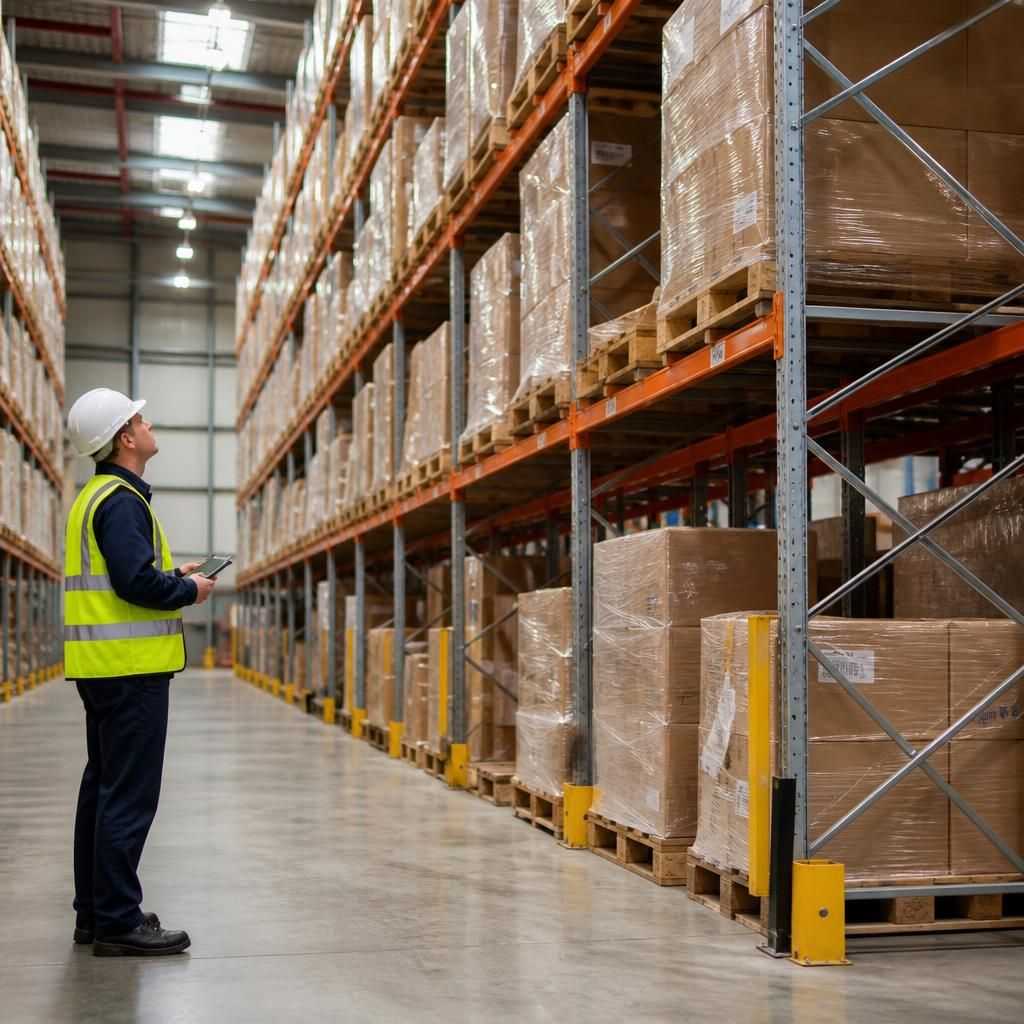
Pallet racking distinguishes itself from denser warehouse storage systems by providing direct access to individual pallet locations. This selectivity is valuable when a warehouse handles varied stock, frequent picking or stock rotation requirements, because a specific pallet can usually be retrieved without moving surrounding loads.
Higher-density systems can store more pallets within a smaller footprint, but may restrict access or require goods to be loaded and retrieved in a particular sequence. The appropriate choice therefore depends on whether the operation prioritises maximum capacity, individual pallet access or a balance of both. When assessing a pallet racking layout, consider product variety, turnover, handling equipment, aisle requirements and future changes to stock profiles.
Discuss your pallet racking requirements
Discuss your pallet racking requirements with Able Racking to assess the most suitable storage solution for your stock, handling equipment and warehouse layout.