
What qualifications and experience should you look for in warehouse racking installers?
Look for warehouse racking installers with documented industry training, manufacturer-specific knowledge, and demonstrable competence in assembling the systems being installed, supported by appropriate site-safety training and supervision. Practical experience across inspections, installations and repairs is equally important, as it helps installers identify unsafe conditions, follow the design and manufacturer’s instructions accurately, and work in line with current UK safety guidance.
The right warehouse racking installers should have recognised industry training, demonstrable competence in assembling the specific system being installed, and relevant experience on comparable warehouse projects. Their qualifications should be supported by effective supervision, site-safety training, knowledge of the manufacturer’s instructions and a proven ability to work from approved drawings and installation specifications.
Qualifications alone do not establish competence. A reliable assessment considers the installer’s training, practical experience, understanding of warehouse racking safety requirements and the quality of their installation process. The installation company should also be able to explain who is responsible for checking the work, recording changes and handing the completed system over to the customer.
Look for recognised warehouse racking installation training
Installers should have current training that relates directly to storage equipment installation. Recognised industry schemes, such as the SEMA Installation Training Scheme or an appropriate Storage Equipment Installers Registration Scheme membership, can provide useful evidence that the company and its operatives understand accepted installation practices. The precise scheme, scope and current status should be checked rather than assumed from a logo or general trade accreditation.
Ask to see evidence of:
- Training in the assembly and installation of the relevant warehouse racking systems.
- Competence in reading layout drawings, elevations, component schedules and installation instructions.
- Manufacturer-specific or system-specific instruction where the design uses proprietary components.
- Site-safety training appropriate to the work and the environment.
- Current training records, renewal dates and details of how competence is assessed.
A general construction card or health and safety certificate can support an installer’s credentials, but it is not, by itself, proof that the person is competent to install warehouse racking. The training must match the work being undertaken.
Check experience with comparable installations
Practical experience is essential because warehouse racking installation involves more than connecting components. Installers need to identify damaged or incompatible parts, maintain correct alignment and tolerances, secure the system as specified and recognise when site conditions differ from the approved design.
Relevant experience may include work with the same type of system, such as adjustable pallet racking, drive-in systems, carton live storage or other specialist storage equipment. It is also useful to establish whether the team has worked in warehouses with similar operating conditions, floor arrangements, access restrictions, vehicle movements and installation heights.
Ask prospective installers for examples of comparable work and consider whether they can provide:
- A clear description of the systems and installation environments involved.
- Evidence of completed projects, inspections, repairs or alterations carried out by the same organisation.
- References from businesses with similar operational requirements.
- Details of the experience held by the operatives who will actually attend your site.
- An explanation of how less experienced workers are supervised and how work is checked.
Experience should be current and relevant. A company may have a long trading history, but that does not necessarily confirm that the proposed installation team has recent experience with your warehouse racking design.
Confirm site and access-equipment competence
Installation work can involve mobile access equipment, lifting operations, work at height and interaction with warehouse vehicles. Operatives should therefore hold the appropriate training for the equipment and tasks they will perform. Depending on the site and method, this may include recognised competence for powered access equipment, access towers, forklifts or other lifting and access equipment.
Where equipment is operated by a separate person, the installation company should still confirm that responsibilities are clearly allocated. Training should be appropriate to the specific machine, and equipment should be selected, inspected and used in accordance with the manufacturer’s instructions and site controls.
Ask how the installer controls:
- Work at height and falling-object risks.
- Exclusion zones around installation areas.
- Interaction with forklifts, pedestrians and other warehouse traffic.
- Delivery, lifting and positioning of frames, beams and associated components.
- Temporary stability before the completed system is secured.
Assess their knowledge of safety duties and technical instructions
Competent installers should understand that the approved design, manufacturer’s instructions and site risk assessment must be followed. They should know how to raise a query if the floor, clearances, load information, building structure or existing warehouse racking differs from the information provided.
They should also understand the principles set out in relevant UK health and safety guidance, including the HSE guidance for warehouse storage equipment, commonly referred to as HSG76. Depending on the project, duties under the Construction (Design and Management) Regulations, the Provision and Use of Work Equipment Regulations and the Lifting Operations and Lifting Equipment Regulations may also be relevant. The installer should be able to explain which requirements apply to its own work rather than simply listing regulations.
A professional team will not make unapproved changes on site to solve a clearance or fitting issue. It will stop, record the issue and obtain suitable technical direction before continuing. This is particularly important where changes could affect load capacity, stability, clearances, anchorage or the safe operation of the warehouse.
Review the company’s installation controls
Before work starts, the installer should provide suitable project information, including a method statement and risk assessment that reflect the actual site. These documents should identify the work sequence, equipment, personnel, exclusion arrangements, emergency procedures and measures for protecting people and property.
The company should also have a competent supervisor who can monitor the work and respond to site conditions. Good supervision includes checking component identity and condition, verifying dimensions and alignment, confirming fixings and protection, and ensuring that incomplete or restricted areas are clearly controlled.
Do not rely solely on a generic method statement. A useful document refers to the actual warehouse, system layout, access arrangements and installation method. It should be reviewed with the site contact so that operational constraints are understood before the installation begins.
Check inspection, handover and documentation arrangements
A competent installer should explain how the completed warehouse racking will be inspected before it is put into service. The handover information should normally identify the installed system, approved load information, any restrictions, outstanding actions and the arrangements for future inspection and maintenance.
Useful completion records may include:
- Marked-up drawings or confirmation that the approved layout was followed.
- Records of anchor installation and other critical checks.
- Details of any approved variations or remedial work.
- Manufacturer instructions and load notices where applicable.
- Inspection and handover records signed by the responsible parties.
- Recommendations for ongoing visual checks and formal warehouse racking inspections.
The installer should make clear whether its scope includes design, installation, inspection, repairs or only a specific part of the work. Design responsibility should not be assumed merely because a company is able to assemble the system. Where the project involves a design change or unusual loading arrangement, an appropriately qualified designer or engineer may be required.
Questions to ask before appointing an installer
- Which recognised installation training do the operatives hold, and is it current?
- Who will supervise the work and verify that the installation matches the approved design?
- Have the proposed operatives installed this type of warehouse racking before?
- How are damaged, missing or incompatible components dealt with?
- What site-safety training and access-equipment competence does the team have?
- What risk assessments, method statements and installation records will be provided?
- How will changes or unexpected site conditions be approved?
- What inspection and handover information will be supplied at completion?
The strongest choice is an installer that can provide specific evidence rather than broad assurances: relevant training records, comparable project experience, competent supervision, clear safety controls and complete handover documentation. This combination gives you greater confidence that the warehouse racking has been installed accurately, safely and in accordance with the intended design.
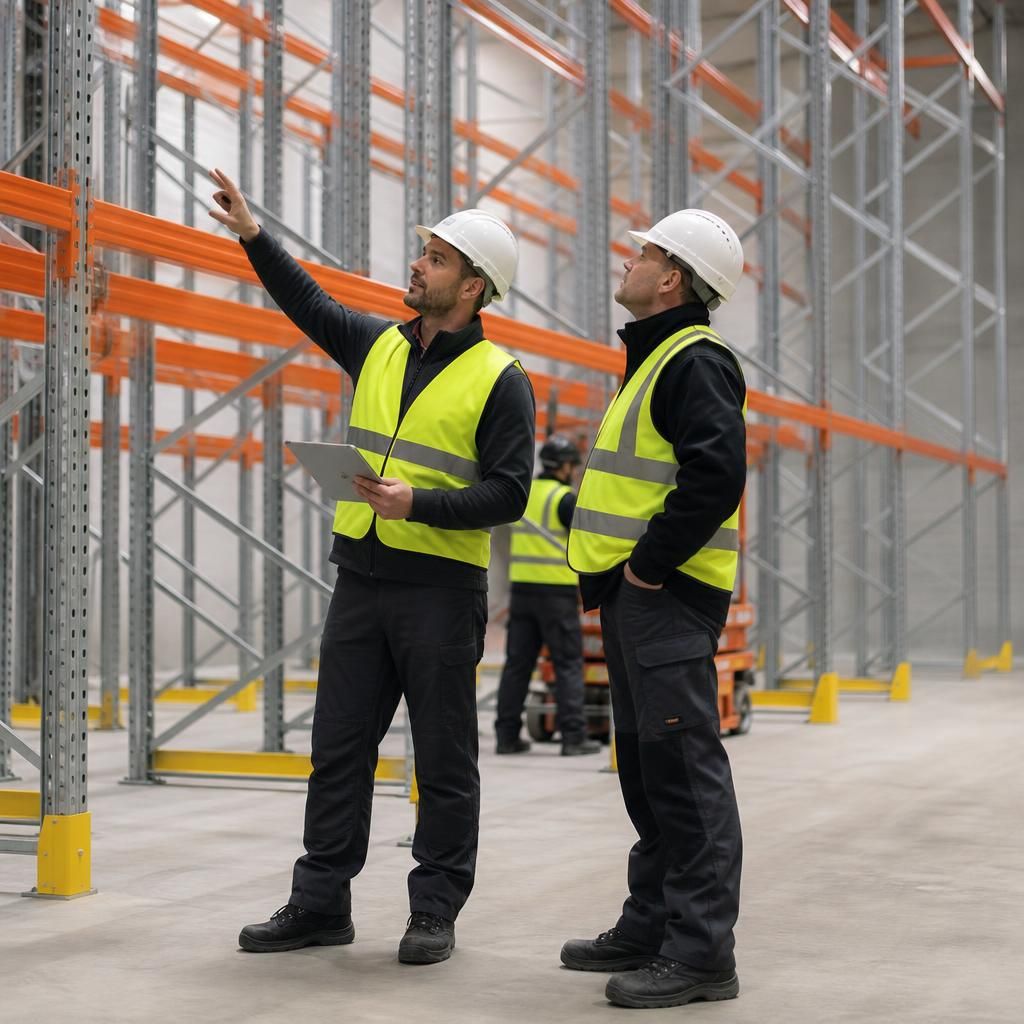
The most useful evidence of a warehouse racking installer’s competence is current, task-specific training supported by practical experience. Operatives should understand the system being assembled, read approved drawings and manufacturer’s instructions accurately, and recognise when site conditions differ from the agreed design.
Ask how the installation team controls work at height, lifting operations, exclusion zones and temporary stability. A competent supervisor should check alignment, fixings, component condition and the completed installation before handover, with any changes recorded and approved rather than improvised on site.
Discuss your warehouse racking installation requirements
Discuss your warehouse racking installation requirements with our experienced team to confirm the appropriate installation method, safety controls and handover documentation for your site.