
How do drive-through racking systems differ from drive-in racking systems?
Drive-through warehouse racking allows forklifts to enter and exit from opposite sides, while drive-in warehouse racking is accessed from one side only. This means drive-through designs support better stock rotation and direct access, whereas drive-in systems generally provide higher-density storage for goods managed on a last-in, first-out basis.
Drive-through warehouse racking is accessed from both ends of each storage lane, while drive-in warehouse racking is accessed from one end only. This difference affects how pallets are loaded and retrieved, how stock is rotated, the level of selectivity available and the way warehouse space is used. Drive-through designs are generally suited to first-in, first-out (FIFO) stock movement, whereas drive-in designs typically support last-in, first-out (LIFO) storage and the highest possible density for compatible products.
Both systems are designed for high-density pallet storage. Forklift trucks enter the storage lanes and place pallets on continuous support rails rather than accessing every pallet from a conventional aisle. The main distinction is whether the lane has a usable loading and retrieval face at both ends or at one end only.
Access and pallet movement
- Drive-through warehouse racking: Forklifts can enter from one side and leave through the opposite side. Pallets may be loaded at the replenishment face and collected from the other face, creating a through-flow arrangement.
- Drive-in warehouse racking: Forklifts enter and leave through the same front opening. The deepest pallet is normally placed first, with subsequent pallets stored nearer to the access face.
Two-sided access does not mean that every lane must always be operated in one direction. The operating method should be defined clearly so that loading and retrieval do not create conflicting vehicle movements. Where both ends are used at the same time, traffic management, visibility and communication become particularly important.
Stock rotation
Drive-through warehouse racking can support FIFO rotation because stock loaded at one end can be retrieved from the opposite end. This can be useful where product age, batch sequence, expiry dates or production order must be controlled. It is especially relevant for goods that should be dispatched in the order they arrive.
Drive-in warehouse racking generally operates on a LIFO basis. The most recently loaded pallet is often the easiest to retrieve because it is positioned closest to the access face. This arrangement can work well for durable, non-perishable products or operations where strict chronological rotation is not required. It is less suitable where older stock must be removed before newer stock.
FIFO is not automatic simply because a system has access at both ends. Stock identification, lane discipline, loading procedures and warehouse management controls must all support the intended rotation method. If pallets are placed in the wrong sequence or retrieved from the wrong face, the expected flow can be lost.
Storage density and selectivity
Drive-in warehouse racking usually provides greater storage density because it needs only one principal access face and fewer conventional aisles. This can make it an efficient choice when a warehouse holds many pallets of the same product and space utilisation is more important than immediate access to individual pallets.
Drive-through warehouse racking requires access and suitable working space at both ends of the lanes. That additional access requirement can reduce the net space available for storage compared with a single-entry arrangement. However, it offers improved stock flow and can reduce the need to move pallets unnecessarily when goods are replenished and dispatched through separate faces.
Neither design provides the same selectivity as conventional adjustable pallet storage, where an operator can normally access an individual pallet position directly from an aisle. Both drive-through and drive-in warehouse racking work best when each lane contains a limited product type or a clearly controlled stock group. Mixing incompatible products or unrelated batches within a lane can make stock control more difficult and increase handling risks.
Typical applications
- Drive-through warehouse racking is often considered for operations with regular inbound and outbound flows, controlled product rotation, or separate loading and dispatch areas.
- Drive-in warehouse racking is commonly considered for bulk storage, seasonal goods, reserve stock and products stored in substantial quantities by product type.
- Where products have different pallet dimensions, weights or handling requirements, each lane and support level must be designed for the relevant load rather than assuming that all pallets are interchangeable.
The correct option depends on more than the number of pallet positions required. The assessment should consider product characteristics, turnover, expiry control, batch management, vehicle type, available building depth, access arrangements, floor condition and the required operating process.
Forklift operation and safety
In both designs, forklift trucks operate within the storage structure, so the equipment must be suitable for the lane width, height, pallet dimensions and turning requirements. Operators need clear procedures for entering lanes, positioning pallets on the support rails and reversing safely. Loads should be stable, correctly positioned and compatible with the specified support arrangement.
Drive-through warehouse racking requires particular attention to the relationship between the two access faces. End protection, pedestrian segregation, vehicle routes, lighting, visibility and communication should be planned so that people and vehicles are not exposed to avoidable risks. Drive-in warehouse racking also needs protection at the entry face, along with controls to prevent contact with uprights, rails and other structural components.
Clearances must be maintained around the structure and at both operating faces where applicable. Damage, displaced components, bent uprights, missing safety pins or altered load notices should be reported promptly and assessed by a competent person. Repairs or alterations should not be improvised, as changes to the structure or loading arrangement can affect its designed capacity and stability.
Which design is appropriate?
Choose drive-through warehouse racking when stock needs a controlled flow between separate loading and retrieval faces, particularly where FIFO handling is important and the building can accommodate access at both ends. Choose drive-in warehouse racking when products can be stored in lane-based groups, LIFO handling is acceptable and maximum density is a priority.
Some warehouses use both arrangements in different areas. For example, drive-through warehouse racking may be used for stock requiring strict rotation, while drive-in warehouse racking may hold reserve products that are issued in bulk. Separating these operating methods can make procedures easier to manage, provided the layout, signage and stock controls are clear.
A suitable design should be confirmed through a review of the warehouse layout, pallet and load data, handling equipment and planned workflow. Installation should follow the approved design and manufacturer’s requirements, followed by regular inspections and prompt action on any reported damage. This helps ensure that the chosen warehouse racking system remains safe, usable and aligned with the way the warehouse actually operates.
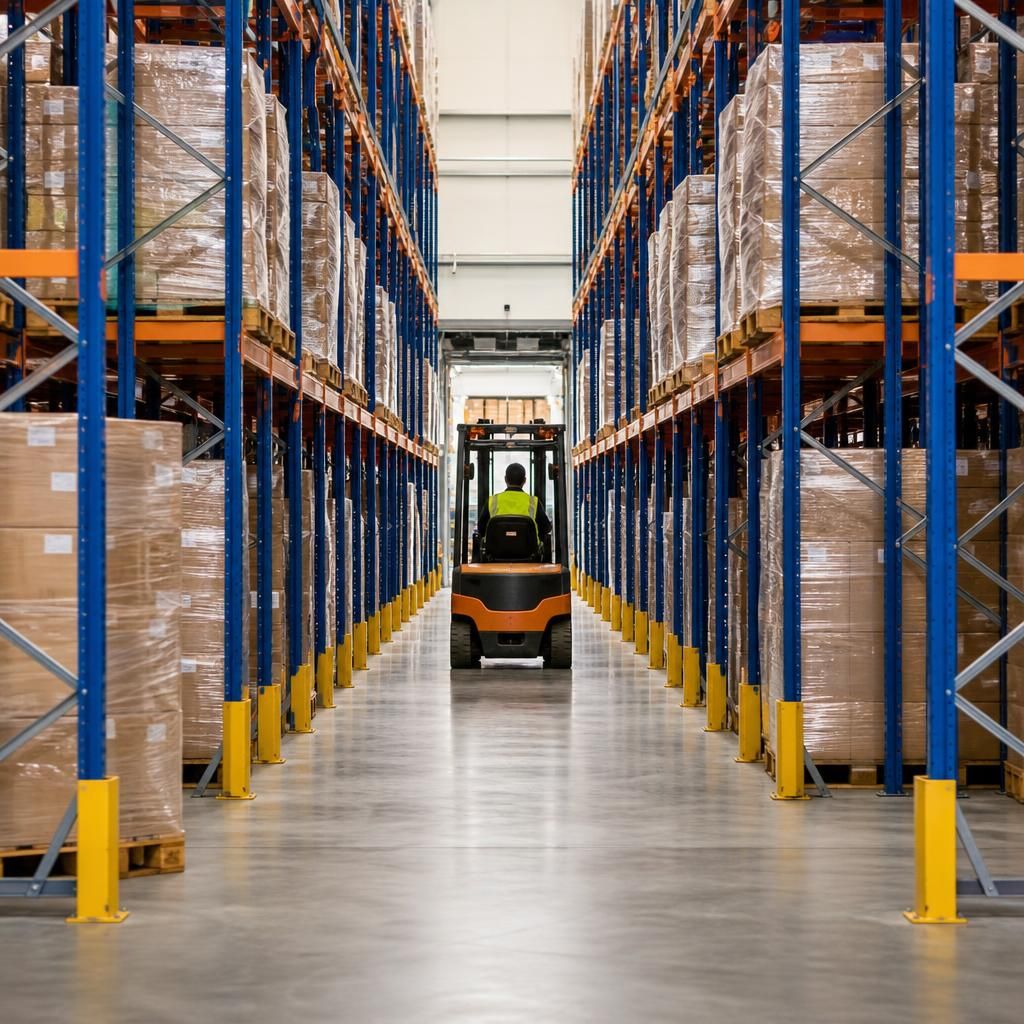
Drive-through warehouse racking differs from drive-in warehouse racking because forklifts can access each storage lane from opposite ends. This supports a controlled flow of pallets from the loading face to the retrieval face, making the system suitable for operations where first-in, first-out stock rotation is important.
Drive-in warehouse racking is accessed from one end, so pallets are loaded and retrieved through the same opening. It normally supports last-in, first-out handling and can provide higher storage density, but it is less suitable for products requiring strict batch or expiry-date control. The correct choice depends on stock rotation requirements, available space, vehicle movements and the way the warehouse operates.
Discuss your drive-through or drive-in warehouse racking requirements
Discuss your drive-through or drive-in warehouse racking requirements with Able Racking to review your stock rotation, warehouse layout, pallet loads and forklift movements. We can help confirm which system best supports safe, efficient operation.