
How do mobile racking systems improve warehouse efficiency?
Mobile racking systems improve warehouse efficiency by moving storage units along guided rails, allowing access aisles to be opened only where needed. This increases usable storage capacity, reduces unnecessary travel and helps teams retrieve goods more efficiently while maintaining an organised warehouse layout.
Mobile racking systems improve warehouse efficiency by moving storage units along guided rails, so access aisles are opened only where they are needed. This arrangement uses the available floor area more effectively than permanently spaced aisles, while helping warehouse teams retrieve, replenish and control stock through a more organised layout.
The main efficiency gains come from combining higher storage density with controlled access. Static warehouse racking normally requires an aisle between each run, even when most aisles are not being used. A mobile system allows several runs to be positioned together and creates an aisle only at the required location. This can release floor space for additional storage or preserve more room for other operational activities within the existing building.
More usable storage capacity
By reducing the amount of space dedicated to inactive aisles, mobile racking can increase the number of available storage positions within a defined area. It is particularly useful where property costs are high, expansion space is limited or a business needs to store more stock without moving to larger premises.
Capacity is not simply a matter of fitting more warehouse racking into a room. The layout must account for load weights, product dimensions, access equipment, fire protection, lighting, walkways and the building structure. A properly planned system makes better use of the available volume without compromising safe operation or access.
Shorter travel routes and easier retrieval
Mobile systems can reduce unnecessary movement because goods are stored in a compact arrangement and the required access aisle is created close to the selected load. When locations are planned logically, operatives can spend less time travelling through empty or unused aisles and more time on picking, replenishment and dispatch tasks.
Efficiency depends on more than the equipment itself. Stock should be allocated according to demand, handling requirements and product characteristics. Frequently picked goods may need to be positioned where they can be accessed quickly, while slower-moving stock can be placed in less convenient locations. Clear location identifiers and an accurate warehouse management system also help operatives find the correct load without avoidable searching.
Better stock control and layout flexibility
Mobile racking systems can be configured for different load types, storage heights and operating patterns. This makes them suitable for warehouses handling changing stock profiles, provided the system is designed with those changes in mind. Adjustable components and controlled aisle positions can support changes to inventory without requiring a complete reconfiguration of the storage area.
Some systems also provide electronic controls or integrated access management. These features can help operators select the correct aisle, monitor system status and apply access restrictions where required. They should complement, rather than replace, clear procedures, competent operation and suitable training.
Improved use of handling equipment
When access points are planned carefully, forklift trucks and other handling equipment can operate with fewer unnecessary journeys. The required aisle must still provide sufficient clearance for the equipment being used, and the operating method must reflect the truck type, load dimensions and turning requirements. A space-efficient layout that is difficult for equipment to use will not deliver genuine operational efficiency.
Before installation, the site should be assessed for traffic routes, loading and unloading activities, pedestrian movement and emergency access. These factors determine whether mobile warehouse racking can support the intended workflow and where controls, barriers, signage or protective measures may be needed.
More consistent picking and replenishment
A defined storage plan reduces misplaced stock and makes routine tasks more repeatable. Operatives can follow the same process for opening an aisle, locating a load, completing the handling task and closing the system. Consistent procedures are especially important in busy warehouses where multiple people use the same equipment across different shifts.
Efficiency can also improve when picking methods are matched to the stock profile. For example, goods that are regularly accessed may be assigned to convenient levels and locations, while full-pallet or reserve stock can be organised separately from smaller picking quantities. Any change to the layout should be reviewed to ensure that load notices, location records and operating instructions remain accurate.
Safety supports long-term efficiency
A mobile system only improves efficiency when it remains safe, serviceable and available for use. Damaged frames, rails, wheels, controls or protection can interrupt operations and create unacceptable risks. Daily checks should identify visible damage, unusual movement, obstructions, faults and changes to the storage arrangement. Reported defects should be assessed promptly, with the affected area isolated where necessary.
Routine inspections and planned maintenance help identify issues before they lead to unplanned downtime. Inspections should consider the structure, moving components, guide rails, drive system, controls, safety devices, load notices and the condition of the surrounding floor. Repairs and alterations should be completed by suitably competent personnel, and the system should not be overloaded or modified outside its approved design.
How to maximise the efficiency of a mobile system
- Use an accurate inventory profile when planning locations and access requirements.
- Position high-demand stock where it can be reached efficiently without creating congestion.
- Allow adequate clearance for the handling equipment and loads in use.
- Keep rails, access routes and operating areas free from obstructions.
- Train all relevant operatives in the controls, safe access procedures and emergency stops.
- Keep load notices, inspection records and operating instructions up to date.
- Review the layout when stock types, load weights, equipment or workflow change.
- Arrange inspections and maintenance at suitable intervals based on use and risk.
Mobile racking is therefore most effective when it is treated as part of the wider warehouse process rather than as an isolated storage product. A correctly specified layout, disciplined stock control, competent operation and preventative maintenance work together to increase usable capacity, reduce wasted movement and maintain reliable access to goods.
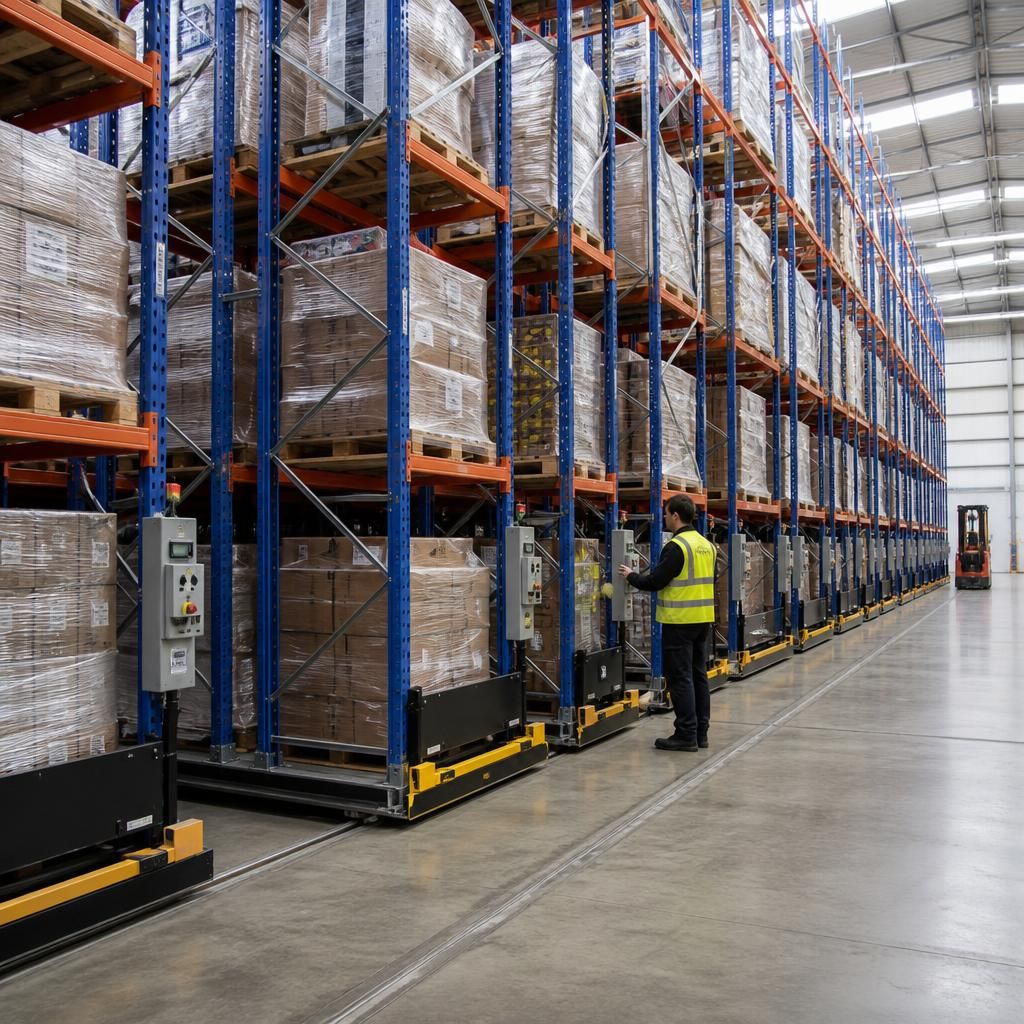
Mobile racking systems improve efficiency by opening an access aisle only where it is needed, allowing storage units to remain compact when access is not required. This reduces unused aisle space and can increase available storage capacity within the existing warehouse footprint.
To achieve these benefits, the layout must reflect the loads stored, the handling equipment used and the way operatives move through the warehouse. Frequently picked goods should be positioned for convenient access, while clear location labels, suitable aisle clearances and trained operation help maintain consistent picking and replenishment.
Discuss your mobile racking efficiency requirements
Discuss your mobile racking efficiency requirements with Able Racking to review your layout, storage needs and operational priorities. Our experienced team can advise on practical ways to improve capacity, access and day-to-day warehouse performance.