
What maintenance is required for cantilever warehouse racking?
Cantilever warehouse racking requires routine visual checks, planned maintenance and documented inspections by a competent person to identify damage, loose fixings, corrosion, impact, uneven loading or deterioration in columns, arms, bases and bracing. Any unsafe component should be isolated and repaired or replaced promptly, with load notices kept clear and the system rechecked after alterations, relocation or impact.
Cantilever warehouse racking requires routine visual checks, planned maintenance and documented inspections by a competent person. The maintenance programme should cover the columns, arms, bases, bracing, anchors, fixings, load notices and surrounding floor, while addressing impact damage, loose components, corrosion, overloading and deterioration before they affect stability. Any unsafe part should be isolated immediately and repaired or replaced by a suitably experienced specialist.
Routine visual checks
A nominated person should carry out regular visual checks as part of normal warehouse operations. The frequency should reflect the working environment, traffic levels, load types and previous damage. Checks should look for:
- Bent, twisted, cracked or visibly distorted columns, arms, bases and bracing.
- Loose, missing or damaged bolts, pins, clips, welds and other fixings.
- Movement at the base, damaged floor anchors or signs that a column is no longer adequately secured.
- Impact from fork-lift trucks, handling equipment or stored materials.
- Corrosion, particularly where the system is exposed to moisture, chemicals or outdoor conditions.
- Arms that are not seated correctly, are uneven or show signs of excessive deflection.
- Damaged, missing or unclear load notices and identification labels.
- Loads that project beyond the intended storage area, are unstable or exceed the system’s stated capacity.
- Obstructions, uneven flooring or housekeeping issues that could affect access, loading or stability.
Visual checks are not a substitute for a formal expert inspection. They provide an early warning so that defects can be reported and controlled without delay.
Planned inspections and thorough examination
A formal inspection should be completed by a competent person with suitable knowledge, training and experience of warehouse racking systems. In the UK, HSE guidance recommends that storage equipment is thoroughly examined at least annually, with more frequent examinations where the risk assessment or operating conditions require them. An inspection may also be needed after a significant impact, relocation, alteration, prolonged overloading, fire, flood or other event that could affect structural integrity.
The inspection should assess the complete installation rather than focusing only on visible damage. This includes the structural condition of the columns and arms, the security of bracing and connections, baseplates and floor fixings, the condition of the floor, protection from vehicle impact, safe clearances and the suitability of the system for the loads being stored. Any changes to the configuration should be checked against the original design and the manufacturer’s requirements.
Damage control and repairs
Damage should be classified and acted on according to its severity. A component that presents an immediate risk should be unloaded and taken out of use straight away. The affected area should be clearly identified so that it cannot be used accidentally, and nearby loads may also need to be removed if the damage could affect the wider structure.
Repairs should be completed using approved components and methods appropriate to the original system. Straightening, welding, drilling or modifying structural members on site can change their strength and should not be undertaken without proper engineering approval. Damaged columns, arms, braces, baseplates, anchors and safety components are often best replaced rather than improvised. Once work is complete, the repaired section should be inspected before it is returned to service.
Care of cantilever arms and supports
Cantilever arms are exposed to repeated loading and impact, particularly when long or heavy materials are handled by fork-lift trucks. Operators should place loads evenly and centrally, within the designed arm capacity, and avoid dropping materials onto the supports. Loads should not be dragged across arms or allowed to catch against adjacent members during removal.
Where arms are adjustable, their locking arrangements should be checked regularly to confirm that they are fully engaged and undamaged. Removable arms should not be substituted with parts from another system unless compatibility and capacity have been confirmed. End stops, restraints and other load-retention accessories should remain fitted where the design requires them.
Protection against corrosion and environmental damage
Corrosion reduces the effective section of steel and may weaken connections over time. Keep the structure clean and dry where possible, remove standing water and deal promptly with leaks or chemical contamination. Surface rust should be assessed rather than simply covered with paint, as concealed section loss or weakened welds may require component replacement.
For external or partially exposed installations, the inspection and maintenance plan should account for weather, temperature changes, drainage and wind exposure. Protective coatings should only be renewed using suitable preparation and products, without obscuring cracks, distortion or other defects.
Load control and safe use
Maintenance depends on the system being used within its design limits. Load notices should state the relevant capacities and remain positioned where operators can see them. They should be updated if the layout, arm arrangement, stored material or design loading changes. Do not assume that a stronger-looking component increases the capacity of the complete installation, because the limiting factor may be the column, base, connection, floor or overall stability.
Materials should be stored in a controlled manner, with the weight and dimensions suitable for the arm spacing and configuration. Operators should be trained to recognise damage, report impacts and avoid placing loads against damaged or restricted sections. Good housekeeping also reduces the likelihood of collisions and makes defects easier to identify.
Records and follow-up
Keep records of visual checks, formal inspections, reported impacts, defects, repairs, replacement parts and reinspection dates. Each finding should have a clear action, responsible person and completion status. Inspection records should identify the location and nature of defects rather than relying on general comments, and outstanding issues should remain visible until they have been controlled.
The maintenance plan should be reviewed after repeated damage, changes in vehicle movements, new load types, layout alterations or changes to working practices. For support with a formal inspection, repair recommendations or an ongoing preventative maintenance programme, Able Racking can assess the installation and help keep the system safe, compliant and suitable for its intended use.
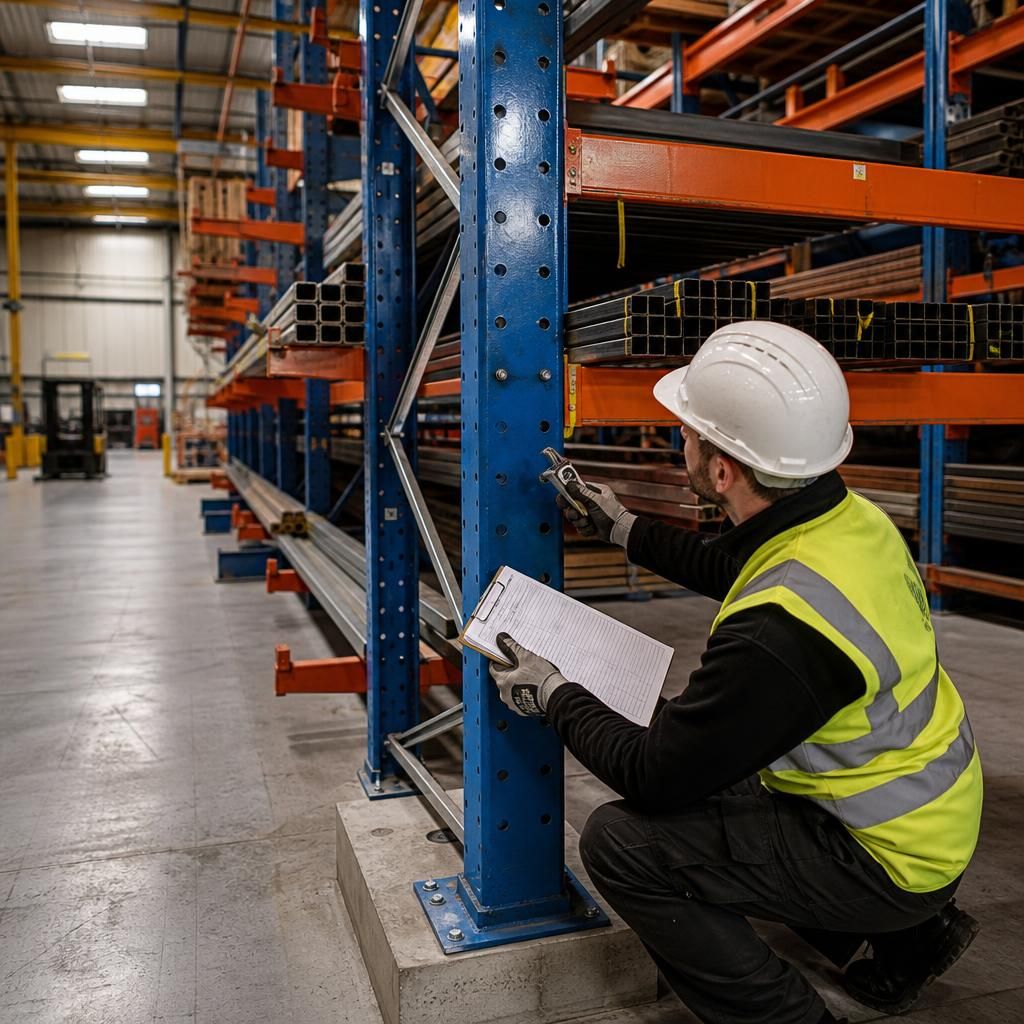
Maintenance of cantilever warehouse racking should include prompt control of damage, followed by repair or replacement using components and methods suitable for the original system. Bent columns, damaged arms, loose bracing, failed anchors or distorted connections can affect stability and should not be corrected by improvised straightening, drilling or welding.
If an impact or defect creates a safety concern, unload and isolate the affected section immediately. Mark it clearly to prevent further use, assess whether adjoining bays are also affected, and arrange an inspection by a competent person. The section should only return to service after the repair has been completed and its condition has been checked.
Arrange a cantilever warehouse racking maintenance inspection
Arrange a cantilever warehouse racking maintenance inspection with Able Racking to identify damage, wear and compliance issues before they affect safe operation. Our experienced team can provide clear findings and practical repair or maintenance recommendations.