
What are the best practices for ensuring effective warehouse racking repairs? Effective warehouse racking repairs begin with prompt damage reporting, a competent inspection, risk assessment, isolation of unsafe areas and repairs carried out by trained professionals using suitable replacement components.
Effective warehouse racking repairs begin with prompt damage reporting, a competent inspection and a documented risk assessment. Unsafe areas should be isolated, with repairs completed by trained professionals using suitable replacement components and verified before the warehouse racking is returned to service.
Effective warehouse racking repairs depend on early reporting, competent assessment, controlled access, correct components and documented verification before the affected structure is used again. Repairs should address the cause and extent of the damage, not simply make a visible defect look acceptable.
Report damage immediately
Everyone working around warehouse racking should know how to report impact damage, deformation, missing components and other unsafe conditions. Reports should identify the location, the affected bay or frame and the apparent type of damage. Photographs can support the initial report, but they do not replace an inspection by a competent person.
Damage should be reported even when it appears minor. A bent upright, dislodged beam connector or damaged guard can reduce the intended capacity of the system. Repeated impacts may also indicate problems with vehicle routes, visibility, working practices or load handling that need to be addressed alongside the repair.
Make the area safe before inspection or repair
Where warehouse racking may be unsafe, the affected location should be clearly identified and access controlled. Loads may need to be carefully removed, provided this can be done without increasing the risk. The area should remain out of service until a competent person has assessed it and confirmed the appropriate action.
Isolation arrangements should prevent forklifts, pallet trucks and pedestrians from entering the affected area. They should also account for adjacent bays where damage or instability could have spread. Temporary measures must not be treated as a permanent repair.
Use a competent inspection and risk assessment
The inspection should consider the whole affected structure, including uprights, beams, bracing, connectors, baseplates, anchors, guards, decking and any other components that contribute to stability or load support. It should also consider the load configuration, the original design, previous repairs and the likely cause of the damage.
A risk assessment should determine whether the warehouse racking can remain in limited use, requires immediate unloading or must be isolated completely. The decision should be based on the condition and design of the system rather than on appearance alone. Where the original specification or load capacity is unclear, the repairer should obtain the relevant drawings, manuals, inspection records or other technical information before proposing work.
Choose repair, replacement or dismantling based on evidence
Not every damaged component can be safely straightened or reused. The proposed solution should reflect the manufacturer’s instructions, the design of the system and the measured damage. Depending on the findings, the correct action may be to replace a component, repair it using an approved method, strengthen the structure or dismantle and reconfigure part of the installation.
Unauthorised welding, drilling, cutting, heating or improvised bracing can alter the structural properties of warehouse racking and invalidate its design assumptions. Components from a different system should not be substituted simply because they appear similar. Replacement parts should be compatible, correctly specified and installed in accordance with the applicable technical requirements.
Use trained and suitably equipped repair personnel
Repairs should be completed by people with the necessary knowledge of warehouse racking systems, safe working methods and the equipment involved. They should understand how to work around stored loads, lifting equipment and operational traffic, and should follow the relevant risk assessment and method statement.
Before work begins, the team should confirm the scope of the repair, access arrangements, required isolation, lifting requirements and any temporary support. The work area should be kept orderly, with removed components and tools managed so they do not create additional trip, impact or falling-object hazards.
Check the installation after repair
A repair is not complete when the replacement component has been fitted. The repaired area should be checked for correct alignment, secure connections, adequate anchorage, undamaged bracing and the proper installation of guards and other safety components. Any temporary supports or restrictions should be removed only when the structure is confirmed to be stable and suitable for service.
The repair should then be verified by a competent person against the agreed scope and the relevant design or manufacturer information. If the repair has changed the configuration, capacity or use of the warehouse racking, updated load information and operating instructions may be required before the area is reopened.
Maintain clear load and safety information
Load notices should remain accurate and visible after repairs. They should reflect the actual configuration, beam levels and permissible loads. If the system has been altered, the load information should be reviewed rather than assumed to remain valid.
Warehouse staff should be briefed on any changes, restrictions or new handling requirements. Forklift operators should also be reminded to report further impacts and to avoid contact with uprights, beams and guards during loading and unloading.
Keep complete repair records
A useful repair record should include the damage report, inspection findings, photographs where appropriate, risk assessment, repair specification, components used, work completed, verification outcome and the date the area was returned to service. Records should identify the location clearly so that future inspections can distinguish the repair from later damage.
Good records help demonstrate that defects were managed promptly and provide evidence for future safety inspections. They also reveal recurring damage patterns, enabling warehouse managers to improve traffic management, protection, training, housekeeping or storage practices.
Follow up through regular inspections
After a repair, the affected area should continue to receive routine visual checks and formal inspections at the intervals required by the system’s risk assessment and applicable guidance. A repaired component should not be considered permanently protected from further impact.
Where damage is recurring, the long-term solution may involve improving end protection, changing vehicle routes, adjusting storage practices, reviewing pallet condition or providing additional operator training. Preventative action is an essential part of effective warehouse racking repairs because it reduces repeat defects and helps preserve the safe working capacity of the installation.
In practice, the most reliable repair process is prompt, controlled and evidence-led: report the defect, isolate the risk, inspect the complete affected area, select an approved solution, use competent repair personnel, verify the result and keep the records up to date. If the damage is extensive, the system configuration is uncertain or the proposed work could affect structural capacity, obtain specialist advice before returning the warehouse racking to service.
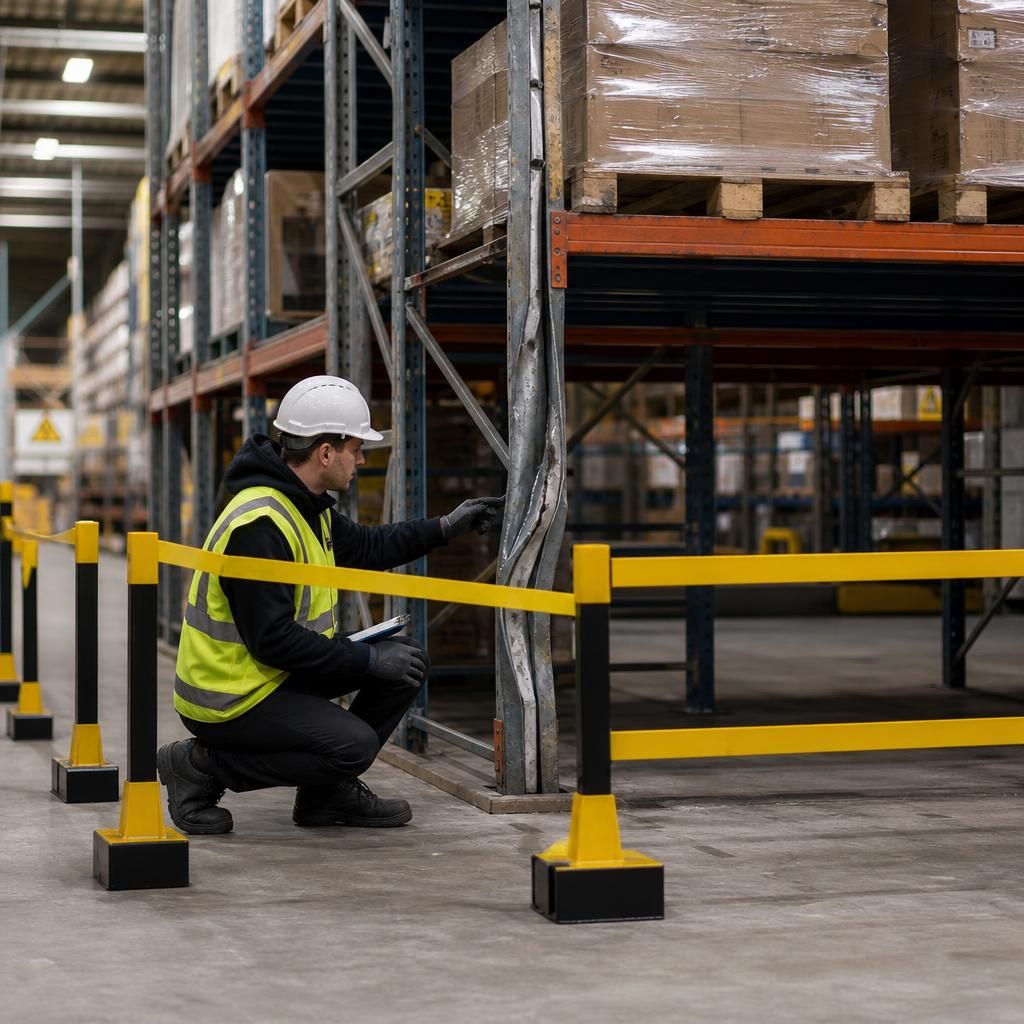
Isolating damaged warehouse racking before inspection or repair is a fundamental safety control. The affected bay should be clearly identified, access restricted and, where safe to do so, stored loads removed under a suitable method statement. Forklifts, pallet trucks and pedestrians must be prevented from entering the area until a competent person has assessed the damage.
Isolation should also consider adjacent bays where an impact may have affected connected components or stability. Barriers and warning signs are useful controls, but they are not a repair and should remain in place until the structure has been inspected, repaired where necessary and formally confirmed as safe to return to service.
Arrange an Expert Warehouse Racking Repairs Assessment
Arrange an expert warehouse racking repairs assessment to identify damage, confirm the appropriate corrective work and verify that the affected area can be returned to safe service.