
What maintenance and upkeep are required for prefab mezzanine installations in warehouses?
Prefab mezzanine installations require routine inspections, prompt attention to damage, and ongoing checks of structural components, flooring, stairs, guardrails, gates and load signage. Keep the area clear of unauthorised alterations, control impacts and overloading, and arrange competent inspections and repairs whenever defects, movement, corrosion or changes in use are identified.
Prefab mezzanine installations require planned inspections, routine housekeeping, prompt repairs and careful control of loads, alterations and workplace activities. Maintenance should cover the complete installation, including the supporting steelwork, deck, stairs, guardrails, gates, access points, protective features, lighting and any services attached to or passing through the structure. The inspection frequency should reflect the manufacturer’s instructions, the working environment, the intensity of use and any relevant risk assessment.
Inspect the structure and connections
Check the visible steelwork for impact damage, distortion, cracking, corrosion, movement or changes in alignment. Particular attention should be given to columns, beams, bracing, base plates, welds, bolted connections and areas close to vehicle routes or handling equipment. Loose, missing or damaged bolts must not be ignored, and components should not be altered, drilled, cut or removed without approval from a suitably competent person.
Any sign that the structure has moved, settled or been struck should trigger a prompt assessment. Do not attempt to straighten, weld or reinforce structural parts as an informal repair. The correct remedial work depends on the original design, the nature of the damage and the loads imposed on the installation.
Keep the deck and flooring in good condition
Inspect the deck for loose panels, broken boards, gaps, raised edges, excessive wear, water damage and localised deflection. Flooring should remain securely supported and suitable for the activities taking place on it. Replace damaged sections with compatible materials and ensure that repairs do not reduce the deck’s strength, fire performance or slip resistance.
Spilt liquids, dust, packaging and debris should be removed promptly. Good housekeeping reduces slip and trip hazards, helps reveal defects during inspections and prevents materials from obstructing access routes, emergency equipment or fire protection measures. Cleaning methods should not introduce moisture or chemicals that could damage the deck or steelwork.
Check stairs, guardrails and gates
Stairs should be inspected for secure fixings, damaged treads, loose handrails, uneven surfaces and obstructions. Guardrails, toe boards and edge protection must be continuous where required and firmly attached. Check that gates close correctly, safety devices function as intended and loading areas cannot be accessed in an unsafe manner.
Do not wedge open gates, remove sections of edge protection or store items against guardrails. If pallets, goods or equipment are regularly moved to or from the platform, review the access arrangement rather than relying on unsafe workarounds. Any protective feature that is damaged or not operating correctly should be taken out of use until it has been assessed and repaired.
Control loads and use
Load signage should remain visible, accurate and consistent with the approved design. It should identify the permitted uniformly distributed load and any restrictions on concentrated loads, storage locations, equipment or activities. Loads must be distributed as intended, with heavier items positioned only where the design permits.
Never assume that a strong-looking deck can support additional stock, machinery, shelving, partitions or services. Changes in the type, weight or location of stored goods can affect the structure. Review the installation before introducing new equipment, handling methods, conveyors, racking, partitions, suspended services or changes in occupancy.
Prevent impact damage
Where forklifts, pallet trucks or other vehicles operate near the supporting columns or access points, maintain suitable separation and use appropriate physical protection. Protection should be inspected after impacts because it may appear intact while the column, base connection or surrounding deck has been affected.
Record all known impacts, even where there is no obvious damage. A competent inspection can determine whether the installation may remain in service, requires a temporary restriction or needs immediate repair. Damaged areas should be clearly controlled so that staff do not unknowingly continue using them.
Manage corrosion, water and the working environment
Look for rust, flaking coatings, standing water, leaks and condensation, particularly in areas with high humidity, wash-down activity or corrosive substances. Identify and rectify the source of moisture before applying a surface treatment. Corrosion repairs should be specified according to the affected component and the required protective finish.
Maintain adequate lighting on the platform, stairs and access areas so that defects, load signs and obstructions can be seen. Services such as electrical installations, sprinklers, ventilation and data cabling should be supported and maintained without imposing unapproved loads or restricting inspection of the structure.
Use a planned inspection programme
Routine visual checks by trained site personnel can identify obvious damage, housekeeping issues and unsafe use. These checks should be supported by more detailed inspections carried out by a competent person at intervals appropriate to the installation and its environment. A further assessment is advisable after impact, fire, flooding, significant alteration, unusual loading or a prolonged period of disuse.
Inspection records should state the date, areas checked, defects found, immediate controls applied, responsible person and completion of remedial work. Photographs, drawings and repair documentation can help establish whether a recurring problem is caused by traffic routes, poor storage practices, water ingress or an unsuitable modification.
Repair defects according to their risk
Defects should be assessed and prioritised rather than left until the next planned visit. Serious damage, instability, missing edge protection or unsafe access may require the affected area to be isolated immediately. Less urgent issues should still be assigned an owner and completion date, with temporary controls maintained until the repair is finished.
Repairs and replacement components should be approved by the original designer, manufacturer or another suitably competent specialist where the work affects structural performance. Keep records of the repair, including any revised drawings, load information, inspection findings and restrictions that apply after completion.
Control alterations and future changes
A prefab installation should be treated as a designed structure, not a kit that can be freely adapted on site. Obtain a technical review before adding openings, partitions, machinery, suspended loads, services, access equipment or fire-related features. Changes to the building, use of the space below or evacuation arrangements may also require the original risk assessment and emergency procedures to be reviewed.
Effective upkeep combines physical maintenance with disciplined site management. Train relevant employees to report damage, display current load information, keep access routes clear and stop using unsafe areas. With documented inspections, competent repairs and control of changing conditions, the installation can remain safe, serviceable and suitable for its intended warehouse use.
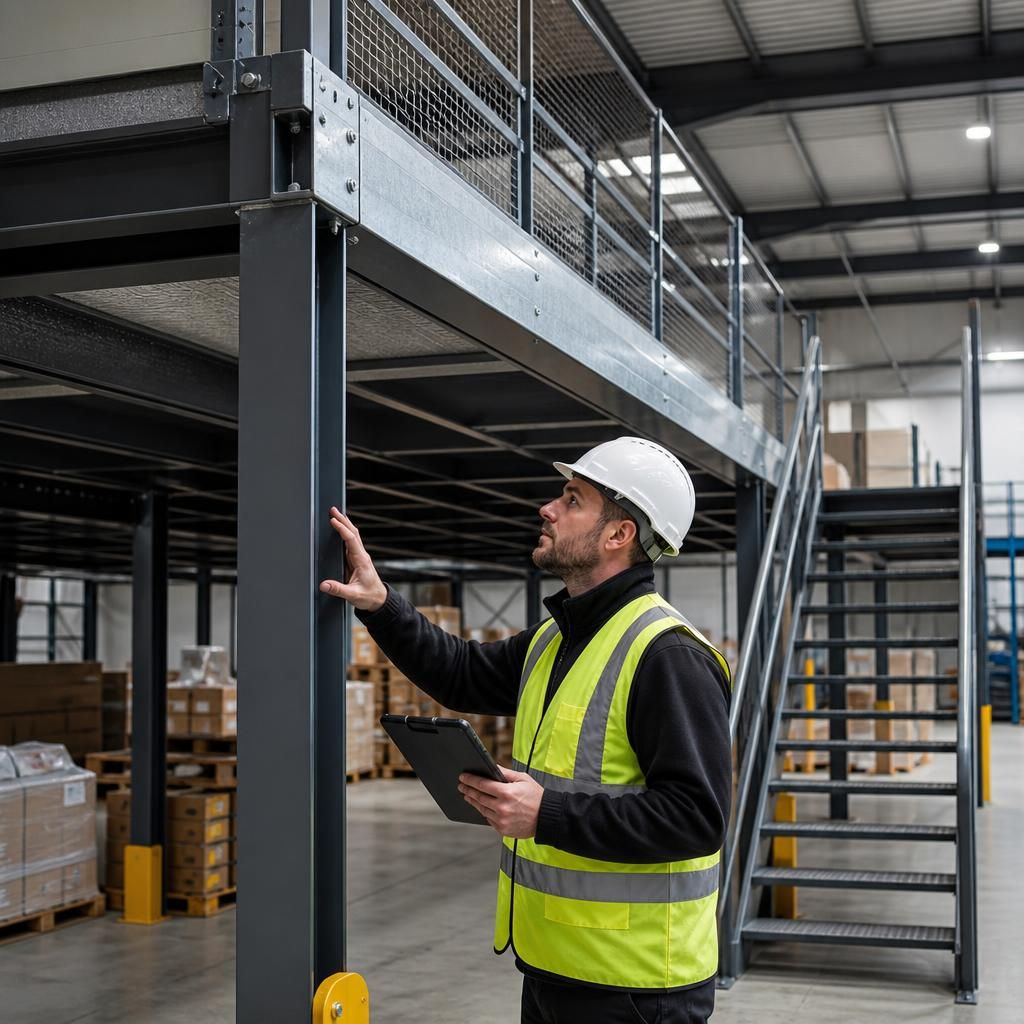
Planned inspections are the foundation of safe prefab mezzanine maintenance. Check the supporting steelwork, connections, flooring, stairs, guardrails, gates, load signs and access areas for damage, movement, corrosion, loose fixings or unsafe alterations. Routine site checks should be supported by competent inspections suited to the installation’s design, working environment and intensity of use.
Record defects clearly and act on them according to risk. Isolate areas affected by structural damage, unsafe access or missing edge protection until they have been assessed and repaired. Keep inspection findings, photographs, repair details and updated load information together so that future maintenance decisions are based on an accurate record of the installation’s condition.
Arrange a professional mezzanine maintenance inspection
Arrange a professional mezzanine maintenance inspection to identify structural defects, access issues, load concerns and other upkeep requirements before they affect safe use. Contact Able Racking to book an inspection suited to your installation and warehouse operations.